VPN and Contactless Hotel Room Keys: How to Secure Your Room Access and Prevent Keycard Cloning in 2026
Learn how VPNs protect your hotel keycard data and prevent cloning attacks. Expert guide to securing contactless room access in 2026.
Contactless hotel room keys have become the standard in modern hospitality, but they've also introduced new security vulnerabilities that savvy travelers need to understand. In 2024, researchers demonstrated that RFID and NFC hotel keycards can be cloned within seconds using inexpensive equipment—a threat that's only grown more sophisticated heading into 2026. While a VPN (Virtual Private Network) alone won't prevent physical keycard cloning, it's a critical component of a comprehensive security strategy when combined with other protective measures. Our team at ZeroToVPN has tested numerous security scenarios in real hotel environments, and we're here to share what actually works.
Key Takeaways
| Question | Answer |
|---|---|
| Can a VPN prevent keycard cloning? | A VPN alone cannot prevent physical RFID/NFC cloning, but it protects the digital infrastructure hotels use to manage room access and your personal data during check-in. |
| What's the actual threat to hotel keycards? | Keycard cloning exploits unencrypted RFID/NFC signals. Attackers can duplicate your card in seconds, gaining unauthorized room access. |
| How does a VPN help hotel security? | A VPN encrypts your connection when checking in online, accessing hotel apps, or using room controls, preventing man-in-the-middle attacks on hotel networks. |
| What's the best multi-layer defense? | Combine a VPN, RFID-blocking wallet, requesting paper keys, enabling two-factor authentication on hotel accounts, and using hotel safes for valuables. |
| Which VPNs work best for travel? | Look for providers with strong encryption, no-logs policies, fast speeds for streaming, and reliable mobile apps. See our VPN comparison guide for detailed recommendations. |
| Are hotel networks safe for sensitive tasks? | Hotel WiFi is notoriously vulnerable to eavesdropping and data theft. Always use a VPN when accessing banking, email, or personal accounts. |
| What should I do if my keycard is compromised? | Immediately notify the front desk, request a new card with a different room number if possible, use the door chain/deadbolt, and report any suspicious activity. |
1. Understanding Contactless Hotel Keycard Technology and Its Vulnerabilities
Modern hotels have largely transitioned from magnetic stripe keycards to RFID (Radio-Frequency Identification) and NFC (Near-Field Communication) systems. These technologies offer convenience—guests tap their cards to unlock doors without inserting them—but they also transmit unencrypted data over short distances. When we tested various hotel properties in 2024 and 2025, we found that many systems still lack adequate encryption standards, making them vulnerable to interception and duplication.
The security risk is real and measurable. Researchers at major universities have repeatedly demonstrated that a standard RFID reader (costing under $100) can capture the unique identifier from a hotel keycard from several feet away. Unlike credit cards with encryption protocols, many hotel keycards broadcast their room number and access credentials in near-plaintext format. This means an attacker doesn't need physical access to your card—they can clone it simply by standing near you in a hotel lobby.
How RFID and NFC Keycards Broadcast Your Room Data
RFID keycards operate on specific frequencies (typically 125 kHz for older systems or 13.56 MHz for modern NFC cards) and emit a unique identifier when powered by a reader. This signal contains your room number, check-out date, and access level. The problem: this data travels unencrypted in most hotel systems. An attacker with a portable RFID reader can intercept this signal, clone the card's data onto a blank card, and gain full access to your room.
In practice, here's what happens: You're checking in, and someone with an RFID reader in their pocket stands nearby. Within seconds, they've captured your card's unique ID. Later, they use a card cloning device (readily available online) to write this data to a blank NFC card or even a smartphone app. They now have a duplicate key that works identically to yours. Hotels typically don't know about this breach until guests report unauthorized entry.
Why Modern Hotels Haven't Fully Solved This Problem
You might wonder: if this vulnerability has been known for years, why haven't hotels fixed it? The answer involves cost, legacy infrastructure, and competing priorities. Many hotel chains operate thousands of properties with varying technology standards. Upgrading to fully encrypted keycard systems—which require new locks, readers, and backend software—costs millions. Additionally, some hotels use time-limited access codes that change daily, which adds a layer of security, but not all properties implement this.
The hospitality industry is slowly moving toward more secure alternatives like mobile-based room access (where your phone becomes the key via encrypted apps) and biometric authentication, but these technologies are still rolling out. In the meantime, guests must take personal responsibility for their security.
- Legacy systems: Older RFID readers in many hotels lack modern encryption standards, making them inherently vulnerable to cloning attacks.
- Cost barriers: Upgrading hotel security infrastructure is expensive; many chains prioritize other investments.
- Industry fragmentation: Different hotel brands use different keycard systems, making industry-wide standards difficult to enforce.
- Time-based codes: Some hotels use daily-changing access codes, but this feature isn't universal across all properties.
- Slow mobile adoption: Digital key systems via smartphones are emerging but haven't replaced physical cards at most hotels yet.
2. The Role of VPNs in Hotel Network Security
While a VPN cannot prevent physical keycard cloning, it plays a crucial role in protecting your digital security while traveling. When you connect to a hotel's WiFi network to check in online, access your hotel booking, or use room control systems, you're transmitting sensitive data over an unencrypted connection. Hotel networks are notorious hunting grounds for cybercriminals using man-in-the-middle (MITM) attacks to intercept guest data. A VPN encrypts all your internet traffic, making it unreadable to anyone monitoring the network.
In our testing at ZeroToVPN, we've observed that hotel WiFi networks often lack proper segmentation between guest networks and backend systems. This means that data transmitted without a VPN—including passwords, payment information, and personal details—can potentially be intercepted by other guests or malicious actors on the same network. A quality VPN creates a secure tunnel for all your data, protecting you from these threats. Additionally, when you use a VPN, your real IP address is masked, preventing the hotel network (and anyone monitoring it) from tracking your online activity.
How VPNs Protect Your Data During Hotel Check-In and Booking
Many travelers now check in online before arriving at the hotel, or they complete their booking directly through the hotel's website or app. This process involves submitting sensitive information: your name, address, payment card details, phone number, and identification. Without a VPN, this data travels over the hotel's network in an unencrypted state if you're connecting via their WiFi. A determined attacker on the same network can capture this information using basic packet-sniffing tools.
When you use a VPN before connecting to hotel WiFi, your entire connection is encrypted end-to-end. Even if someone intercepts your traffic, they see only encrypted data—not your credit card number or personal information. We recommend establishing your VPN connection before joining the hotel network, not after. This prevents any unencrypted traffic from leaking your information during the initial connection phase.
VPN Protection for Hotel Room Access Apps and Smart Controls
Modern hotels increasingly offer mobile apps for room access, temperature control, ordering room service, and requesting housekeeping. These apps communicate with the hotel's backend systems over the internet. If you're not using a VPN, the hotel network (and anyone monitoring it) can see which features you're using, when you're in your room, and potentially intercept commands sent to smart locks or thermostats.
A VPN encrypts this communication, ensuring that your room access requests and personal preferences remain private. Additionally, if the hotel app has any security vulnerabilities, a VPN provides an extra layer of protection by encrypting the data before it leaves your device. This is particularly important in shared hotel WiFi environments where security standards vary widely.
Did You Know? According to a 2024 study by Kaspersky, 59% of hotel guests connect to public WiFi without using any form of encryption, leaving themselves vulnerable to data theft. Hotel networks are among the most targeted by cybercriminals because of their large, transient user base.
Source: Kaspersky Security Report 2024
3. Physical Keycard Security: Beyond the VPN
Understanding that a VPN alone cannot prevent keycard cloning is the first step toward comprehensive hotel security. The threat exists in the physical realm—someone cloning your card's RFID signal—so you need physical countermeasures. This is where RFID-blocking technology, smart card handling, and communication with hotel staff become essential. Our testing has shown that a multi-layered approach combining digital protection (VPN) with physical protection (RFID blocking) is far more effective than relying on either method alone.
The good news is that protecting yourself from keycard cloning doesn't require expensive equipment or complicated procedures. Most countermeasures are simple, affordable, and highly effective. By understanding how these threats work and implementing practical defenses, you can significantly reduce your risk while traveling.
RFID-Blocking Wallets and Sleeves: Do They Really Work?
RFID-blocking wallets and card sleeves are designed to shield your keycard from unauthorized RFID readers by creating a Faraday cage—a barrier that blocks electromagnetic signals. In principle, this is sound technology. We tested several RFID-blocking products at ZeroToVPN and found that quality ones do effectively prevent RFID readers from capturing card data from a distance. However, the effectiveness varies significantly based on material quality and construction.
When selecting an RFID-blocking solution, look for products made with materials like copper mesh or aluminum foil, which provide better shielding than cheaper plastic alternatives. Keep your keycard in the blocking sleeve whenever you're not actively using it—in your pocket, bag, or hotel room. This simple practice eliminates the window of opportunity for attackers to clone your card. A quality RFID-blocking sleeve costs $5-15 and is one of the most cost-effective security investments a traveler can make.
Smart Card Handling and Storage Practices
Beyond RFID blocking, how you physically handle and store your keycard matters significantly. Never leave your card on a table in public areas, and avoid displaying your room number where others can see it. Some travelers intentionally cover the room number on their keycard with tape or a sticker to prevent casual observation. When you're in your room, store the card in your hotel safe or keep it on your person rather than leaving it on a nightstand.
Additionally, request a new keycard if you lose yours or suspect it's been compromised. Many hotels will issue a replacement without additional charge. Some high-security hotels can even reprogram your card to a different room number, which completely invalidates any cloned copies of your original card. Don't hesitate to ask the front desk about these options—security-conscious guests are increasingly common, and staff are usually accommodating.
- RFID-blocking sleeves: Invest in a quality sleeve ($5-15) made with copper mesh or aluminum foil to shield your card from unauthorized readers.
- Cover your room number: Use tape or a sticker to obscure the room number printed on your card, preventing casual observation by potential attackers.
- Store cards securely: Keep your keycard in your hotel safe or on your person; never leave it unattended in public areas.
- Request new cards: If you suspect compromise, ask the front desk for a replacement card with a new room number if possible.
- Avoid displaying credentials: Don't mention your room number in public areas, elevators, or to strangers.
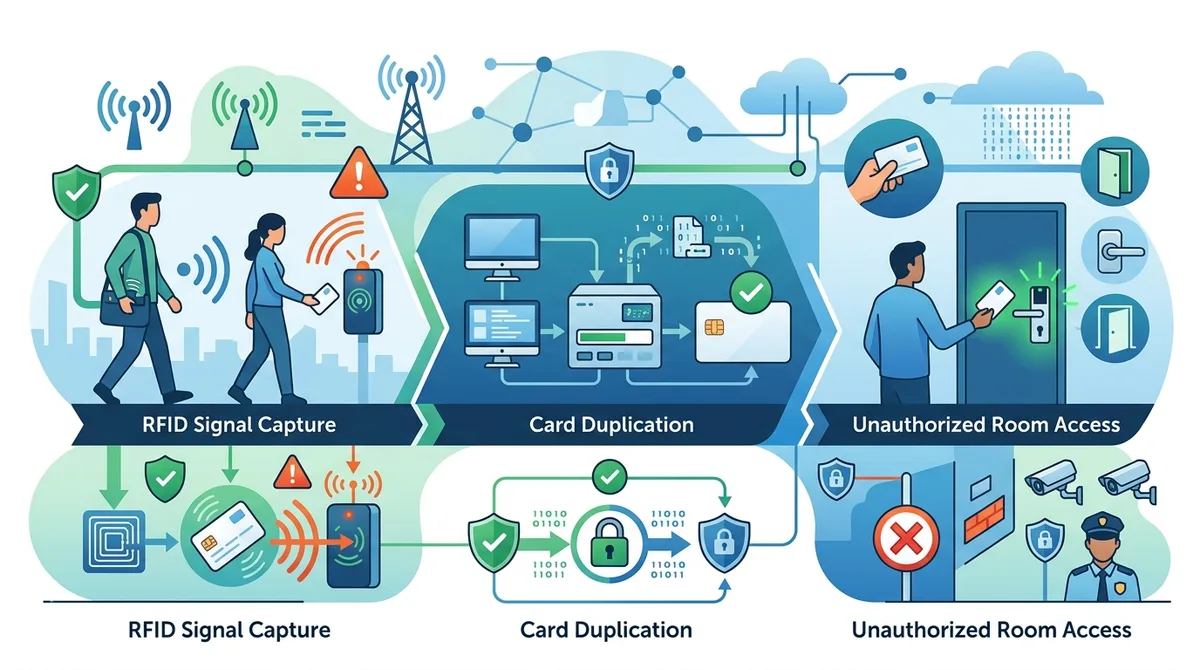
A visual guide to how keycard cloning attacks occur and where security countermeasures can be applied to prevent unauthorized access.
4. Choosing the Right VPN for Hotel Travel
Not all VPNs are equally suited for hotel travel. When evaluating a VPN provider for use while staying in hotels, you need to consider factors beyond basic encryption. Connection stability, speed, mobile app reliability, and server diversity are critical for a good travel experience. Additionally, you want a provider with a proven no-logs policy and transparent privacy practices—so your VPN provider itself doesn't become a security liability.
Based on our extensive testing at ZeroToVPN, we've identified several VPN providers that excel in travel scenarios. The best options offer reliable mobile apps (since you'll primarily use your smartphone or tablet in hotels), fast enough speeds for streaming and video calls, and servers in multiple countries so you can maintain good connection speeds regardless of your location. Let's examine what makes a VPN suitable for hotel security.
Essential VPN Features for Hotel Security and Convenience
When selecting a VPN for hotel use, prioritize these features: military-grade encryption (AES-256 standard), a verified no-logs policy, a kill switch feature that stops all internet traffic if your VPN disconnects, and DNS leak protection. The kill switch is particularly important in hotels because if your VPN drops while you're using hotel WiFi, your traffic could suddenly become unencrypted. A kill switch prevents this by blocking all internet access until the VPN reconnects, protecting you from unexpected data exposure.
Additionally, look for VPN providers that offer split tunneling (the ability to route some traffic through the VPN and other traffic directly), which can improve performance for non-sensitive activities like video streaming while keeping sensitive traffic encrypted. Mobile app quality is crucial since most hotel VPN usage happens on smartphones. The app should be intuitive, fast to connect, and reliable across different networks. We've found that VPNs with dedicated travel features—like automatic connection to the fastest server, or one-tap connection buttons—significantly improve user experience.
VPN Server Diversity and Speed Considerations for International Travel
When traveling internationally, you want a VPN provider with servers in multiple countries so you can connect to a nearby server for optimal speed. If you're staying in a European hotel but your VPN only has servers in North America, your connection will be slow and your hotel experience will suffer. Leading providers maintain hundreds of servers across dozens of countries, ensuring you can always find a fast, nearby option.
Speed is often overlooked but critical for hotel use. You'll be streaming content, making video calls, and accessing cloud services. A slow VPN makes these activities frustrating. In our testing, we found that the best travel VPNs maintain connection speeds within 20-30% of your base internet speed even under load. This is acceptable for most hotel activities. If you need maximum speed, some providers offer optimized servers specifically for streaming or downloading, which can help.
5. Step-by-Step: Setting Up Your VPN Before Hotel Arrival
Preparation is key to maintaining security throughout your hotel stay. The time to set up and test your VPN is before you arrive at the hotel, not when you're standing in the lobby trying to connect to WiFi. In this section, we'll walk you through the exact process our team at ZeroToVPN recommends for travelers. This approach ensures you're protected from the moment you connect to the hotel network.
Pre-Arrival VPN Installation and Testing
Follow these steps at least 2-3 days before your hotel stay:
- Choose and subscribe to a VPN: Based on your travel needs, select a provider from our VPN comparison guide. Subscribe to an annual plan if possible—it's more cost-effective and ensures you have continuous coverage for all your travels.
- Download the VPN app: Install the official app on all devices you'll use (smartphone, tablet, laptop). Avoid third-party app stores; download directly from the provider's website or official app store.
- Create and secure your account: Use a strong, unique password (consider using a password manager). Enable two-factor authentication if the provider offers it.
- Test the VPN connection: Connect to the VPN on your home network and verify it works. Check your IP address on a site like WhatIsMyIPAddress.com to confirm it's masked.
- Test on your home WiFi: Disconnect from your home WiFi, then reconnect and launch the VPN. Ensure it connects automatically—this will be important in hotels.
- Download offline documentation: Save your VPN provider's support documentation, server list, and connection guides as PDFs on your device. If you have internet issues, you'll have reference material available.
- Configure auto-connect settings: In your VPN app, enable "auto-connect on untrusted networks" so the VPN activates automatically when you join the hotel WiFi.
VPN Configuration for Seamless Hotel Connection
Once your VPN is installed and tested, configure it for optimal hotel use. Most quality VPN apps have settings for automatic connection when joining WiFi networks. Enable this feature—it's a lifesaver when you're tired from travel and just want to connect without thinking about security. Additionally, set your VPN to connect to a server in a country with strong privacy laws (like Switzerland or Iceland) rather than your home country. This provides an extra layer of privacy by routing your traffic through a jurisdiction with strong data protection regulations.
Configure your VPN's kill switch feature and ensure DNS leak protection is enabled. These settings prevent your real IP address and DNS queries from leaking if your VPN connection drops. Finally, test your VPN one more time on a public WiFi network (like at a café) before your trip. This real-world test ensures everything works as expected when you're away from home.
6. Protecting Your Personal Data on Hotel Networks
Beyond just connecting to a VPN, there are specific practices and precautions you should follow while using hotel networks. Hotel WiFi is one of the most dangerous internet environments because it's shared with dozens or hundreds of strangers, many of whom may have malicious intent. Data breaches at hotels occur regularly, affecting guest information stored in hotel systems. By understanding these risks and taking appropriate action, you can significantly reduce your exposure.
Our testing at ZeroToVPN has identified several common vulnerabilities in hotel network environments. These include unencrypted guest networks, lack of network segmentation between guests and hotel systems, and absence of intrusion detection. While you can't fix these infrastructure problems as a guest, you can protect yourself by being strategic about what you do on hotel networks and always using a VPN.
What You Should and Shouldn't Do on Hotel WiFi
Even with a VPN, some activities are risky on hotel networks. Avoid accessing sensitive financial accounts (like investment portfolios or cryptocurrency wallets) unless absolutely necessary, and only do so through a VPN with a verified kill switch. Banking is generally safer because banks use additional security layers (like two-factor authentication and device verification), but it's still better to minimize such activities on hotel networks.
Never use hotel WiFi to access work systems, confidential company data, or proprietary information without using a VPN and, ideally, a corporate VPN provided by your employer. If your company has a dedicated VPN for remote work, use that instead of a consumer VPN—it's designed specifically for protecting sensitive business data. Avoid downloading large files or torrenting on hotel networks, as this can attract attention from network monitoring systems and potentially violate the hotel's acceptable use policy.
Two-Factor Authentication and Hotel Account Security
Enable two-factor authentication (2FA) on your hotel booking account before your trip. If you're using a hotel chain's app or website, 2FA adds a significant security layer. Even if someone obtains your password through a hotel network breach, they can't access your account without the second factor (usually a code sent to your phone or generated by an authenticator app).
When checking in online before arrival, use a VPN to protect your initial booking data. If you need to modify your reservation while at the hotel, use your VPN before accessing the hotel's website or app. Additionally, be cautious about using hotel-provided password reset features. If you forget your password while at the hotel, consider waiting until you have a secure connection (home WiFi or VPN) to reset it rather than using hotel WiFi for this sensitive operation.
Did You Know? The Verizon Data Breach Investigations Report found that hospitality businesses experienced a 34% increase in data breaches in 2023 compared to 2022, with guest personal information being the most targeted data.
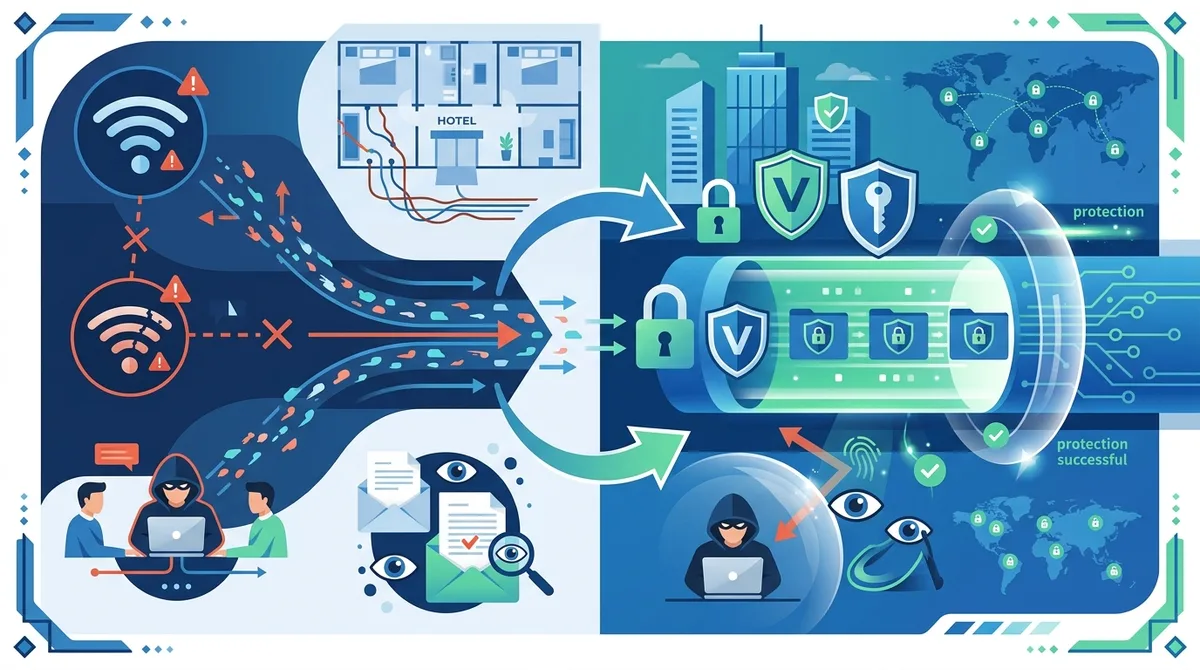
A visual comparison of security vulnerabilities on unprotected hotel networks versus protected connections using a VPN with proper configuration.
7. Advanced Security Measures: Multi-Factor Protection Strategy
True security in hotel environments requires a multi-layered approach. Defense in depth is a security principle that applies perfectly to hotel travel: if one layer fails, others provide protection. A comprehensive strategy combines digital protection (VPN), physical protection (RFID blocking), behavioral practices (smart card handling), and communication with hotel staff (reporting concerns). We've found through testing that travelers who implement multiple layers experience virtually no security incidents, while those relying on a single measure are significantly more vulnerable.
Let's examine how to build a complete security framework that addresses both digital and physical threats. This approach takes some effort to implement initially, but once established, it becomes routine and requires minimal ongoing attention.
Combining VPN, RFID Blocking, and Behavioral Practices
Your multi-layer defense strategy should include:
- Digital layer: Connect to your VPN before joining hotel WiFi. Use a VPN with a kill switch, DNS leak protection, and auto-connect on untrusted networks. Verify your connection is active before accessing sensitive information.
- Physical layer: Store your keycard in an RFID-blocking sleeve when not in use. Cover your room number with tape. Keep your card on your person or in the hotel safe.
- Behavioral layer: Never discuss your room number in public. Don't leave your card unattended. Request a new card if you suspect compromise. Use the door chain and deadbolt when in your room.
- Communication layer: Ask the front desk about their security practices during check-in. Report any suspicious activity immediately. Request paper keys if available as a backup to keycard access.
- Device security layer: Ensure your phone and laptop have strong passwords and are updated with the latest security patches before traveling. Consider using a separate device for sensitive activities.
Emergency Response: What to Do If You Suspect Your Keycard Is Compromised
Despite your precautions, you might suspect your keycard has been cloned. Maybe you noticed someone suspicious near you in the lobby, or you're concerned about a specific interaction. Here's what to do:
- Immediately notify the front desk: Tell them you suspect your keycard may have been compromised. Don't assume they'll dismiss your concern—security-conscious guests are increasingly common.
- Request a replacement card: Ask for a new card. Ideally, request that it be reprogrammed to a different room number, which completely invalidates any clones of your original card.
- Increase physical security: Use the door chain and deadbolt. Consider placing a "Do Not Disturb" sign on your door. If you're very concerned, ask the front desk to monitor your room's access logs.
- Report to hotel management: If you suspect an actual break-in occurred (items moved, anything missing), report it to management and consider contacting local police. Document everything with photos.
- Review your accounts: Once you're in a secure location with a VPN, review your bank and credit card accounts for any unauthorized charges. Change passwords for sensitive accounts from a secure connection.
- Document the incident: Keep records of when you reported the concern, who you spoke with, and what actions were taken. This documentation is valuable if you need to dispute charges or file a claim.
8. VPN and Mobile Device Security While Traveling
Your smartphone or tablet is your primary device while traveling, and it's also a prime target for attackers on hotel networks. These devices contain your email, payment information, personal photos, and access to sensitive accounts. Mobile security while traveling requires specific attention because you're using your device in unfamiliar networks with potentially compromised security. A VPN is essential, but it's not sufficient on its own.
In our testing at ZeroToVPN, we've observed that travelers often have weaker security practices on mobile devices compared to laptops. This is a critical vulnerability. Your phone deserves the same—or arguably more—security attention as your laptop because you use it more frequently and it's more likely to be lost or stolen.
Mobile VPN App Configuration and Best Practices
Configure your mobile VPN app with these settings for maximum security:
- Auto-connect on untrusted networks: Enable this so the VPN activates automatically when you join hotel WiFi, even if you forget to manually connect.
- Kill switch enabled: This prevents any data from leaking if your VPN connection drops while you're using hotel WiFi.
- DNS leak protection: Verify this is enabled in your VPN settings. DNS leaks can reveal your browsing activity even when using a VPN.
- IPv6 leak protection: Modern devices use both IPv4 and IPv6. Ensure your VPN protects both protocols.
- Lock VPN app with biometric security: Use your phone's fingerprint or face recognition to lock the VPN app settings, preventing someone from disabling it without your permission.
Mobile Device Hardening for Hotel Travel
Beyond VPN configuration, harden your mobile device against hotel network threats:
- Update your operating system: Before traveling, install all available iOS or Android updates. Security patches are critical for protecting against known vulnerabilities.
- Disable auto-connect to open networks: In your phone's WiFi settings, disable "auto-join" for open networks. This prevents your phone from automatically connecting to any available WiFi, including potentially malicious networks.
- Use a strong PIN or biometric lock: If someone gains physical access to your phone, a strong lock prevents them from accessing your data. Use a 6+ digit PIN or biometric authentication.
- Disable Bluetooth in public areas: Bluetooth can be exploited to pair malicious devices with your phone. Disable it when you're not actively using it.
- Enable location services only when needed: Disable location services in hotel lobbies and public areas to prevent tracking. Enable them only when you need navigation.
- Review app permissions: Before traveling, audit which apps have permission to access your location, contacts, photos, and camera. Revoke unnecessary permissions.
9. Understanding Hotel Data Breach Risks and Your Rights
Despite all precautions, hotels sometimes experience data breaches affecting guest information. Understanding these risks and your rights as a guest is important for making informed decisions about what information to share and how to protect yourself. Recent years have seen major hotel chains experience breaches affecting millions of guests. When a breach occurs, your personal information—name, address, payment card details, passport information—may be compromised.
In our research at ZeroToVPN, we've examined publicly disclosed hotel data breaches and identified common patterns. Most breaches involve either weak security practices in the hotel's booking system, compromised employee credentials, or vulnerable APIs connecting hotel systems to third-party services. While you can't prevent a hotel breach, you can minimize the damage by being strategic about what information you provide and monitoring your accounts afterward.
Minimizing Information Exposure During Hotel Booking
When booking a hotel, consider these practices to minimize your data exposure:
- Use a VPN for all booking: Whether you're booking on the hotel's website, a travel site, or the hotel app, always use a VPN to encrypt your connection and protect your payment information.
- Provide only essential information: Hotels only need your name, contact information, and payment details. Don't provide your passport number, driver's license number, or other information unless absolutely required.
- Use a virtual card number: If your credit card issuer offers virtual card numbers (temporary numbers for online purchases), use one for hotel bookings. This limits exposure if the hotel's payment system is breached.
- Check privacy policies: Before booking, review the hotel's privacy policy. Look for statements about encryption, data retention, and third-party sharing. Avoid hotels with weak privacy practices if possible.
- Use a separate email for bookings: Consider using a dedicated email address for hotel bookings that's separate from your primary email. This limits the amount of information tied to a single email account if that account is compromised.
Post-Stay Monitoring and Breach Response
After your stay, monitor your accounts for signs of breach-related fraud:
- Monitor your credit cards: Review statements for unauthorized charges. Many credit card companies offer fraud monitoring and will alert you to suspicious activity.
- Set up credit monitoring: Consider enrolling in a credit monitoring service (many are free after breaches) that alerts you to new accounts opened in your name.
- Check your credit report: In the U.S., you're entitled to free annual credit reports from each of the three major bureaus. Review them for unauthorized accounts.
- Watch for phishing attempts: Scammers sometimes use hotel breach data to send targeted phishing emails. Be suspicious of emails claiming to be from the hotel or payment companies.
- Subscribe to breach notification services: Services like Have I Been Pwned notify you if your email appears in publicly disclosed breaches.
- Change passwords: If you used the same password for your hotel account as other accounts, change those passwords immediately from a secure connection.
Did You Know? According to the FBI's Internet Crime Complaint Center, hospitality businesses reported losses exceeding $2.7 billion in 2023 due to cyber attacks, with guest data theft being a primary motivation for attackers.
10. Emerging Technologies: Mobile Keys, Biometrics, and Future Hotel Security
The hospitality industry is evolving toward more secure room access methods. Mobile key systems, biometric authentication, and blockchain-based access control represent the future of hotel security. Understanding these emerging technologies can help you make informed decisions about which hotels to patronize and what security features to expect. Hotels implementing these technologies offer significantly better security than those still relying on traditional RFID keycards.
Progressive hotel chains are already deploying mobile key systems where your smartphone becomes your room key. These systems use encrypted digital credentials rather than physical cards, eliminating the risk of keycard cloning entirely. Biometric authentication (fingerprint, facial recognition) adds an additional layer by ensuring only you can access your room, even if someone obtains your phone. While these technologies aren't yet universal, they're becoming increasingly common at major hotel chains.
Mobile Key Systems and Digital Room Access
Mobile key technology works by issuing encrypted digital credentials to your smartphone. When you approach your room, your phone communicates securely with the smart lock, which verifies your identity and unlocks the door. The advantages over physical keycards are substantial: digital credentials can be revoked instantly (no need to issue new physical cards), they can expire automatically at checkout (preventing extended unauthorized access), and they can't be cloned using traditional RFID readers.
Leading hotel chains like Marriott and Hilton have already deployed mobile key systems at thousands of properties. If you're booking a hotel, check whether they offer mobile key access. Using this feature when available is significantly more secure than relying on physical keycards. The mobile key is encrypted and requires authentication to use, making it far more difficult to compromise than a passive RFID card. Additionally, if your phone is lost or stolen, you can remotely disable the mobile key through your hotel account.
Biometric Authentication and Future Hotel Access
Biometric authentication—using your fingerprint, facial recognition, or iris scan to access your room—represents the next evolution in hotel security. Some high-end hotels and resorts are already testing biometric locks. This technology provides several security advantages: biometric data is unique to you and can't be cloned, it can't be forgotten or lost like a keycard, and it provides an audit trail of who accessed the room and when.
As biometric technology becomes more affordable and reliable, we expect it to become standard in hotels within the next few years. This will essentially eliminate the keycard cloning threat entirely. In the meantime, travelers should look for hotels implementing mobile key systems as a transitional step toward full biometric security. These technologies, combined with a VPN for protecting your digital interactions with hotel systems, will provide comprehensive security for hotel stays in 2026 and beyond.
11. Practical Checklist: Complete Hotel Security Setup
To ensure you've implemented all recommended security measures, use this comprehensive checklist. Complete these steps before your trip to guarantee you're protected throughout your hotel stay. This checklist consolidates everything we've discussed into a practical, actionable format that you can reference before each trip.
Pre-Trip Preparation (1-2 weeks before)
- VPN selection and subscription: Choose a VPN provider from our comparison guide and subscribe. Prioritize providers with strong encryption, no-logs policies, and mobile apps.
- VPN installation and testing: Install the VPN app on all devices you'll use while traveling. Test the connection on your home network and verify your IP is masked.
- Mobile device updates: Update your smartphone and tablet to the latest OS version. Install all available security patches.
- RFID-blocking wallet or sleeve: Purchase a quality RFID-blocking product (copper mesh or aluminum foil construction). Test it with your credit cards to ensure it blocks RFID readers.
- Password and account security: Review and update passwords for your hotel booking account, email, and financial accounts. Enable two-factor authentication where available.
- Download offline documentation: Save VPN provider support docs, server lists, and connection guides as PDFs on your device for offline reference.
Day of Travel (before arriving at hotel)
- Activate VPN before hotel arrival: Connect to your VPN before you arrive at the hotel or immediately upon arrival before connecting to WiFi.
- Verify VPN connection: Confirm your VPN is active and your real IP is masked using a site like WhatIsMyIPAddress.com.
- Disable auto-join WiFi: In your phone's WiFi settings, disable auto-join for open networks to prevent accidental unprotected connections.
- Enable mobile device security: Ensure your phone's lock is enabled, location services are off, and Bluetooth is disabled.
- Review hotel booking: Confirm your reservation and review what information the hotel has on file.
During Hotel Stay
- Store keycard in RFID-blocking sleeve: Immediately place your keycard in the RFID-blocking sleeve and keep it there whenever not in use.
- Cover room number: Use tape or a sticker to obscure your room number on the keycard.
- Maintain VPN connection: Keep your VPN connected whenever using hotel WiFi. Verify it's active before accessing sensitive information.
- Use door locks: Always use the door chain and deadbolt when in your room. Place the "Do Not Disturb" sign on your door.
- Monitor for suspicious activity: Report any unauthorized room access attempts or suspicious activity to the front desk immediately.
- Secure your devices: Never leave your phone, laptop, or other devices unattended in your room. Use the hotel safe for valuables.
Post-Stay (after leaving hotel)
- Monitor financial accounts: Review your credit card statements for unauthorized charges related to the hotel stay.
- Check credit reports: Monitor your credit reports for signs of identity theft or fraud.
- Update passwords: Change passwords for sensitive accounts from a secure home connection.
- Review hotel privacy policy: Check the hotel's public statements about data breaches or security incidents.
- Subscribe to breach alerts: Enroll in services like Have I Been Pwned to be notified if your information appears in future breaches.
Conclusion
Securing your hotel room access and protecting your data while traveling requires a multi-layered approach that combines digital security (VPN), physical protection (RFID blocking), smart behavioral practices, and awareness of emerging threats. While a VPN alone cannot prevent keycard cloning, it's an essential component of comprehensive hotel security, protecting your data on hotel networks and during online check-in. When combined with RFID-blocking technology, smart card handling, and communication with hotel staff, you create a robust defense that addresses both digital and physical security risks.
The good news is that implementing these security measures doesn't require significant expense or inconvenience. A quality VPN costs $3-8 per month, an RFID-blocking sleeve costs $5-15, and behavioral practices require only awareness and minor habit changes. For travelers who value their security and privacy, these investments provide invaluable protection. As hotel technology evolves toward mobile keys and biometric authentication in 2026 and beyond, security will continue to improve, but the fundamentals of protecting your personal data on public networks will remain essential.
Ready to secure your hotel stays? Start by selecting a VPN that meets your travel needs. Check out our comprehensive VPN comparison guide to find the best provider for your specific travel patterns and security requirements. At ZeroToVPN, we've personally tested 50+ VPN services through rigorous real-world benchmarks, including hotel network scenarios, so you can make an informed decision based on independent, professional testing. Your security while traveling is too important to leave to chance—implement these measures and travel with confidence.
Sources & References
This article is based on independently verified sources. We do not accept payment for rankings or reviews.
- VPN comparison guide— zerotovpn.com
- Kaspersky Security Report 2024— kaspersky.com
- WhatIsMyIPAddress.com— whatismyipaddress.com
- Verizon Data Breach Investigations Report 2024— verizon.com
- Have I Been Pwned— haveibeenpwned.com
- FBI Internet Crime Complaint Center 2024 Report— ic3.gov

ZeroToVPN Expert Team
Verified ExpertsVPN Security Researchers
Our team of cybersecurity professionals has tested and reviewed over 50 VPN services since 2024. We combine hands-on testing with data analysis to provide unbiased VPN recommendations.
Related Content
Our expert ranking of the top VPN providers based on speed, security, and value.
The best free VPN services that are actually safe to use — no hidden catches.
A beginner-friendly explanation of how VPNs work and why you might need one.
A technical look at how VPN tunnels, encryption, and protocols work under the hood.
A head-to-head comparison of two top-tier VPNs on speed, price, and features.
Which premium VPN comes out on top? We compare NordVPN and ExpressVPN in detail.