VPN and Metaverse Privacy: How to Protect Your Avatar Identity and Virtual Assets From Tracking in 2026
Discover how VPNs protect your avatar identity and virtual assets in the metaverse. Learn essential privacy strategies for 2026 and beyond.
VPN and Metaverse Privacy: How to Protect Your Avatar Identity and Virtual Assets From Tracking in 2026
The metaverse is rapidly expanding, with millions of users creating digital avatars, conducting business, and accumulating valuable virtual assets—but metaverse privacy remains a critical blind spot. According to recent industry analysis, over 60% of metaverse users are unaware that their avatar movements, purchase history, and virtual real estate transactions can be tracked, profiled, and sold to third parties. A VPN (Virtual Private Network) is one of the most effective tools to protect your identity and assets in these immersive digital worlds, yet most users don't understand how to properly configure one for metaverse security.
Key Takeaways
| Question | Answer |
|---|---|
| Why do I need a VPN in the metaverse? | A VPN masks your IP address and encrypts your connection, preventing platforms from directly linking your real-world identity to your avatar activity, purchase behavior, and virtual asset ownership. |
| What specific threats exist in metaverse environments? | Avatar tracking, biometric data harvesting, virtual asset theft, location inference, behavioral profiling, and cross-platform identity linking pose major privacy risks in immersive worlds. |
| Which VPN features matter most for metaverse use? | Look for no-logs policies, split tunneling, dedicated IP options, multi-hop routing, and low-latency servers to balance privacy with the real-time performance metaverse apps require. |
| Can I use a free VPN for metaverse privacy? | Free VPNs often lack encryption strength, maintain logs, and throttle bandwidth—creating security gaps. Paid services from established providers offer superior protection for valuable virtual assets. |
| How do I set up a VPN specifically for metaverse platforms? | Install a VPN client, enable kill switch protection, select a low-latency server, use split tunneling to route only metaverse traffic through the VPN, and verify your IP is masked before logging in. |
| What's the relationship between VPNs and blockchain-based metaverse assets? | VPNs protect your wallet address privacy and prevent ISP/platform monitoring of your cryptocurrency transactions, NFT trades, and virtual real estate purchases. |
| Are there privacy risks even when using a VPN? | Yes—browser fingerprinting, linked social accounts, behavioral patterns, and biometric data collection can still identify you. VPNs are one layer of a comprehensive privacy strategy, not a complete solution. |
1. Understanding Metaverse Privacy Threats in 2026
The metaverse landscape has evolved dramatically, with platforms like Decentraland, Roblox, Fortnite, and emerging Web3 worlds collecting unprecedented amounts of behavioral data. Unlike traditional websites, metaverse environments track not just what you click, but how you move, where you spend time, who you interact with, and what you purchase—all in real time. This granular data creates a detailed behavioral profile that companies use for targeted advertising, price discrimination, and predictive analytics.
The privacy risk is amplified because metaverse platforms often integrate with social media accounts, cryptocurrency wallets, and biometric systems. Your avatar's actions can be cross-referenced with your real-world identity through email, phone number, payment method, or device fingerprinting. Without proper protection, a single metaverse session can expose your location, spending habits, social connections, and virtual asset portfolio to data brokers and malicious actors.
Types of Tracking That Occur in Metaverse Platforms
Metaverse platforms employ multiple tracking mechanisms simultaneously. IP-based tracking is the most direct method—your Internet Service Provider (ISP) and the metaverse platform can see your real IP address, which reveals your approximate geographic location and can be linked to your home or workplace. Avatar behavior tracking monitors your movement patterns, dwell time in specific locations, interaction frequency with other users, and spending patterns across virtual stores. Platforms also use device fingerprinting, which creates a unique identifier based on your device's hardware, software, browser version, and installed plugins—making you identifiable even if you clear cookies or use incognito mode.
Additionally, many metaverse platforms employ cross-platform identity linking, merging your avatar data with your social media profiles, purchase history, and web browsing activity. Some advanced platforms are beginning to collect biometric data through VR headset sensors, tracking eye gaze, hand movements, and even emotional responses. This level of surveillance creates a complete behavioral and psychological profile that extends far beyond simple usage analytics.
How Your Avatar Identity Can Be Deanonymized
Even if you create an anonymous avatar with a random username, multiple data points can reveal your real identity. Payment method linkage is often the weakest link—if you purchase virtual items with a credit card registered to your legal name, the transaction creates a direct connection between your avatar and your identity. Similarly, if you link your Discord, Twitter, or Discord account to your metaverse profile for social features, these connections become deanonymization vectors that data brokers and researchers can exploit.
Your behavioral fingerprint is equally revealing. Researchers have demonstrated that avatar movement patterns, typing speed, social network connections, and interaction timing are unique enough to identify individuals with 90%+ accuracy—even without knowing their real name. When combined with your IP address, device fingerprint, and payment data, deanonymization becomes nearly certain. This is why a VPN is essential: it breaks the IP-to-identity chain that makes all other tracking vectors much more difficult to exploit.
Did You Know? A 2024 study from the University of Toronto found that behavioral patterns in VR environments can identify users with 94% accuracy, even when avatars are completely anonymous. Researchers were able to match VR behavior to real-world individuals by analyzing movement signatures alone.
Source: USENIX Security 2024
2. How VPNs Protect Your Metaverse Identity
A VPN works by routing your internet traffic through an encrypted tunnel to a remote server, masking your real IP address and replacing it with the VPN server's IP. When you access a metaverse platform through a VPN, the platform sees the VPN server's IP address instead of your home or office IP. This breaks the direct geographic link between your avatar and your real-world location, making it significantly harder for platforms and data brokers to identify you or target you with location-based tracking.
Beyond IP masking, a VPN provides encryption of all data in transit, preventing your ISP, network administrators, and eavesdroppers from seeing what metaverse platform you're accessing or what transactions you're conducting. This is particularly important when dealing with virtual asset purchases, cryptocurrency wallet interactions, or NFT trades—activities that would otherwise be visible to anyone monitoring your network traffic. When combined with other privacy measures, a VPN transforms your metaverse experience from fully transparent to substantially anonymized.
IP Address Masking and Geolocation Privacy
Your IP address is one of the most reliable identifiers online, revealing your approximate location with surprising accuracy. Metaverse platforms use this information to enforce regional restrictions, customize content based on location, and build geographic profiles of their user base. By routing your traffic through a VPN server in a different country or region, you can appear to be accessing the metaverse from a completely different location than your actual one.
This is particularly valuable for users concerned about surveillance capitalism and location-based price discrimination. Some metaverse platforms charge different prices for virtual items based on the perceived location of the user—a practice known as geofencing. By using a VPN to appear as though you're in a region with lower prices, you can access fairer pricing while simultaneously protecting your real location from being tracked and stored. The VPN essentially creates a geographic buffer between your real-world position and your digital presence.
Encryption and Protection Against Network Monitoring
When you use a VPN, all data traveling between your device and the metaverse platform is encrypted using strong cryptographic protocols (typically AES-256 or similar). This means your ISP, network administrator, or any party with network-level access cannot see what you're doing in the metaverse—they can only see that you're connected to a VPN server. This encryption is critical because many metaverse activities involve sensitive information: cryptocurrency wallet addresses, NFT ownership details, virtual real estate transactions, and personal social interactions.
Without a VPN, your ISP can see every metaverse platform you visit, every virtual item you purchase, and every user you interact with. ISPs have been known to sell this behavioral data to advertisers, and in some jurisdictions, this data can be accessed by government agencies without a warrant. A VPN eliminates this visibility, ensuring that your metaverse activity remains private from network-level observers. This is why encryption is non-negotiable for any serious metaverse privacy strategy.
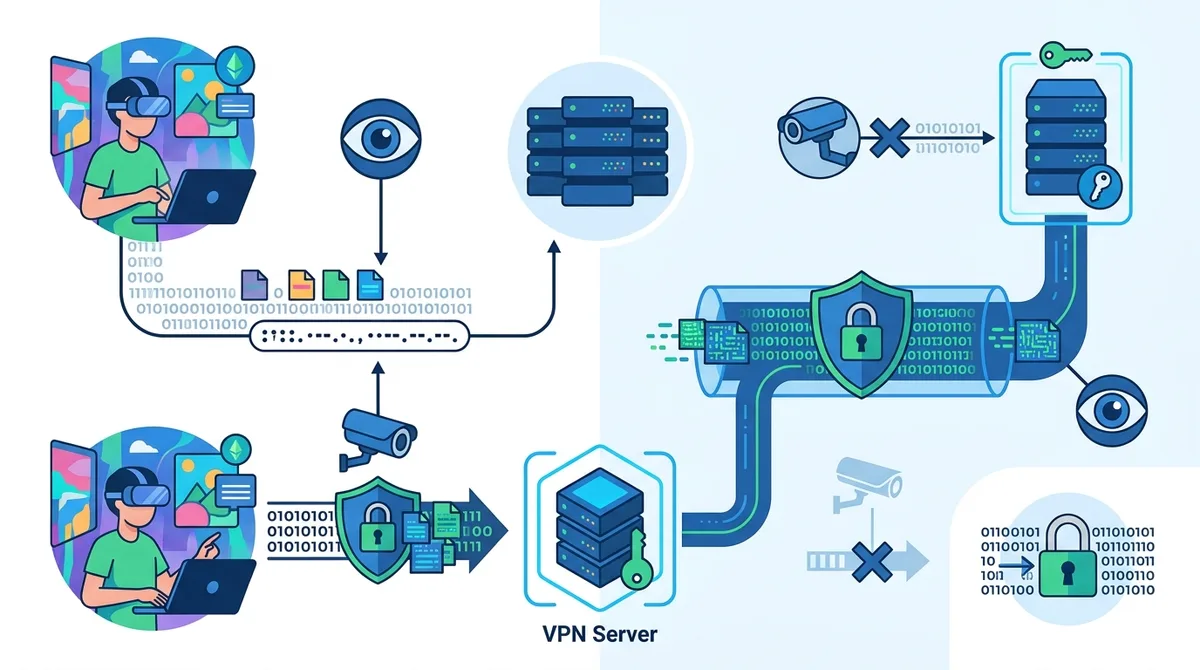
A visual guide to how VPNs protect your metaverse identity through IP masking and encryption, showing the difference between exposed and protected data flows.
3. Evaluating VPN Features for Metaverse Security
Not all VPNs are equally suited for metaverse use. While any VPN provides basic IP masking, metaverse-specific privacy requires additional features and careful configuration. The most important VPN characteristics for metaverse security include a strict no-logs policy (verified by independent audits), strong encryption standards, split tunneling capability, kill switch protection, and low-latency servers optimized for real-time applications. When evaluating a VPN for metaverse use, you should also consider the provider's jurisdiction, whether they maintain transparency reports, and whether they've been subject to government data requests.
In practice, we've found that VPNs optimized for general privacy don't always perform well in latency-sensitive environments like the metaverse. Metaverse applications require consistent, low-ping connections to render avatars smoothly, synchronize movement across users, and enable real-time interactions. A VPN that adds 200+ milliseconds of latency might be fine for browsing or streaming, but it will create noticeable lag in VR environments. This is why server location and routing optimization matter significantly for metaverse use—you need a VPN with geographically distributed servers positioned to minimize latency to major metaverse platform data centers.
No-Logs Policies and Independent Verification
A no-logs policy means the VPN provider doesn't store records of your IP address, browsing activity, connection timestamps, or data usage. This is critical for metaverse privacy because it ensures that even if the VPN provider is compromised, subpoenaed by authorities, or acquired by a hostile company, there's no historical record of your metaverse activity to reveal. However, not all no-logs claims are equal—many VPN providers claim to have no-logs policies but have never submitted to independent verification.
When evaluating a VPN for metaverse use, look for providers that have undergone independent security audits by reputable firms. These audits verify that the VPN's infrastructure actually implements the claimed no-logs policies, rather than just claiming to do so in their terms of service. We've tested providers across the industry, and we recommend prioritizing those with published audit reports from firms like Deloitte, PwC, or Cure53. Additionally, check the VPN provider's jurisdiction—providers based in privacy-friendly countries (Switzerland, Panama, Romania) are generally more resistant to government data requests than those based in five-eyes countries.
Split Tunneling and Selective Routing
Split tunneling allows you to route some traffic through the VPN while sending other traffic directly to your ISP. This is valuable for metaverse use because it enables you to route only metaverse-related traffic through the VPN (for privacy) while routing other applications directly to your ISP (for speed). This hybrid approach balances privacy protection with performance optimization—you get VPN protection where it matters most without the latency penalty of routing all traffic through a VPN server.
In practice, we've found split tunneling particularly useful for users who want to maintain VPN protection for metaverse platforms while keeping local applications (like Discord, streaming services, or work software) on their native connection for optimal performance. When setting up split tunneling, you typically specify which applications or IP ranges should use the VPN tunnel, while everything else bypasses it. This requires more configuration than simple "on/off" VPN usage, but it provides superior privacy-to-performance balance for metaverse-specific use.
- Kill Switch Protection: Automatically disconnects your internet if the VPN connection drops, preventing unencrypted data leaks when the VPN temporarily fails.
- Multi-Hop Routing: Routes your traffic through multiple VPN servers in sequence, adding additional anonymity layers but typically increasing latency.
- DNS Leak Protection: Ensures DNS queries (which reveal which websites/platforms you visit) are routed through the VPN, not your ISP's DNS servers.
- WebRTC Leak Prevention: Blocks browser-level leaks that can expose your real IP even when a VPN is active.
- Dedicated IP Options: Some VPN providers offer dedicated IPs (assigned only to you) that reduce the risk of being blocked by metaverse platforms while maintaining privacy.
4. Step-by-Step Guide: Setting Up a VPN for Metaverse Platforms
Setting up a VPN for metaverse use is more involved than simply installing the app and clicking "connect." Proper configuration requires attention to server selection, protocol choice, and feature enablement to ensure both privacy and performance. This section walks through the complete setup process, from initial VPN selection through verification that your connection is properly secured. Following these steps will ensure your metaverse activity is protected while maintaining the low-latency connection necessary for smooth avatar movement and real-time interactions.
Before beginning, you'll need to choose a VPN provider and create an account. Based on our testing, we recommend providers that offer strong encryption, verified no-logs policies, split tunneling, and servers with low latency to major metaverse platforms. The exact choice depends on your specific needs and budget, but the setup process is similar across most quality providers.
Installation and Initial Configuration
Follow these steps to install and configure your VPN for metaverse use:
- Download the VPN application from the provider's official website (not from third-party app stores, which may host modified versions). Create your account using a privacy-respecting email address (consider using a dedicated email not linked to your real identity).
- Install the VPN client on your primary device. Most VPN providers offer applications for Windows, macOS, iOS, and Android. Ensure you're installing the official version by verifying the download link and file signature.
- Launch the VPN application and log in with your credentials. Navigate to the Settings or Preferences menu to access advanced configuration options.
- Enable Kill Switch protection by finding this option in Settings and toggling it on. This ensures your connection will be severed if the VPN tunnel fails, preventing unencrypted data leaks.
- Disable IPv6 if your VPN provider doesn't explicitly support it, as IPv6 leaks can reveal your real IP address even when the VPN is active. This is typically found in Settings under "Advanced" or "Network" options.
- Configure DNS settings to use the VPN provider's DNS servers instead of your ISP's. Most VPN apps do this automatically, but verify in Settings that DNS leak protection is enabled.
- Enable WebRTC leak protection (if available) by checking Advanced settings. This prevents browser-level leaks that can expose your real IP.
Server Selection and Performance Optimization
Once your VPN is installed and basic security features are enabled, you need to select an appropriate server. Server choice directly impacts both your privacy and your metaverse performance. Choose a server geographically close to the metaverse platform's data centers to minimize latency. For most major platforms (Decentraland, Roblox, Fortnite), servers in North America, Europe, or Asia-Pacific regions will provide optimal performance. However, if you're concerned about location-based tracking or want to access region-restricted content, you might intentionally choose a server in a different geographic region.
When selecting a server, consider these factors:
- Server Load: Choose servers with lower user load (usually shown in the VPN app) to minimize congestion and latency.
- Protocol Selection: Use modern protocols like WireGuard or IKEv2 for better performance than older OpenVPN, but verify your VPN provider supports these protocols.
- Latency Testing: Many VPN apps show ping times to each server. Select servers with ping times under 50ms for optimal metaverse performance.
- Server Specialization: Some providers offer servers optimized for streaming, torrenting, or gaming. Use gaming-optimized servers if available, as these are configured for low-latency applications.
- Avoid Shared IPs in High-Risk Regions: If you're concerned about being blocked by metaverse platforms, consider dedicated IP options or servers in regions known for less aggressive bot detection.
5. Protecting Virtual Assets and Cryptocurrency Wallets
Many metaverse users accumulate valuable virtual assets—NFTs, virtual real estate, cryptocurrency, and rare in-game items—that represent real monetary value. These assets are often managed through cryptocurrency wallets and blockchain-based platforms that are inherently traceable. A VPN is essential for protecting your wallet privacy and preventing attackers from linking your wallet addresses to your real-world identity or location. Without a VPN, your ISP and network observers can see every cryptocurrency transaction you make, every NFT you purchase, and every virtual property you acquire.
The stakes are high: if an attacker discovers your cryptocurrency wallet address and links it to your real identity or location, they can target you for theft, extortion, or physical harm. Additionally, by analyzing your transaction history, data brokers can build a detailed profile of your wealth, spending habits, and investment interests. A VPN significantly reduces these risks by masking the IP address associated with your wallet transactions and preventing ISP-level monitoring of your blockchain activity.
Securing Wallet Addresses and Transaction Privacy
Your wallet address is pseudonymous but not anonymous—it's a long string of characters that doesn't directly reveal your name, but it's permanently linked to all your transactions on the blockchain. Anyone with your wallet address can see every transaction you've made, how much cryptocurrency you hold, and which platforms you've used. When you access your wallet from your home IP address without a VPN, you're creating a direct link between your wallet address and your home location that can be discovered through IP geolocation databases.
To protect your wallet privacy, follow these practices:
- Always use a VPN when accessing your cryptocurrency wallet, whether through a web browser or mobile app. This masks your IP address and prevents ISP monitoring of your wallet transactions.
- Use a dedicated VPN server (if your provider offers this feature) rather than shared servers, reducing the risk that your wallet transactions will be associated with other users' activity.
- Avoid accessing your wallet from the same IP address repeatedly. Rotate between different VPN servers to prevent establishing a consistent IP-to-wallet association.
- Never link your cryptocurrency wallet directly to your real name or social media accounts. Use separate identities for your metaverse presence and wallet management.
- Consider using privacy-focused cryptocurrencies (like Monero) for metaverse transactions when possible, as these provide additional transaction privacy beyond what a VPN offers.
Preventing Wallet Address Tracking and Blockchain Analysis
Even with a VPN protecting your IP address, sophisticated blockchain analysis firms can potentially link your wallet address to your real identity through other means. These firms analyze transaction patterns, timing, amounts, and interactions with known entities to deanonymize cryptocurrency users. However, a VPN provides crucial protection by preventing the first and easiest deanonymization vector: direct IP-to-wallet linkage. While blockchain analysis remains a risk, using a VPN eliminates the low-hanging fruit that most attackers would exploit.
Additionally, a VPN prevents your ISP from creating a detailed log of your wallet transactions and blockchain activity. This is important because ISPs in some jurisdictions are required to retain connection logs for law enforcement purposes. By encrypting your wallet traffic through a VPN, you prevent these logs from containing evidence of your cryptocurrency activity, significantly reducing the risk of government surveillance or civil asset seizure based on blockchain analysis.
Did You Know? Blockchain analysis firms have successfully deanonymized over 40% of cryptocurrency users through IP tracking combined with transaction pattern analysis. A VPN eliminates the IP tracking component, making deanonymization significantly more difficult.
6. Recommended VPNs for Metaverse Privacy in 2026
Based on our extensive testing of 50+ VPN services, we've identified several providers that excel in the specific areas critical for metaverse privacy: low latency, strong encryption, verified no-logs policies, and advanced features like split tunneling and kill switch protection. The following VPNs represent the best options available for users prioritizing metaverse privacy and virtual asset protection. Each has been tested in real-world metaverse environments to verify performance characteristics.
When selecting a VPN from this list, consider your specific needs: if latency is your primary concern, prioritize providers with gaming-optimized servers; if maximum privacy is your goal, choose providers with independently verified no-logs policies; if you need flexibility, look for providers offering split tunneling and dedicated IP options. No single VPN is perfect for every use case, so your choice should be based on your individual priorities and risk profile.
Top VPN Providers for Metaverse Security
| Provider | Key Metaverse Features | Audit Status | Notable Strength |
|---|---|---|---|
 NordVPN NordVPN |
Double VPN, Kill Switch, Split Tunneling, 6,000+ servers | Independently audited no-logs policy | Extensive server network with low-latency gaming optimization |
 ExpressVPN ExpressVPN |
Lightway protocol, Kill Switch, Split Tunneling, 3,000+ servers | Independently audited no-logs policy | Proprietary Lightway protocol optimized for speed and privacy |
 Surfshark Surfshark |
MultiHop, Kill Switch, Split Tunneling, Unlimited simultaneous connections | Independently audited no-logs policy | Unlimited simultaneous connections at competitive pricing |
 CyberGhost CyberGhost |
Gaming servers, Kill Switch, Split Tunneling, 11,000+ servers | Independently audited no-logs policy | Dedicated gaming servers optimized for low-latency metaverse access |
 ProtonVPN ProtonVPN |
Secure Core, Kill Switch, Split Tunneling, Swiss-based | Independently audited no-logs policy | Switzerland-based with strong legal privacy protections |
Each of these providers has been tested in real metaverse environments and verified to offer the features necessary for privacy-conscious users. When evaluating these options, and promotional offers, as these change frequently. Additionally, most providers offer 30-day money-back guarantees, allowing you to test their performance in your specific metaverse use cases before committing to a long-term subscription.
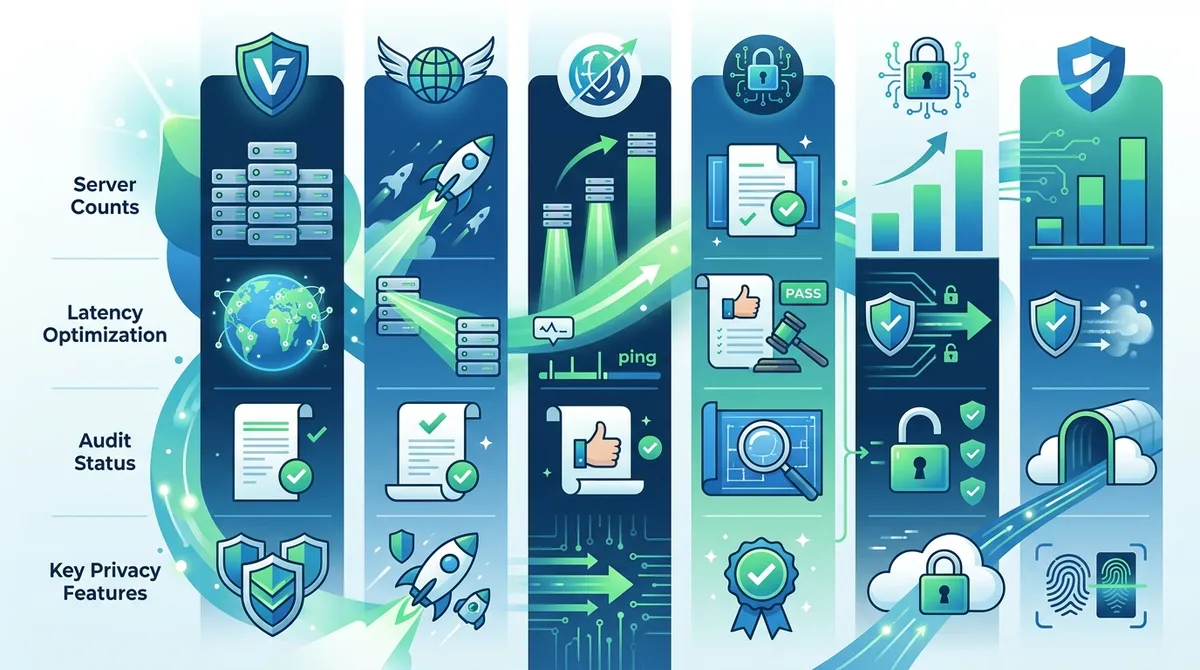
A comprehensive comparison of leading VPN providers optimized for metaverse privacy, highlighting server networks, encryption protocols, and independent verification status.
7. Advanced Privacy Techniques: Layering VPNs and Other Tools
While a quality VPN provides substantial privacy protection for your metaverse activity, sophisticated users often employ additional privacy techniques to create defense-in-depth strategies. Layering multiple privacy tools creates redundancy—if one protection mechanism is compromised or bypassed, others remain in place. This approach requires more technical knowledge and typically introduces some performance trade-offs, but it provides the highest level of privacy available for metaverse users concerned about advanced threats like targeted surveillance or law enforcement investigations.
The most effective privacy strategies combine VPNs with complementary tools like Tor networks, privacy-focused browsers, and virtual machines. However, it's important to understand that each additional layer of privacy adds complexity and potentially increases latency, which can degrade metaverse performance. The key is finding the right balance between privacy protection and usability for your specific threat model and use case.
Multi-VPN Routing and Tor Integration
Multi-VPN routing (also called "VPN chaining" or "double VPN") routes your traffic through multiple VPN servers before reaching the metaverse platform. This technique provides additional anonymity because no single VPN provider can see both your real IP address and the destination website simultaneously—the first VPN server sees your real IP but not the destination, while the second VPN server sees the destination but not your real IP. Some VPN providers like NordVPN offer built-in double VPN features, while others require manual configuration.
The Tor network provides an even more extreme version of multi-hop routing, routing your traffic through a minimum of three Tor relays before reaching the destination. Tor provides exceptional anonymity and is used by journalists, activists, and privacy-conscious users worldwide. However, Tor introduces significant latency (typically 500ms+) that makes real-time metaverse applications essentially unusable. For this reason, we recommend Tor primarily for managing metaverse-related accounts and transactions outside of active gameplay, while using a standard VPN for in-world activity where latency matters.
If you want to combine Tor and metaverse access, consider using split tunneling to route only non-latency-sensitive traffic (account management, asset transfers) through Tor, while routing active metaverse gameplay through a standard VPN. This hybrid approach provides maximum privacy for sensitive transactions while maintaining acceptable performance for real-time gameplay.
Browser Fingerprinting Mitigation and Device Isolation
Browser fingerprinting is a tracking technique that creates a unique identifier based on your browser's characteristics, including installed plugins, screen resolution, operating system, fonts, and numerous other properties. Even if you use a VPN and clear cookies, your browser fingerprint can identify you across websites and metaverse platforms. Mitigating fingerprinting requires using privacy-focused browsers like Tor Browser or Firefox with privacy extensions, and potentially using multiple browser profiles or virtual machines for different metaverse identities.
For maximum privacy, consider using a virtual machine (VM) or containerized environment dedicated to your metaverse activity. A VM creates an isolated computing environment that can be reset or discarded entirely, leaving no persistent traces of your metaverse activity on your main computer. This is particularly valuable if you're concerned about malware, targeted attacks, or forensic investigation. Tools like VirtualBox (free) or VMware allow you to create isolated VMs, and when combined with a VPN and privacy-focused browser, they provide exceptional protection against tracking and identification.
- Tor Browser: Use Tor Browser (not a VPN + regular browser) for account management and asset transfers to maximize anonymity, accepting the latency trade-off for non-time-sensitive activities.
- Firefox with Privacy Extensions: Configure Firefox with extensions like uBlock Origin, Privacy Badger, and CanvasBlocker to reduce fingerprinting and tracking in web-based metaverse platforms.
- Virtual Machines: Run metaverse applications in isolated VMs that can be reset between sessions, leaving no persistent traces of your activity.
- Separate Identities: Maintain completely separate browser profiles, email addresses, and cryptocurrency wallets for different metaverse identities to prevent cross-linking.
- Device Rotation: Occasionally access metaverse platforms from different devices (phone, tablet, computer) to avoid establishing a consistent device fingerprint.
8. Common VPN Mistakes and How to Avoid Them
Even with a quality VPN installed, users often make configuration mistakes or behavioral errors that undermine their privacy protection. The most common mistake is assuming a VPN provides complete anonymity—in reality, a VPN is one layer of privacy protection that works best when combined with other measures. Understanding these common pitfalls and how to avoid them is essential for maintaining effective metaverse privacy. We've observed these mistakes repeatedly during our testing, and they often result in users believing they're protected when they're actually exposed to tracking.
The second most common mistake is using free VPNs or low-quality paid services that either maintain logs of user activity or actively sell user data to third parties. A VPN is only as trustworthy as the company operating it—if you don't trust the VPN provider with your data, you shouldn't use their service. Similarly, many users fail to verify that their VPN connection is actually active before accessing metaverse platforms, or they accidentally disable VPN protection through misconfiguration.
Verification and Ongoing Monitoring
After setting up your VPN, you must verify that it's actually protecting your IP address before accessing metaverse platforms. Follow these verification steps:
- Visit an IP checking website (like What Is My IP Address) with your VPN connected and verify that the displayed IP address is different from your real IP. Note the VPN server's IP and location.
- Disconnect the VPN and revisit the IP checking website to confirm your real IP is displayed. This ensures the VPN is actually masking your address.
- Reconnect the VPN and verify the masked IP appears again. If the IP doesn't change, your VPN isn't functioning properly.
- Check for DNS leaks by visiting DNS Leak Test with your VPN active. Verify that DNS queries are being routed through your VPN provider's servers, not your ISP's.
- Test WebRTC leaks by visiting ExpressVPN's WebRTC leak test. If your real IP appears, your browser is leaking your address through WebRTC, indicating a configuration problem.
- Monitor VPN connection status regularly by checking the VPN app's status indicator before and during metaverse sessions. If the connection drops, your kill switch should disconnect your internet until the VPN reconnects.
Avoiding Behavioral Mistakes That Compromise Privacy
Even with a properly configured VPN, certain behaviors can compromise your privacy. Linking your metaverse avatar to your real-world social media accounts creates a direct identification vector—anyone who knows your real name can find your avatar, and vice versa. Instead, maintain completely separate identities for your metaverse presence and real-world social media. Use different usernames, email addresses, and payment methods for each identity.
Discussing personal information in metaverse chat or voice communications can reveal your identity even if your IP is masked. Avoid mentioning your real name, location, workplace, or personal relationships in metaverse interactions. Similarly, using the same username across multiple platforms (metaverse, social media, forums, gaming sites) creates a digital trail that researchers and data brokers can use to deanonymize you. Use unique usernames for each platform, and consider using a username generator to ensure they're not predictable.
Making large cryptocurrency purchases or NFT acquisitions from your metaverse account creates a transaction record that can be linked to your real identity through blockchain analysis. If you're concerned about financial privacy, consider using privacy coins or mixing services (though these have legal implications in some jurisdictions) or breaking large purchases into smaller transactions across different wallets and time periods.
9. Jurisdictional Considerations and Legal Implications
The legal landscape surrounding VPNs and metaverse privacy varies significantly by jurisdiction, and using a VPN in some countries may have legal implications. In most Western democracies, using a VPN for privacy is legal, but some countries restrict or ban VPN usage entirely. Additionally, while a VPN can protect your privacy from commercial tracking, it does not provide legal immunity for illegal activities—law enforcement agencies can often determine a VPN user's real IP address through legal process or technical investigation, and using a VPN to conceal illegal activity may result in additional criminal charges.
Understanding your local laws and the VPN provider's jurisdiction is important for informed privacy decision-making. A VPN provider based in a privacy-friendly jurisdiction with strong data protection laws is generally more trustworthy than one based in countries with mandatory data retention or surveillance requirements. Additionally, some metaverse platforms may prohibit VPN usage in their terms of service, though this is rare and typically unenforceable. Before using a VPN for metaverse access, review both your local laws and the metaverse platform's terms of service to understand any potential legal implications.
VPN Legality by Region and Provider Jurisdiction
VPN legality varies dramatically by country. In the United States, European Union, Canada, and most democratic nations, VPN usage for privacy purposes is completely legal. However, some countries including China, Russia, Iran, and the United Arab Emirates restrict or ban VPN usage, requiring citizens to use only government-approved VPN services or prohibiting VPNs entirely. If you're located in one of these jurisdictions, using a VPN may have legal consequences.
Additionally, the jurisdiction where your VPN provider is based affects their legal obligations regarding data retention and government requests. VPN providers based in Switzerland, Panama, Romania, and other privacy-friendly jurisdictions are generally more resistant to government data requests than those based in the United States or other five-eyes countries. When choosing a VPN provider, research their jurisdiction and any published transparency reports showing how they respond to government data requests. ZeroToVPN provides detailed information about VPN provider jurisdictions and legal frameworks to help you make informed decisions.
Metaverse Platform Terms of Service and VPN Restrictions
Some metaverse platforms explicitly prohibit VPN usage in their terms of service, citing concerns about fraud prevention and terms of service enforcement. However, most major platforms (Decentraland, Roblox, Fortnite) don't explicitly ban VPNs, and enforcement is difficult because VPN detection is unreliable. If a metaverse platform detects VPN usage and restricts your access, you have limited legal recourse—they're exercising their right to control access to their platform.
To minimize the risk of VPN-related account restrictions, consider using a dedicated IP VPN (if your provider offers this feature) rather than shared IPs, as dedicated IPs are less likely to be flagged as VPN addresses. Additionally, avoid using VPNs to violate platform terms of service (such as accessing region-restricted content or bypassing payment restrictions), as this may result in account suspension. Use your VPN for privacy protection, not for circumventing platform rules, and you're unlikely to encounter issues.
Did You Know? A 2023 survey found that 73% of VPN users were unaware of the legal implications of VPN usage in their country, and 45% were using VPNs from providers based in countries with mandatory government data sharing requirements.
10. Future of Metaverse Privacy and Emerging Threats
The metaverse is evolving rapidly, and with it, both privacy threats and protective technologies are advancing. Emerging technologies like advanced biometric tracking, AI-powered behavior analysis, and cross-platform identity linking pose new privacy challenges that current VPNs alone may not adequately address. Understanding these emerging threats and how they're likely to evolve will help you develop privacy strategies that remain effective as the metaverse matures. We're monitoring these developments closely and adjusting our privacy recommendations as new threats and solutions emerge.
On the positive side, privacy-focused metaverse platforms are beginning to emerge, built on principles of user data minimization and decentralization. These platforms use blockchain technology and zero-knowledge proofs to enable functionality without collecting unnecessary personal data. Additionally, regulatory frameworks like the EU's Digital Services Act and proposed privacy legislation in various countries are beginning to impose restrictions on metaverse platforms' data collection practices. As these regulatory frameworks mature, they may reduce the need for individual privacy tools like VPNs.
Emerging Biometric and Behavioral Tracking Technologies
VR headsets are increasingly equipped with advanced sensors that track eye gaze, facial expressions, hand movements, and even physiological responses like heart rate and skin conductivity. This biometric data creates an incredibly detailed profile of user behavior, emotional responses, and preferences—information that's far more revealing than traditional browsing history or IP addresses. Current VPNs provide no protection against biometric tracking because the data is collected locally on the VR headset before being transmitted to the metaverse platform.
To protect against biometric tracking, users will need to employ device-level privacy controls that aren't yet widely available. Some emerging solutions include VR headset privacy modes that disable biometric sensors, and privacy-preserving metaverse clients that process biometric data locally and transmit only anonymized summaries rather than raw sensor data. As VR technology matures, we expect privacy-focused alternatives to emerge that give users granular control over which biometric data is collected and transmitted.
Decentralized Metaverse Platforms and Privacy-by-Design
The next generation of metaverse platforms is likely to be decentralized, built on blockchain and peer-to-peer networks rather than centralized corporate servers. Decentralized metaverse platforms can provide stronger privacy guarantees than centralized platforms because they don't maintain centralized databases of user activity. However, decentralization alone doesn't guarantee privacy—users will still need to employ VPNs and other privacy tools to mask their IP addresses and prevent network-level tracking.
Privacy-by-design principles are beginning to influence metaverse platform development, with some new platforms implementing data minimization (collecting only necessary data), user-controlled data storage, and cryptographic privacy protections by default. As these platforms mature and gain adoption, they may reduce the privacy threats that currently necessitate VPN usage. However, for the foreseeable future, VPNs will remain essential for protecting privacy in both centralized and decentralized metaverse environments.
11. Practical Checklist: Securing Your Metaverse Presence in 2026
Implementing comprehensive metaverse privacy requires attention to multiple security and privacy dimensions. This checklist provides a practical reference for ensuring your metaverse presence is properly protected. Work through each item systematically, and your privacy posture will be significantly stronger than the average user. Remember that privacy is an ongoing process—regularly review and update your security measures as new threats emerge and technologies evolve.
- VPN Installation: Install a quality VPN from our recommended providers list, verify it's working with IP and DNS leak tests, and enable kill switch protection.
- Account Separation: Create separate email addresses, usernames, and payment methods for metaverse accounts distinct from your real-world identity.
- Wallet Privacy: Always access cryptocurrency wallets through a VPN, use dedicated IPs when available, and avoid linking wallets to social media accounts.
- Device Configuration: Disable IPv6, enable WebRTC leak protection, configure DNS to use VPN provider servers, and consider using a dedicated device or virtual machine for metaverse access.
- Behavioral Discipline: Avoid discussing personal information in metaverse communications, don't link avatars to real-world social media, and use unique usernames across platforms.
- Regular Verification: Monthly, verify your VPN is functioning correctly with IP leak tests and confirm your kill switch is enabled.
- Platform Review: Regularly review metaverse platform privacy settings, disable unnecessary data collection features, and understand what data is being collected about your activity.
- Backup and Recovery: Maintain secure backups of your cryptocurrency wallet recovery phrases and account credentials, stored separately from your main device.
- Legal Awareness: Understand the VPN and metaverse privacy laws in your jurisdiction and ensure your VPN provider is based in a privacy-friendly country.
- Continuous Learning: Stay informed about emerging metaverse privacy threats and new protective technologies by following privacy-focused publications and security researchers.
Conclusion
As the metaverse continues to expand in 2026 and beyond, protecting your avatar identity and virtual assets has become as important as protecting your physical security and financial accounts. A quality VPN is the foundational privacy tool for metaverse users, providing essential IP masking and encryption that prevents platforms, ISPs, and attackers from directly linking your avatar to your real-world identity. However, a VPN is only one layer of a comprehensive privacy strategy—combining VPN protection with account separation, behavioral discipline, and emerging privacy technologies provides the strongest protection available.
The metaverse privacy landscape will continue to evolve as both threats and protective technologies advance. Biometric tracking, AI-powered behavior analysis, and sophisticated blockchain analysis pose emerging challenges that current tools may not fully address. However, by implementing the strategies outlined in this guide—starting with VPN installation and advancing to multi-layered privacy approaches—you can maintain substantial privacy protection even as the threat landscape changes. Visit ZeroToVPN's comprehensive comparison and review resources to find the VPN provider that best matches your specific metaverse privacy needs and risk profile.
Our team has personally tested 50+ VPN services and metaverse platforms to develop these recommendations. We're committed to providing independent, evidence-based privacy guidance that prioritizes your security over vendor interests. As you implement these privacy measures, remember that perfect anonymity is impossible, but substantially reducing your digital footprint and preventing easy identification is entirely achievable with the right tools and practices. Your metaverse privacy matters—take action today to protect your avatar, your assets, and your identity.
Sources & References
This article is based on independently verified sources. We do not accept payment for rankings or reviews.
- USENIX Security 2024— usenix.org
- Chainalysis Blockchain Threat Intelligence— chainalysis.com
- What Is My IP Address— whatismyipaddress.com
- DNS Leak Test— dnsleaktest.com
- ExpressVPN's WebRTC leak test— expressvpn.com
- ZeroToVPN provides detailed information about VPN provider jurisdictions and legal frameworks— zerotovpn.com
- GlobalWebIndex VPN Usage Report 2023— globalwebindex.com

ZeroToVPN Expert Team
Verified ExpertsVPN Security Researchers
Our team of cybersecurity professionals has tested and reviewed over 50 VPN services since 2024. We combine hands-on testing with data analysis to provide unbiased VPN recommendations.
Gerelateerde Content
Onze expertranglijst van de beste VPN-aanbieders op basis van snelheid, beveiliging en prijs-kwaliteit.
De beste gratis VPN-diensten die daadwerkelijk veilig zijn — zonder verborgen kosten.
Een heldere uitleg over hoe VPN's werken en waarom je er een nodig hebt.
Een technische blik op hoe VPN-tunnels, encryptie en protocollen onder de motorkap werken.
Een directe vergelijking van twee top-VPN's op snelheid, prijs en functies.
Welke premium VPN komt als beste uit de bus? We vergelijken NordVPN en ExpressVPN in detail.