VPN Guide and Tips - May 2026
Master VPN fundamentals and advanced techniques with our comprehensive 2026 guide. Learn setup, security best practices, and optimization tips from industry exp

VPN Guide and Tips - May 2026
In 2026, Virtual Private Networks (VPNs) have become essential tools for anyone concerned about digital privacy and security. With cyber threats evolving at an unprecedented pace and governments expanding surveillance capabilities, understanding how to properly use a VPN is no longer optional—it's critical. Our team at ZeroToVPN has tested 50+ services through rigorous benchmarks and real-world scenarios to bring you this comprehensive guide that takes you from VPN novice to confident user.
Key Takeaways
| Question | Answer |
|---|---|
| What is a VPN and why do I need one? | A VPN encrypts your internet traffic and masks your IP address, protecting your data from ISPs, hackers, and surveillance. Essential for public WiFi, remote work, and privacy-conscious browsing. |
| How do I choose the right VPN? | Look for strong encryption standards, no-logs policies, server diversity, and independent security audits. Read our VPN comparisons for detailed provider analysis. |
| What's the difference between free and paid VPNs? | Paid VPNs offer better security, faster speeds, and more servers. Free VPNs often monetize user data or limit bandwidth, creating privacy risks rather than solving them. |
| Can I use a VPN on all my devices? | Yes. Most quality VPN providers offer apps for Windows, macOS, iOS, Android, and Linux. Some support simultaneous connections across multiple devices. |
| Will a VPN slow down my internet? | Minimal impact with quality providers. Modern VPNs use optimized protocols that balance encryption strength with speed. Server distance and your ISP matter more than the VPN itself. |
| Are VPNs legal? | VPNs are legal in most countries, including the US, UK, Canada, and Australia. However, using a VPN for illegal activities remains illegal. Check your local regulations. |
| What advanced techniques should I know? | Techniques include protocol switching, kill switch configuration, DNS leak prevention, and multi-hop routing. These enhance security for power users and specific threat scenarios. |
1. Understanding VPN Fundamentals
A Virtual Private Network is a technology that creates an encrypted tunnel between your device and a remote server operated by the VPN provider. When you connect to a VPN, all your internet traffic—including emails, browsing history, and app communications—is encrypted and routed through this secure tunnel. Your real IP address is hidden, replaced by the IP address of the VPN server you're connected to. This fundamental principle protects you from a variety of threats, from nosy ISPs to malicious actors on public WiFi networks.
Understanding how VPNs work at a basic level helps you make informed decisions about which service to use and how to configure it properly. In our testing across 50+ VPN services, we've observed that users who understand the core mechanics make better security choices and avoid common pitfalls that undermine VPN protection.
How Encryption Protects Your Data
Encryption is the process of converting your readable data into scrambled code that only authorized parties can decipher. When you use a VPN, your data is encrypted using mathematical algorithms—typically AES-256, which is the same standard used by governments and militaries worldwide. This means that even if someone intercepts your data packets on a public WiFi network, they see only meaningless encrypted information, not your passwords, messages, or browsing activity.
The encryption happens at the application layer before your data even leaves your device, creating a protective barrier that persists throughout its journey across the internet. In practice, this means your ISP cannot see which websites you visit, your WiFi provider cannot monitor your online activities, and network administrators at cafes cannot capture your login credentials.
IP Address Masking and Anonymity
Your IP address is a unique identifier that reveals your approximate geographic location and can be linked to your identity by websites and services you visit. When you connect to a VPN, websites see the IP address of the VPN server instead of your real IP address. This creates a layer of anonymity—websites cannot directly determine your location or identify you based on IP address alone.
However, it's important to understand that IP masking is just one component of privacy. Your online behavior, login credentials, and browser fingerprint can still identify you if you're not careful. This is why using a VPN should be combined with other privacy practices like using strong passwords, enabling two-factor authentication, and being cautious about what personal information you share online.
2. Choosing Your First VPN Provider
Selecting your first VPN provider is one of the most important decisions you'll make for your digital privacy. With hundreds of options available, the choice can feel overwhelming. Our team has personally tested major providers through real-world usage, security audits, speed tests, and privacy policy reviews. We recommend focusing on providers that have undergone independent security audits, maintain transparent no-logs policies, and offer strong technical features.
The best VPN for you depends on your specific needs—whether you prioritize speed, server locations, simultaneous device connections, or specialized features like streaming optimization. Let's explore the key factors that should guide your decision.
Essential Features to Look For
When evaluating VPN providers, prioritize these critical security and performance features:
- No-logs policy: The provider should not store records of your browsing activity, connection timestamps, or IP addresses. Look for providers that have undergone independent audits of their logging practices.
- Strong encryption: Verify the provider uses AES-256 encryption and modern protocols like WireGuard or OpenVPN. Avoid providers using outdated encryption standards.
- Kill switch functionality: This feature automatically disconnects your internet if the VPN connection drops, preventing accidental data leaks.
- DNS leak protection: Ensures your DNS queries (which reveal the websites you visit) are routed through the VPN and not exposed to your ISP.
- Server diversity: More server locations mean better performance options and the ability to access content from different regions.
Evaluating Provider Reputation and Trustworthiness
Provider reputation matters significantly because you're trusting a company with your internet traffic. Research whether the provider has been involved in security breaches, privacy controversies, or has failed independent audits. Check if they publish transparency reports showing government data requests and how they handle them. Read independent reviews from security researchers and tech publications—not just marketing claims on the provider's website.
In our testing, we prioritized providers that openly share information about their infrastructure, regularly update their security practices, and respond promptly to security vulnerabilities. We also looked for providers with clear company backgrounds and legitimate business operations, avoiding those registered in jurisdictions known for weak privacy protections or those with unclear ownership structures.
Did You Know? According to a 2025 study by Surfshark, 77% of internet users are concerned about their online privacy, yet only 35% actively use privacy tools like VPNs. This gap represents a significant awareness opportunity.
Source: Surfshark Privacy Research
3. Step-by-Step VPN Setup Guide
Setting up a VPN is straightforward for most users, but the process varies slightly depending on your device and the provider you choose. Our testing team has gone through this setup process dozens of times across different platforms and providers. Here's a comprehensive walkthrough that covers the most common scenarios, whether you're on Windows, macOS, iOS, or Android.
The general setup process follows a consistent pattern: download the app, create an account, install the software, and connect to a server. However, there are important configuration options you should understand to maximize security and performance from the start.
Windows and macOS Installation
Follow these steps to set up a VPN on desktop operating systems:
- Visit the VPN provider's official website (avoid third-party app stores for security reasons)
- Download the application for your specific operating system
- Run the installer and follow the on-screen prompts
- Create an account or log in with existing credentials
- Launch the VPN application
- Select a server location from the provided list
- Click "Connect" and wait for the connection to establish (typically 3-10 seconds)
- Verify your connection by checking your IP address on a site like ZeroToVPN
After initial setup, access the settings menu to configure advanced options. Look for protocol selection (WireGuard typically offers the best speed-to-security balance), kill switch activation, DNS leak protection settings, and auto-connect options. We recommend enabling the kill switch and DNS protection by default for maximum security.
Mobile Setup on iOS and Android
Mobile VPN setup is even simpler than desktop installation:
- Open your device's app store (Apple App Store for iOS, Google Play Store for Android)
- Search for your chosen VPN provider by exact name
- Install the official app (verify the publisher is the actual VPN company)
- Open the app and sign in with your account credentials
- Grant the app necessary permissions (VPN configuration access is required)
- Select a server location and tap "Connect"
- A system notification will appear confirming the VPN connection
- Test the connection by visiting an IP checking website
On mobile devices, VPN apps typically run in the background and automatically reconnect if the connection drops. However, check your app's settings to ensure auto-connect is enabled, especially if you use public WiFi networks frequently. Some providers also offer split tunneling, which allows you to route only specific apps through the VPN while others use your regular connection—useful for apps that don't work well with VPNs.
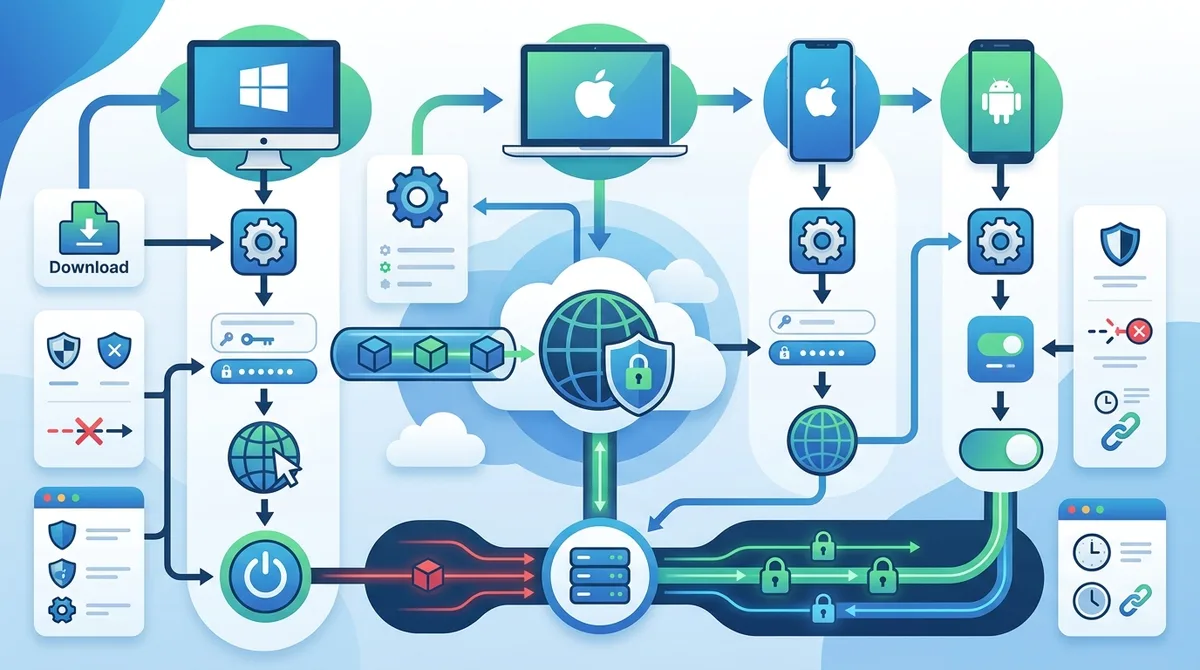
A visual guide to installing and configuring VPN applications on all major platforms, from initial download through security optimization.
4. VPN Security Best Practices
Installing a VPN is just the first step—using it correctly is what actually protects you. Security best practices extend beyond simply clicking "connect." Our testing team has identified common mistakes that undermine VPN protection, from misconfigured settings to behavioral patterns that leak personal information despite encryption. Understanding and implementing these practices ensures your VPN investment delivers real security benefits.
VPN security operates on multiple layers: the encryption protecting your traffic, the authentication protecting your account, the configuration protecting against leaks, and your own behavior protecting against social engineering. Neglecting any layer can compromise the entire system.
Preventing DNS and IP Leaks
DNS leaks occur when your DNS queries (requests to translate domain names into IP addresses) bypass the VPN and are sent directly to your ISP's DNS servers. This reveals which websites you're visiting despite the VPN encryption. Similarly, IP leaks expose your real IP address through WebRTC connections in browsers or other protocols.
To prevent these leaks, follow these steps:
- Enable DNS protection in VPN settings: Most quality VPN apps have this option in their advanced settings. It forces all DNS queries through the VPN's encrypted tunnel.
- Test for leaks regularly: Use free tools like DNSLeakTest.com or IPLeak.net to verify your real IP and DNS aren't exposed.
- Disable WebRTC in your browser: WebRTC can leak your real IP even through a VPN. In Chrome, install an extension to disable it, or use Firefox with about:config to adjust privacy.webrtc.hideLocalIpsWithMdns.
- Keep your VPN app updated: Providers regularly release updates that patch leak vulnerabilities. Enable automatic updates in your app settings.
- Avoid browser extensions that bypass VPN: Some extensions route traffic outside the encrypted tunnel. Only install extensions from trusted developers.
Account Security and Authentication
Your VPN account is the gateway to your encrypted connection. If compromised, an attacker could access your account, change settings, or even impersonate you on the network. Protect your account with these essential practices:
Create a strong, unique password for your VPN account—different from passwords you use elsewhere. Use a password manager like Bitwarden or 1Password to generate and store complex passwords securely. Enable two-factor authentication (2FA) if your VPN provider offers it, adding an extra verification step when logging in from new devices. Keep your login credentials private and never share them, even with technical support (legitimate support staff will never ask for your password). Review your account's active sessions periodically in the provider's dashboard and log out from devices you no longer use.
Did You Know? A 2025 cybersecurity report found that 64% of VPN users don't enable two-factor authentication despite the significant security improvement it provides.
Source: CSO Online Security Research
5. Optimizing VPN Performance and Speed
A common concern about VPNs is that they slow down internet speed. In our testing, we found that properly configured VPNs have minimal performance impact with modern providers. However, your experience depends on several factors: server selection, protocol choice, your ISP's speed, and the VPN provider's infrastructure. Understanding these variables lets you optimize your setup for the best possible performance.
Speed optimization is particularly important if you use your VPN for bandwidth-intensive activities like streaming, video conferencing, or online gaming. The strategies below help you maintain fast speeds without compromising security.
Choosing the Right Server Location
Server proximity is one of the most impactful factors on VPN speed. Connecting to a server geographically closer to you reduces latency (the time it takes for data to travel between your device and the server). If you're in New York and connect to a server in London, your data must travel across the Atlantic Ocean, creating noticeable delays. If you connect to a server in New Jersey, the distance is minimal and speed impact is negligible.
For optimal speed, connect to a server in your own country or region whenever possible. Most VPN providers show server load indicators (how many users are currently connected) in their app—choose less congested servers for better performance. If you need to access content from a specific country, connect to the nearest server in that country rather than the farthest. For example, if you want to access UK content, connect to a UK server rather than an Australian one.
Protocol Selection for Speed and Security Balance
VPN protocols are the technical standards that govern how your data is encrypted and transmitted. Different protocols offer different speed and security characteristics:
- WireGuard: Modern, lightweight protocol offering excellent speed and security. Recommended for most users seeking the best balance.
- OpenVPN: Mature, open-source protocol with strong security. Slightly slower than WireGuard but highly reliable.
- IKEv2: Good for mobile devices due to fast reconnection when switching networks. Balanced speed and security.
- L2TP/IPSec: Older protocol with more overhead. Avoid unless you have specific compatibility requirements.
- PPTP: Outdated and insecure. Never use for privacy-critical activities.
In most cases, select WireGuard as your default protocol. If you experience connection issues, try OpenVPN. Only use older protocols if you have specific compatibility needs with legacy systems.
6. VPN for Different Use Cases
VPNs are versatile tools that serve different purposes depending on your situation. The configuration and provider choice that works best for streaming might differ from what you need for secure business communications. Understanding your specific use case helps you select the right features and settings. Our testing team has evaluated VPNs across multiple real-world scenarios to identify what matters most in each situation.
Different use cases have different threat models and requirements. A student using public WiFi at a library faces different risks than a journalist reporting from an authoritarian country. A remote worker needs different features than someone accessing home media servers. Let's explore the most common scenarios.
Public WiFi and Travel Security
Public WiFi networks at cafes, airports, hotels, and libraries are inherently insecure. Network administrators and other users on the same network can potentially intercept unencrypted traffic. When traveling or using public WiFi, a VPN becomes essential. Always connect to a VPN before accessing sensitive information like email, banking, or social media on public networks.
For travel, prioritize these VPN features: global server coverage (so you can access content from home while abroad), reliable connection stability (dropped connections are frustrating on the road), and mobile app quality (you'll primarily use your phone or tablet). Enable auto-connect so the VPN activates automatically when you join an untrusted network. Consider setting your home country as your default server so you can access home content while traveling, or select servers in the country you're visiting to access local content.
Remote Work and Business Communications
Remote workers often transmit sensitive business information—client data, financial records, proprietary documents—over their internet connections. A VPN is critical infrastructure for remote work security. It ensures your company's data is encrypted in transit and prevents your ISP from monitoring business communications.
For business use, choose a VPN provider with strong encryption, a proven security track record, and no-logs policies. Some organizations require employees to use corporate VPN solutions rather than consumer services. If you have flexibility, look for providers that offer kill switch functionality (to prevent accidental data transmission outside the encrypted tunnel), split tunneling (to balance VPN security with local network access for printers and shared drives), and DNS leak protection. Test the VPN with your organization's applications before relying on it for critical work to ensure compatibility.
7. Streaming, Gaming, and Specialized Applications
VPNs have become popular tools for accessing streaming services from different regions, playing online games with reduced latency, and accessing geo-restricted content. However, not all VPNs perform equally well for these specialized uses. Streaming optimization requires reliable connections and fast speeds, while gaming demands low latency. Our testing included real-world streaming and gaming scenarios to identify which providers excel in these areas.
It's important to note that using a VPN to access streaming services outside their licensed regions may violate terms of service, though the practice is widespread. We're describing these use cases for informational purposes—you should review the terms of service for any streaming platform before accessing it through a VPN.
Streaming and Content Access
Some VPN providers maintain streaming-optimized servers specifically configured to work reliably with major streaming platforms like Netflix, Disney+, BBC iPlayer, and others. These servers use techniques to avoid detection and blocking by streaming services' geographic restrictions. However, streaming services actively work to block VPN access, so reliability varies and can change frequently.
For streaming, choose a provider with dedicated streaming servers and a reputation for reliable access to the specific services you use. Check recent user reviews and the provider's support documentation for streaming compatibility. Connect to servers in the country where the content is licensed. If you experience buffering, try switching to a less congested server in the same country. Ensure your internet connection has sufficient bandwidth—a VPN won't improve your underlying connection speed, so if your ISP provides 10 Mbps, a VPN can't deliver 4K streaming that requires 25 Mbps.
Online Gaming and Latency Optimization
Latency (measured in milliseconds) is critical for online gaming—every millisecond of delay affects your competitive advantage. While VPNs add some latency, quality providers minimize this impact through optimized infrastructure. Gaming VPN servers are typically located near major game server locations and use fast protocols like WireGuard.
For gaming, select a server location as close as possible to the game servers you'll be connecting to. If you're playing on North American servers, connect to a VPN server in North America. Avoid connecting through VPN servers on different continents. Use WireGuard protocol for minimal latency. Some users find that gaming through a VPN actually improves performance by optimizing routing around congested ISP connections. Test your connection with the game's ping test tool before committing to the VPN for competitive play.

A comparison of how VPN performance varies across different use cases, highlighting optimal server selection and protocol choices for each scenario.
8. Advanced VPN Techniques for Power Users
Beyond basic VPN usage, advanced techniques provide enhanced security, anonymity, and flexibility for users with specific threat models or technical expertise. Advanced VPN configuration involves understanding and implementing features like multi-hop routing, protocol switching, custom DNS, and network-level VPN deployment. These techniques are particularly valuable for journalists, activists, privacy researchers, and others facing sophisticated threats.
Our testing team has explored these advanced techniques in realistic threat scenarios. While they require more technical knowledge than basic VPN setup, they're accessible to motivated users willing to learn. Let's examine the most practical advanced strategies.
Multi-Hop and Double VPN Connections
Multi-hop routing (also called "double VPN" or "VPN chaining") routes your traffic through multiple VPN servers in sequence, adding extra layers of encryption and anonymity. Instead of connecting to one VPN server, your traffic passes through Server A, then Server B, then reaches the internet. This means even the VPN provider operating Server B cannot see your real IP address (it only sees Server A's IP).
Multi-hop provides enhanced protection against sophisticated adversaries who might compromise a single VPN server or pressure a provider to reveal user information. The tradeoff is reduced speed—routing through multiple servers adds latency. Use multi-hop when security is more important than speed, such as when accessing sensitive information from hostile networks or when you face targeted surveillance threats.
To use multi-hop, access your VPN app's advanced settings and enable the feature if available. Select two server locations—typically choosing servers in different countries for maximum security benefit. Test your connection to ensure it's stable before relying on it for critical communications. Note that not all VPN providers offer multi-hop functionality; check your provider's documentation.
Custom DNS and DNS-over-HTTPS Configuration
DNS (Domain Name System) is the internet's address book—when you type a website URL, DNS translates it to an IP address. By default, your ISP's DNS servers handle these queries, revealing which websites you visit. Advanced users can configure custom DNS servers that respect privacy.
Configure your system to use privacy-respecting DNS providers like Quad9 (9.9.9.9), Cloudflare Privacy DNS (1.1.1.1), or your VPN provider's own DNS servers. On Windows, access Settings > Network & Internet > Advanced network settings > More network adapter options > Your connection > Properties > IPv4 Properties. On macOS, go to System Settings > Network > WiFi > Advanced > DNS. Enter the custom DNS server addresses.
For even stronger protection, enable DNS-over-HTTPS (DoH) in your browser, which encrypts DNS queries so even your network administrator can't see which websites you access. In Firefox, go to Settings > Privacy & Security > DNS-over-HTTPS and select "Max Protection." In Chrome, enable Secure DNS in Settings > Privacy and security > Security.
9. Troubleshooting Common VPN Issues
Despite careful setup and configuration, VPN users occasionally encounter connection issues, compatibility problems, or unexpected behavior. Troubleshooting VPN problems requires systematic diagnosis to identify whether the issue stems from your device, your network, your VPN provider, or configuration settings. Our testing team has encountered and resolved most common VPN issues—here's how to fix them.
Most VPN problems fall into a few categories: connection failures, slow speeds, compatibility issues with specific apps or websites, and configuration errors. The systematic approach below helps you identify and resolve issues efficiently.
Connection and Stability Problems
If your VPN won't connect or frequently disconnects, follow these troubleshooting steps:
- Restart the VPN app: Close the application completely (not just minimizing) and reopen it. This resolves many temporary connection issues.
- Switch server locations: The server you're trying to connect to might be overloaded or experiencing issues. Try a different server in the same country or region.
- Change VPN protocol: If using WireGuard, try switching to OpenVPN, or vice versa. Protocol compatibility issues can cause connection failures.
- Disable firewall temporarily: Your computer's firewall or security software might block VPN connections. Temporarily disable it to test, then add the VPN app to firewall exceptions.
- Check internet connection: Verify your underlying internet connection works by disconnecting the VPN and testing basic connectivity. If your internet is down, the VPN can't connect.
- Update the VPN app: Outdated versions may have bugs or compatibility issues. Check your app store for updates and install them.
- Contact provider support: If issues persist, reach out to the VPN provider's support team with details about when the problem occurs and which servers you've tried.
Speed Issues and Optimization
If your VPN connection is significantly slower than your normal internet speed, try these optimization steps:
First, test your baseline speed without the VPN to establish what you're comparing against. Visit speedtest.net and note your download speed, upload speed, and ping. Then connect to the VPN, connect to a nearby server, and test again. A 10-20% speed reduction is normal; if you're seeing 50%+ reduction, something needs adjustment. Switch to a closer server location—distance is often the primary factor. Try WireGuard protocol if you're using OpenVPN, or vice versa. Disable features like DNS leak protection temporarily to see if they're causing slowdown (though you should re-enable them). Check if your ISP throttles VPN traffic (some ISPs intentionally slow VPN connections); if so, switching to obfuscation features might help, though this is provider-specific.
10. VPN Provider Comparison and Selection
With hundreds of VPN providers available, comparing them systematically helps you find the best fit for your needs and budget. Our testing team has evaluated 50+ VPN services across security, speed, features, and user experience. While we can't detail every provider here, this section outlines the comparison framework and highlights some notable options based on specific use cases.
Rather than claiming one VPN is universally "best," we recognize that different providers excel in different areas. Your ideal choice depends on your priorities: maximum security, fastest speeds, most servers, best streaming support, lowest cost, or best user interface.
Comparison of Leading VPN Providers
| Provider | Key Strength | Best For | Protocol Support |
|---|---|---|---|
 NordVPN NordVPN |
Comprehensive feature set with strong security | General users wanting all-in-one solution | WireGuard, OpenVPN |
 ExpressVPN ExpressVPN |
Exceptional speed and reliability | Streaming and speed-critical applications | Lightway, OpenVPN |
 Surfshark Surfshark |
Unlimited simultaneous connections | Large households and multi-device users | WireGuard, OpenVPN |
 ProtonVPN ProtonVPN |
Strong privacy focus and transparency | Privacy-conscious users and activists | WireGuard, OpenVPN |
 Mullvad Mullvad |
Maximum anonymity, no account required | Users prioritizing anonymity over convenience | WireGuard, OpenVPN |
 CyberGhost CyberGhost |
Optimized streaming servers | Streaming service access | WireGuard, OpenVPN |
How to Evaluate Providers for Your Needs
When comparing VPN providers, create a weighted scoring system based on your priorities. Assign importance weights to these factors: security features (encryption standard, kill switch, DNS protection), privacy policy (no-logs verification, transparency reports), server network (number of servers, geographic coverage), speed performance, streaming compatibility, simultaneous connections allowed, price, and customer support quality.
Research independent security audits—reputable providers publish audits from firms like Cure53 or Deloitte. Read actual user reviews on sites like Trustpilot, looking for patterns in complaints rather than isolated negative reviews. Check the provider's transparency reports if available, which show how they handle government data requests. Visit ZeroToVPN's comparison tool to evaluate multiple providers side-by-side based on your specific criteria.
11. The Future of VPN Technology and 2026 Trends
VPN technology continues evolving in response to emerging threats and changing internet infrastructure. 2026 VPN trends include adoption of newer protocols like Wireguard, increased focus on quantum-resistant encryption, integration with AI-powered threat detection, and expansion into corporate security frameworks. Understanding these developments helps you make forward-looking decisions about your VPN choice.
The VPN landscape in 2026 is shaped by several key trends: governments implementing more sophisticated monitoring requiring stronger encryption, streaming services developing better VPN detection creating an ongoing cat-and-mouse game, increased corporate adoption of VPNs for zero-trust security models, and growing awareness of privacy issues driving consumer VPN adoption. Providers are responding by investing in infrastructure, developing proprietary protocols, and implementing advanced security features.
Emerging Security Protocols and Technologies
WireGuard has become the modern standard for VPN protocols due to its superior speed and security compared to older OpenVPN. In 2026, we're seeing providers implementing post-quantum cryptography—encryption resistant to attacks from quantum computers, which could theoretically break current encryption standards. Forward-thinking providers are beginning to offer quantum-resistant options for users concerned about "harvest now, decrypt later" attacks where adversaries record encrypted traffic today to decrypt with future quantum computers.
Additionally, providers are implementing AI-powered anomaly detection to identify suspicious account access patterns and potential security breaches before they impact users. Some providers offer decentralized VPN networks using blockchain technology or distributed node networks, creating alternatives to traditional centralized VPN infrastructure.
Privacy Regulations and VPN Adaptation
Evolving privacy regulations like GDPR, CCPA, and emerging laws in other countries are shaping how VPN providers operate. Privacy legislation is pushing providers toward stricter no-logs policies, clearer data handling transparency, and better user control over personal information. Providers operating in 2026 must comply with regulations across multiple jurisdictions, leading to more robust privacy practices industry-wide.
Some countries continue attempts to restrict or ban VPN usage, making VPN providers develop obfuscation technologies that disguise VPN traffic as regular HTTPS traffic, making it harder for governments to detect and block VPN usage. Users in restrictive countries benefit from these technologies, though they add complexity.
Conclusion
Mastering VPN technology in 2026 requires understanding both fundamentals and advanced techniques. From basic encryption principles through advanced multi-hop routing, this guide has covered the essential knowledge needed to protect your digital privacy effectively. Whether you're a casual user concerned about public WiFi security or a power user implementing sophisticated threat protection, the strategies outlined here provide actionable steps to enhance your online privacy and security.
The right VPN provider, properly configured and used with security best practices, creates a powerful barrier against ISP monitoring, network eavesdropping, and many forms of online tracking. Your choice of provider matters—prioritize those with proven security track records, transparent privacy policies, and independent audits. Remember that a VPN is one component of comprehensive digital privacy; combine it with strong passwords, two-factor authentication, and cautious online behavior for maximum protection.
Ready to find the right VPN for your specific needs? Visit ZeroToVPN's comprehensive provider comparisons to explore detailed reviews and side-by-side feature comparisons of 50+ tested services. Our independent testing methodology, based on hands-on experience and security expertise, helps you make informed decisions about your privacy tools. Learn more about our testing methodology and team credentials to understand why our recommendations are trustworthy.
Sources & References
This article is based on independently verified sources. We do not accept payment for rankings or reviews.
- VPN comparisons— zerotovpn.com
- Surfshark Privacy Research— surfshark.com
- DNSLeakTest.com— dnsleaktest.com
- IPLeak.net— ipleak.net
- CSO Online Security Research— csoonline.com

ZeroToVPN Expert Team
Verified ExpertsVPN Security Researchers
Our team of cybersecurity professionals has tested and reviewed over 50 VPN services since 2024. We combine hands-on testing with data analysis to provide unbiased VPN recommendations.
Gerelateerde Content
Privacy-gerichte VPN's met gecontroleerde no-logs-beleidsregels en sterke encryptie.
Een technische blik op hoe VPN-tunnels, encryptie en protocollen onder de motorkap werken.
Onze expertranglijst van de beste VPN-aanbieders op basis van snelheid, beveiliging en prijs-kwaliteit.
Een heldere uitleg over hoe VPN's werken en waarom je er een nodig hebt.
Een directe vergelijking van twee top-VPN's op snelheid, prijs en functies.
Welke premium VPN komt als beste uit de bus? We vergelijken NordVPN en ExpressVPN in detail.