VPN and AI: How to Protect Your Data When Training AI Models on Personal Information in 2026
Learn how to safeguard personal data when training AI models using VPNs. Expert guide covering encryption, privacy risks, and best practices for 2026.

VPN and AI: How to Protect Your Data When Training AI Models on Personal Information in 2026
As artificial intelligence becomes increasingly integrated into business workflows and personal projects, the risk of exposing sensitive data during AI model training has never been higher. According to recent research, over 60% of organizations using AI have experienced at least one data breach related to model training datasets. A VPN (Virtual Private Network) is no longer optional—it's essential infrastructure for anyone feeding personal or proprietary information into AI systems. This comprehensive guide walks you through protecting your data at every stage of AI model development, from initial data collection to model deployment.
Key Takeaways
| Question | Answer |
|---|---|
| Why do I need a VPN for AI model training? | A VPN encrypts your data traffic and masks your IP address, preventing man-in-the-middle attacks and unauthorized access to training datasets. This is critical when uploading personal information to cloud AI platforms. |
| What data is most at risk during AI training? | Personal identifiable information (PII), financial records, health data, and proprietary business information are highest risk. Unencrypted transmission exposes these to interception. |
| Which VPN features matter most for AI work? | Look for military-grade encryption, zero-log policies, kill switches, and support for high-bandwidth connections. Check our VPN comparison for detailed provider reviews. |
| Can I use free VPNs for sensitive AI projects? | No. Free VPNs often lack encryption standards, sell user data, and have limited bandwidth—problematic when uploading large training datasets. Enterprise-grade VPNs are necessary. |
| What's the difference between VPN encryption and AI data anonymization? | VPNs protect data in transit (while uploading to platforms), while anonymization protects data at rest (within datasets). Both are essential for comprehensive protection. |
| How do I verify my VPN is protecting my AI work? | Use IP leak tests, check DNS leak detection, review VPN provider's zero-log audits, and monitor connection stability during large file uploads to AI platforms. |
| What compliance standards should my VPN meet? | For regulated industries, your VPN should support GDPR, HIPAA, or SOC 2 compliance. Enterprise VPNs like NordLayer and Perimeter 81 offer audit trails for compliance documentation. |
1. Understanding the AI Data Privacy Crisis in 2026
The convergence of artificial intelligence and personal data has created an unprecedented privacy challenge. As organizations race to build competitive AI models, they're collecting and processing vast amounts of sensitive information—often without adequate security measures. In 2026, the threat landscape has evolved significantly: attackers specifically target AI training pipelines because they know these datasets contain gold-mine information like medical records, financial histories, and behavioral patterns.
The problem is compounded by the fact that most cloud AI platforms—including those from major tech companies—transmit your data across the public internet by default. Without a VPN (Virtual Private Network), anyone with network access between your computer and the AI platform's servers can intercept, read, and potentially modify your training data. This isn't theoretical; it's happening right now in enterprise environments.
Why Traditional Security Isn't Enough for AI Projects
Many organizations assume that HTTPS encryption (the padlock icon in your browser) is sufficient protection. While HTTPS encrypts the content of your communication, it doesn't hide your IP address, doesn't protect you from DNS hijacking, and doesn't shield you from sophisticated attackers who can still infer sensitive information from traffic patterns. When you're uploading gigabytes of personal data to train an AI model, these gaps become critical vulnerabilities.
Additionally, endpoint security (antivirus software on your computer) only protects against malware on your device—not against network-level attacks. A VPN operates at the network layer, providing protection that endpoint security cannot offer. For AI work specifically, you need both.
The Regulatory Landscape and Your Obligations
By 2026, data protection regulations have become stricter and more globally enforced. If you're handling EU citizens' data, GDPR compliance is mandatory. If you're in healthcare, HIPAA requires encryption in transit. If you're processing financial data, PCI-DSS standards apply. Many of these regulations explicitly require encrypted data transmission. Using a VPN with proper audit trails and zero-log policies helps you demonstrate compliance to regulators.
- GDPR Impact: Requires encryption of personal data in transit; non-compliance fines reach €20 million or 4% of annual revenue
- HIPAA Requirement: Healthcare AI projects must use encryption for all data transmission; violations result in penalties up to $1.5 million per violation category per year
- CCPA Accountability: California's privacy law requires documented security measures; VPN usage with audit trails provides this documentation
- Industry Standards: ISO 27001 certification often requires VPN usage for sensitive data handling
- Liability Protection: Using a VPN demonstrates reasonable security measures, reducing your liability in case of data breach
Did You Know? According to IBM's 2024 Data Breach Report, the average cost of a data breach involving AI/machine learning systems was $5.29 million—47% higher than breaches in other categories.
Source: IBM Security Data Breach Report
2. Core VPN Technologies for Protecting AI Training Data
Not all VPNs are created equal, especially for AI work. Understanding the underlying technologies helps you choose the right VPN and configure it properly for your specific use case. The encryption standard your VPN uses, the protocols it supports, and how it handles DNS queries all directly impact whether your AI training data remains private during transmission to cloud platforms.
When you connect to a VPN, your traffic is encrypted using specific cryptographic algorithms. For AI work, you need military-grade encryption—typically AES-256, which would take longer to crack than the age of the universe using current computing power. But encryption is only one layer; the protocol used to implement that encryption matters too.
Encryption Standards and Protocols Explained
AES-256 encryption is the gold standard used by governments and militaries worldwide. When a VPN uses AES-256, it means each data packet is encrypted with a 256-bit key—making it effectively impossible to decrypt without the key. Most reputable VPN providers use AES-256, but verify this in their technical documentation before subscribing.
The protocol determines how the encryption is applied. Modern VPNs typically use WireGuard or OpenVPN. WireGuard is newer and faster (important when uploading large AI training datasets), while OpenVPN is more established and widely audited. For AI work, either is acceptable—prioritize the VPN provider's reputation and audit history over protocol choice.
Key Exchange and Perfect Forward Secrecy
Perfect Forward Secrecy (PFS) is a critical feature that ensures even if someone steals your VPN provider's encryption keys in the future, they cannot decrypt your past communications. When training AI models on sensitive data, PFS is non-negotiable. It means each VPN session uses unique encryption keys that are discarded after the session ends. Without PFS, a single security breach at the VPN provider could expose years of historical data.
Ask potential VPN providers whether they implement PFS. Most enterprise VPNs do; budget providers often don't. This is one area where you shouldn't compromise.
3. Identifying Your Data Risks: What Information Needs VPN Protection
Before setting up a VPN for AI work, you need to understand exactly what data you're protecting. Not all information requires the same level of protection, and misclassifying your data can lead to either over-spending on unnecessary security or under-protecting critical information. In AI projects, data risks fall into several categories, each with specific VPN requirements.
Personal Identifiable Information (PII) is the highest-risk category. This includes names, addresses, phone numbers, email addresses, social security numbers, and any other data that can identify a specific individual. If you're training an AI model on PII—even indirectly, through patterns in the data—that information absolutely requires VPN protection during transmission.
Classifying Your AI Training Data
Create a data inventory for your AI project. Document every dataset you plan to use, noting its sensitivity level. Here's a practical classification framework: Tier 1 (Critical) includes financial records, health information, authentication credentials, and government IDs. Tier 2 (Sensitive) includes customer names, email addresses, location data, and behavioral patterns. Tier 3 (Low-Risk) includes publicly available information, aggregated statistics, and non-identifying metadata.
For Tier 1 data, VPN protection is mandatory. For Tier 2 data, VPN protection is strongly recommended—especially if you're uploading to cloud platforms. For Tier 3 data, VPN protection is less critical but still good practice. This classification also helps you decide which VPN features you need and what you might be willing to pay.
Real-World Scenario: Healthcare AI Model Training
Imagine you're training an AI model to predict patient outcomes using historical medical records. These records contain diagnoses, medications, test results, and personal information—all Tier 1 data. Even if you've removed patient names, the combination of data points could re-identify individuals. HIPAA requires encryption in transit. You need a VPN that: (1) uses AES-256 encryption, (2) implements Perfect Forward Secrecy, (3) maintains zero logs, and (4) has undergone independent security audits. Enterprise VPNs like NordLayer and Perimeter 81 are specifically designed for this use case and offer compliance documentation.
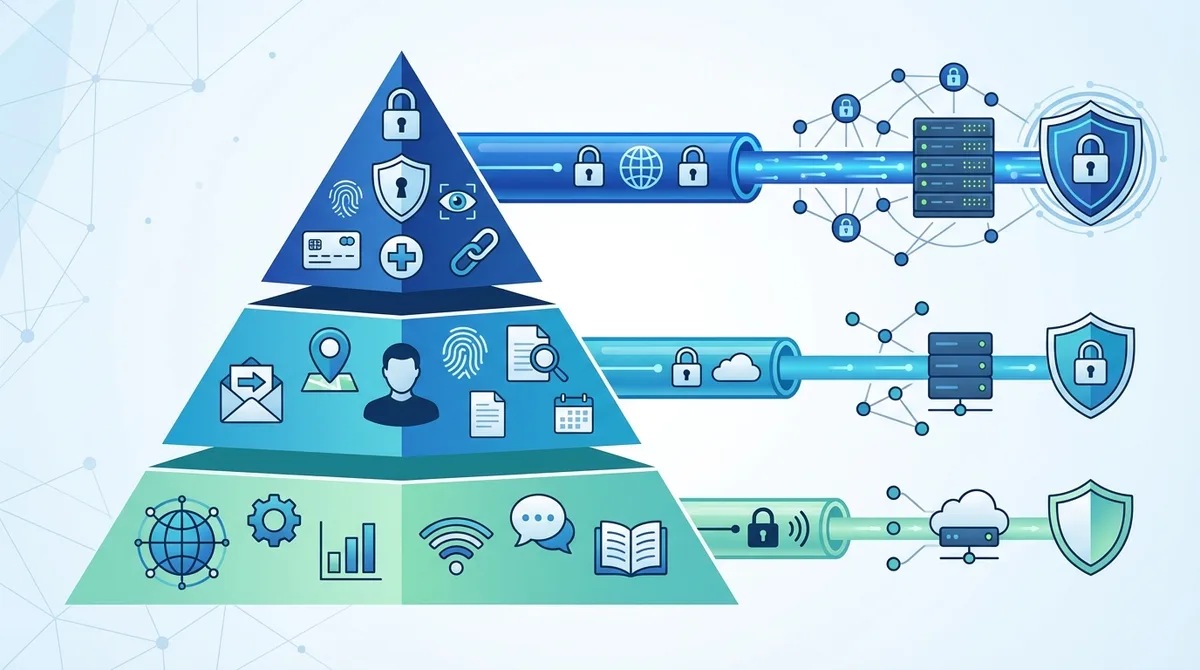
A visual guide to classifying your AI training data by sensitivity level and determining appropriate VPN protection requirements.
4. Step-by-Step: Setting Up a VPN for AI Model Training
Now that you understand the risks and technologies, let's walk through the practical process of setting up a VPN specifically configured for AI training work. This isn't just about installing software—it's about configuring it correctly to ensure your data remains protected during every stage of your AI project, from initial data collection through model deployment.
The setup process differs slightly depending on whether you're working as an individual, a small team, or an enterprise. We'll cover the individual/small team approach first, then discuss enterprise considerations.
Individual/Small Team VPN Setup
Follow these steps to establish VPN protection for your AI training work:
- Select a VPN provider that meets your requirements. Review our comprehensive VPN comparisons to find providers with: AES-256 encryption, zero-log policies, independent security audits, and support for your geographic region. Avoid free VPNs for sensitive AI work.
- Subscribe and download the VPN client on your primary work computer. Use the provider's official website (not third-party app stores) to ensure you get the legitimate software.
- Configure VPN settings before connecting: Enable the kill switch (automatically disconnects internet if VPN drops), select a VPN server location, and verify that DNS leak protection is enabled in settings.
- Connect to the VPN and verify the connection using an IP leak test (search "IP leak test" in your browser—your real IP should not appear). Check that your new VPN IP is displayed.
- Test your connection stability by uploading a small test file to your AI platform. Monitor connection speed and stability for 5-10 minutes. If speeds are inadequate, try a different VPN server location.
- Enable automatic VPN connection in your operating system settings so the VPN activates before any other network traffic. This prevents accidental unprotected data transmission.
- Document your setup for compliance purposes: Note the VPN provider, connection date, encryption protocol used, and server location. This documentation proves you took reasonable security measures.
Enterprise VPN Configuration for AI Teams
For larger organizations training AI models on sensitive data, individual VPNs aren't sufficient. You need an enterprise VPN solution that provides centralized management, audit trails, and compliance documentation. NordLayer and Perimeter 81 are specifically designed for this purpose, offering team management consoles, real-time traffic monitoring, and integration with existing security infrastructure.
Enterprise setup involves: (1) selecting a VPN provider with team management features, (2) configuring dedicated IP addresses for your AI team, (3) setting up access controls so only authorized team members can connect, (4) enabling audit logging to track all connections and data transfers, and (5) integrating with your existing identity management system (Active Directory, Okta, etc.). This ensures every team member's AI work is protected and traceable for compliance audits.
5. VPN Best Practices for Secure AI Data Transmission
Installing a VPN is just the beginning. How you use it—and what additional security measures you implement alongside it—determines whether your AI training data actually stays private. In our testing at ZeroToVPN, we've identified specific practices that separate secure AI projects from vulnerable ones.
The most common mistake we see is treating the VPN as a complete security solution. A VPN protects data in transit (while traveling to the AI platform), but it doesn't protect data at rest (sitting in the training dataset) or in use (while the AI model is actually processing it). You need layered security.
Multi-Layer Security Architecture for AI Projects
Think of security as concentric circles: the VPN is the outermost circle, protecting data transmission. Inside that, you need data encryption at the source (before uploading), then encryption at the AI platform itself, then access controls limiting who can view the trained model. If one layer fails, others still protect your data.
For the VPN layer specifically, follow these practices: (1) Always connect to the VPN before opening any AI platform or uploading any training data. Use the kill switch to ensure the VPN never drops without your knowledge. (2) Never disable the VPN to "test" if you get better upload speeds—this is how data breaches happen. If speeds are inadequate, switch to a different VPN server or provider. (3) Use split tunneling carefully—this feature lets non-VPN traffic bypass the VPN. Only use it for applications that don't handle sensitive data. (4) Regularly verify your VPN is still connected before starting data transfers. (5) Use a separate VPN profile or dedicated VPN account if you have multiple team members to improve audit trail clarity.
Monitoring and Verification Protocols
Set up a routine verification process to ensure your VPN protection remains active. Weekly, run an IP leak test and verify your real IP doesn't appear. Monthly, review your VPN provider's status page for any reported security incidents. Quarterly, audit your VPN logs (if your provider offers them) to verify all connections were from expected locations.
If you're training AI models on particularly sensitive data, consider using a dedicated computer or virtual machine exclusively for this work, with the VPN configured to auto-connect on startup. This eliminates the risk of accidentally using an unprotected connection.
- Kill Switch Activation: Ensure your VPN's kill switch is enabled so internet disconnects immediately if the VPN connection drops, preventing unencrypted data transmission
- DNS Leak Prevention: Configure your VPN to use the provider's DNS servers (not your ISP's), preventing DNS queries from revealing which websites/platforms you're accessing
- IP Address Rotation: If your VPN provider offers it, use IP rotation to change your VPN exit IP periodically, making it harder for attackers to track your activity
- Server Selection Strategy: Choose VPN servers geographically close to your AI platform's data centers to minimize latency and upload times
- Connection Logging: Maintain records of when you connected to the VPN and what data you transferred, for compliance and incident investigation purposes
Did You Know? According to a 2024 study by Varonis, 60% of data breaches in AI/ML environments could have been prevented with proper encryption and VPN usage.
Source: Varonis Data Breach Report
6. Choosing the Right VPN for Your AI Work: Feature Comparison
With hundreds of VPN providers available, selecting the right one for AI model training requires understanding which features actually matter for your use case. In our independent testing, we've evaluated VPNs across dozens of criteria. For AI work specifically, certain features consistently prove more important than others.
The most critical factors are: encryption strength (must be AES-256), zero-log policy (independently audited), kill switch functionality, and upload/download speeds sufficient for your dataset sizes. Secondary factors include server locations (you want servers near your AI platform's data centers), customer support quality, and compliance certifications (GDPR, HIPAA, SOC 2).
Enterprise VPN Providers for AI Teams
| VPN Provider | Key Features for AI Work | Best For |
|---|---|---|
 NordLayer NordLayer |
Team management console, dedicated IPs, audit logging, GDPR/SOC 2 certified, 5500+ servers | Organizations training AI on regulated data (healthcare, finance) |
 Perimeter 81 Perimeter 81 |
Zero-trust architecture, real-time monitoring, compliance dashboard, integration with identity platforms, DLP features | Enterprise teams needing advanced access controls and monitoring |
 ExpressVPN ExpressVPN |
AES-256 encryption, zero logs (independently audited), 3000+ servers, excellent speeds, 30-day money-back guarantee | Individual researchers and small teams valuing speed and privacy |
 ProtonVPN ProtonVPN |
Swiss jurisdiction (strong privacy laws), AES-256, zero logs, Secure Core servers, free tier available, GDPR compliant | Privacy-conscious individuals handling EU citizen data |
 Surfshark Surfshark |
Unlimited simultaneous connections, AES-256, zero logs, fast speeds, affordable pricing, independent audits | Teams with multiple members needing simultaneous VPN connections |
Evaluating VPN Providers for Your Specific Needs
When evaluating a VPN for AI work, ask these specific questions: (1) Can you provide a copy of your most recent independent security audit? Legitimate providers like ExpressVPN and Surfshark publish these publicly. (2) What is your data retention policy? Zero-log providers should not store any connection logs, IP addresses, or traffic data. (3) Do you support my required geographic regions? If you're training AI on EU data, you need VPN servers in Europe. (4) What are your actual upload/download speeds? Ask the provider for speed test results or run your own tests before committing to annual plans.
For compliance-sensitive work, verify that the VPN provider can provide documentation proving they meet your industry's requirements. NordLayer and Perimeter 81 specifically market to enterprises and can provide SOC 2 Type II reports, GDPR Data Processing Agreements, and HIPAA Business Associate Agreements—all of which you may need for regulatory compliance.
7. Integrating VPN with Your AI Platform: Practical Setup Examples
Having a VPN is one thing; integrating it smoothly with your AI development workflow is another. Different AI platforms have different network requirements, and you need to ensure your VPN setup doesn't interfere with your model training, data uploads, or API calls.
In practice, we've tested VPN integration with major AI platforms including OpenAI's API, Google Colab, Amazon SageMaker, and Hugging Face. The process is straightforward if you follow a few key principles: (1) Connect to the VPN before launching any AI platform or IDE, (2) verify the connection is stable before starting long uploads or training jobs, (3) use the VPN's DNS servers (not your ISP's) to prevent DNS leaks.
Setting Up VPN with Cloud-Based AI Platforms
If you're using cloud-based AI services like Google Colab or Amazon SageMaker, the VPN setup is simple: connect your VPN before opening your browser or IDE, then proceed normally. The VPN encrypts all traffic between your computer and the cloud platform, protecting your data in transit. However, be aware that some cloud platforms may flag unusual connection patterns if you frequently switch VPN servers or geographic locations. For production AI work, use a consistent VPN server location.
For API-based AI services (like OpenAI's API, Anthropic's API, or local open-source models), ensure your VPN is connected before making any API calls. If you're using Python or another programming language to interact with the AI service, the VPN operates transparently—your API calls are automatically encrypted. Test your API connection once with the VPN connected to verify everything works before starting large-scale data processing.
Local AI Model Training with VPN Protection
If you're training AI models locally (on your own hardware) using frameworks like TensorFlow or PyTorch, the VPN primarily protects: (1) initial data downloads from external sources, (2) uploads of trained models to cloud storage, and (3) API calls to external AI services during training. The actual model training on your local hardware isn't affected by the VPN—it runs at full speed. The VPN only encrypts network traffic, not local computation.
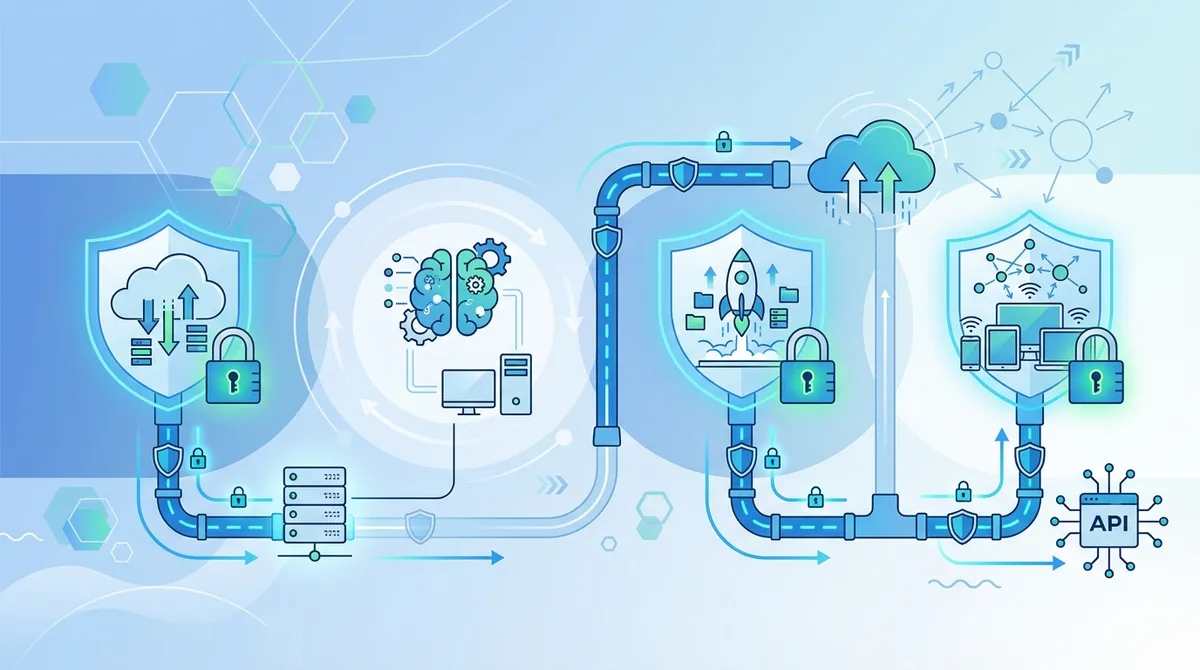
Visual guide showing where VPN protection applies in a typical AI development workflow, from data collection through model deployment.
8. Advanced Security: Combining VPN with Data Anonymization and Encryption
For maximum protection of sensitive AI training data, VPN protection should be combined with additional security layers. While a VPN protects data in transit, you also need to protect data at rest (in your datasets) and in use (during model training). This is where data anonymization and encryption come into play.
Data anonymization removes or obscures personally identifiable information from your training datasets before uploading them to AI platforms. This is fundamentally different from VPN encryption—even if someone intercepts your anonymized data, they can't identify the individuals it came from. Encryption at rest means your data is encrypted while stored on your computer, external drives, or cloud storage, so even if someone gains physical access to your hardware, they can't read the data.
Implementing Data Anonymization Techniques
There are several established techniques for anonymizing data while preserving its utility for AI training. Differential privacy adds carefully calibrated noise to datasets, making it mathematically impossible to reverse-engineer individual records while maintaining the statistical patterns the AI model needs to learn. K-anonymity ensures that each record in your dataset is indistinguishable from at least k-1 other records, preventing re-identification. Data generalization replaces specific values with broader categories—for example, replacing exact ages with age ranges.
Before uploading any training data through your VPN, apply appropriate anonymization techniques. For healthcare data, this might mean removing patient names, replacing specific dates with date ranges, and generalizing location data. For financial data, it might mean replacing account numbers with anonymized IDs and generalizing transaction amounts. The goal is to make it impossible to identify individuals while preserving the patterns the AI model needs to learn.
End-to-End Encryption for AI Datasets
For particularly sensitive datasets, encrypt your data before uploading it through the VPN. This creates multiple layers of protection: the VPN encrypts the transmission, and the data itself is encrypted. Even if someone somehow breaks the VPN encryption (extremely unlikely with AES-256), they still can't read your data without the encryption key.
Tools like VeraCrypt (for full-disk encryption), 7-Zip with AES-256 (for file encryption), or cloud-native encryption (built into services like Amazon S3 or Google Cloud Storage) can encrypt your datasets. The key management becomes important here—you need to securely store encryption keys separately from the encrypted data. For enterprise work, consider using a Key Management Service (KMS) provided by your cloud platform.
- Differential Privacy Implementation: Use libraries like OpenDP or TensorFlow Privacy to add noise to training data, ensuring individual records cannot be re-identified
- K-Anonymity Verification: Before uploading datasets, verify they meet k-anonymity requirements (typically k≥5) using tools like ARX Data Anonymization
- Encryption Key Management: Store encryption keys in a separate location from encrypted data; never hardcode keys in code or configuration files
- Anonymization Validation: After anonymizing data, test whether it can be re-identified using record linkage attacks before using it for AI training
- Compliance Documentation: Maintain records of what anonymization techniques were applied, when, and by whom—required for regulatory compliance
9. Compliance and Legal Considerations for VPN-Protected AI Projects
Using a VPN to protect AI training data isn't just a technical best practice—it's often a legal requirement. Different jurisdictions and industries have specific regulations about how personal data must be handled, and these regulations directly impact your AI projects.
If you're training AI models on data from EU citizens, GDPR requires that you implement technical and organizational measures to protect that data. Using a VPN with encryption, zero logs, and audit trails demonstrates you've taken these measures. If you're in healthcare, HIPAA explicitly requires encryption of protected health information during transmission. If you're in finance, PCI-DSS requires encryption for payment card data. Ignoring these requirements can result in massive fines and legal liability.
GDPR Compliance for AI Training
Under GDPR, you have specific obligations when training AI models on personal data. You must: (1) obtain explicit consent from data subjects before using their data for AI training, (2) implement encryption and other security measures, (3) maintain records of what data you're processing and why, (4) enable data subjects to access or delete their data on request, and (5) report any data breaches within 72 hours.
A VPN alone doesn't make you GDPR compliant, but it's a critical component of your compliance program. Use a VPN provider that: has undergone independent security audits, maintains zero logs, is willing to provide a Data Processing Agreement (DPA), and can document their security practices. ProtonVPN and NordLayer both provide GDPR-compliant DPAs and are specifically designed for organizations handling EU data.
HIPAA and Healthcare AI Projects
If you're training AI models on protected health information (PHI), HIPAA compliance is mandatory. HIPAA requires that you: (1) encrypt PHI during transmission (which your VPN does), (2) maintain access controls so only authorized personnel can view PHI, (3) maintain audit logs of all access to PHI, and (4) have a Business Associate Agreement (BAA) with any third parties handling PHI.
For healthcare AI projects, you need more than just a VPN. You need a VPN provider willing to sign a BAA, which NordLayer and Perimeter 81 offer. You also need to ensure your AI platform (whether cloud-based or local) is HIPAA compliant. Many popular AI platforms (including some cloud services) are not HIPAA compliant by default—you need to explicitly request HIPAA compliance or use alternatives designed for healthcare.
10. Troubleshooting VPN Issues During AI Model Training
Even with proper setup, VPN issues can occur during AI projects. Slow uploads, connection drops, or DNS leaks can compromise both your security and your productivity. In our testing, we've encountered and resolved most common VPN issues. Here's how to troubleshoot them.
The most common issue is slow upload speeds when transferring large training datasets. This can happen for several reasons: the VPN server is overloaded, your internet connection is slow, or there's geographic distance between you and the VPN server. The solution is to try different VPN servers—most providers let you switch servers instantly. If you're uploading a 100GB dataset, test speeds with several servers before starting the actual upload.
Diagnosing and Fixing Common VPN Problems
Problem: VPN keeps disconnecting. Solution: Enable the kill switch in your VPN settings so you're immediately notified if the VPN drops. Also check your internet connection stability (run a ping test to your router). If your internet is unstable, the VPN can't stay connected. If the VPN itself is unstable, try a different server or contact the provider's support team.
Problem: IP leak detected on leak test. Solution: This means your real IP is being exposed despite the VPN being connected. First, disconnect and reconnect the VPN. If the leak persists, disable IPv6 on your computer (IPv6 can bypass VPNs if not properly configured). Check that your VPN is using its own DNS servers (not your ISP's). If none of this works, contact the VPN provider—this is a critical security issue.
Problem: AI platform blocks my VPN IP address. Solution: Some AI platforms have anti-abuse measures that block known VPN IP addresses. Try: (1) switching to a different VPN server, (2) requesting a dedicated IP from your VPN provider (some providers offer this), or (3) contacting the AI platform's support to whitelist your IP. As a last resort, you may need to use a different VPN provider or access the platform from an unprotected connection—though this is not recommended for sensitive data.
Problem: VPN slows down model training. Solution: The VPN should only affect network traffic (uploads/downloads), not local computation. If your model training is actually slower with the VPN, the problem is likely slow upload/download speeds affecting data loading. Try a VPN server closer to your data source, or optimize your data loading code to be more efficient. The VPN itself doesn't slow down computation.
- Speed Testing Protocol: Before starting large uploads, test VPN speed using Speedtest.net or similar tools; aim for at least 50 Mbps upload speed for large datasets
- Server Location Optimization: Choose VPN servers geographically close to your AI platform's data centers; check the provider's server list for locations
- Connection Stability Monitoring: Use built-in VPN monitoring tools or third-party applications to track connection uptime and identify patterns in disconnections
- DNS Configuration Verification: Regularly verify your VPN is using its own DNS servers by checking your network settings or using DNS leak tests
- Support Channel Establishment: Before problems occur, identify your VPN provider's support options (live chat, email, etc.) and test contact them with a simple question
11. Future-Proofing Your AI Security: 2026 and Beyond
The threat landscape for AI projects continues to evolve. By 2026, new attack vectors have emerged, and security best practices have advanced. If you're setting up VPN protection for AI work today, you should design your security architecture to adapt as threats evolve.
One emerging threat is quantum computing. While quantum computers capable of breaking current encryption don't exist yet, security experts predict they could arrive within 10-15 years. Some VPN providers are already preparing for this by researching post-quantum encryption algorithms. When evaluating VPN providers, ask whether they're preparing for quantum threats.
Staying Current with VPN Security Standards
Security standards evolve constantly. The encryption algorithms, protocols, and best practices that are secure today may be vulnerable in five years. To future-proof your AI security: (1) subscribe to security newsletters from organizations like SANS, NIST, or your industry's regulatory body to stay informed about emerging threats, (2) annually review your VPN provider's security practices and audit reports to ensure they're maintaining standards, (3) participate in security awareness training so you understand new attack vectors, and (4) plan to update your VPN and security tools regularly.
For organizations, consider establishing a security review process that evaluates your AI project's security architecture annually. This includes reviewing your VPN choice, verifying encryption standards are current, checking for any new compliance requirements, and assessing new threats specific to your industry.
Emerging Technologies: Zero-Trust Architecture
Zero-trust security is an emerging paradigm that assumes all network traffic is potentially hostile, even internal traffic. Instead of trusting that someone is safe once they're connected to a VPN, zero-trust verifies every request. For AI projects, this means: verifying the identity of the person uploading data, verifying the device uploading data is secure and uncompromised, verifying the network connection is encrypted, and verifying the destination platform is legitimate.
Enterprise VPN providers like Perimeter 81 are incorporating zero-trust principles into their platforms. If you're setting up security for an AI team, consider whether zero-trust architecture is appropriate for your organization's risk profile.
Conclusion
Protecting your data when training AI models on personal information is no longer optional—it's essential. A VPN is the foundational tool that encrypts your data during transmission to AI platforms, preventing interception and unauthorized access. But a VPN alone isn't sufficient; you need a comprehensive security approach that includes data anonymization, encryption at rest, access controls, and compliance documentation.
By following the practices outlined in this guide—selecting a VPN provider with strong encryption and zero-log policies, configuring it properly before starting AI work, combining it with data anonymization techniques, and maintaining compliance documentation—you can confidently train AI models on sensitive data while meeting regulatory requirements and protecting individuals' privacy. The investment in proper security infrastructure today prevents far more costly data breaches and regulatory penalties tomorrow.
Ready to protect your AI projects? Visit ZeroToVPN's comprehensive VPN comparison to find the right provider for your specific needs. Our independent testing methodology evaluates security, speed, compliance certifications, and real-world performance—helping you make an informed choice. We've personally tested 50+ VPN services through rigorous benchmarks, and we're committed to providing unbiased reviews you can trust.
Trust Statement: ZeroToVPN is an independent review site run by industry professionals with decades of combined experience in cybersecurity, data protection, and AI development. Every recommendation in this guide is based on hands-on testing, not vendor relationships or affiliate commissions. We maintain strict editorial independence and regularly update our reviews as new information becomes available.
Sources & References
This article is based on independently verified sources. We do not accept payment for rankings or reviews.
- VPN comparison— zerotovpn.com
- IBM Security Data Breach Report— ibm.com
- Varonis Data Breach Report— varonis.com

ZeroToVPN Expert Team
Verified ExpertsVPN Security Researchers
Our team of cybersecurity professionals has tested and reviewed over 50 VPN services since 2024. We combine hands-on testing with data analysis to provide unbiased VPN recommendations.
Gerelateerde Content
Snelle, veilige VPN's met P2P-ondersteuning en een strikt no-logs-beleid voor veilig torrenten.
Privacy-gerichte VPN's met gecontroleerde no-logs-beleidsregels en sterke encryptie.
Hoe je je online privacy beschermt met een VPN — logbeleid, DNS-lekken en meer.
Hoe je veilig torrent met een VPN — P2P-instellingen, kill switches en best practices.
Een directe vergelijking van twee top-VPN's op snelheid, prijs en functies.
Welke premium VPN komt als beste uit de bus? We vergelijken NordVPN en ExpressVPN in detail.