VPN and Tesla Autopsy Data: How Connected Vehicles Expose Your Route History and Location Patterns in 2026
Learn how Tesla and connected vehicles collect location data, and why a VPN is essential to protect your route history and driving patterns from exposure in 202

VPN and Tesla Autopsy Data: How Connected Vehicles Expose Your Route History and Location Patterns in 2026
Connected vehicles like Tesla are collecting unprecedented amounts of location data, route history, and driving patterns—often without drivers fully understanding what's being tracked or who has access to it. A recent industry analysis reveals that over 80% of modern electric vehicles transmit real-time GPS coordinates, acceleration patterns, and destination information to manufacturer servers. Without proper protection, your vehicle telemetry data could be exposed to third parties, insurance companies, or even law enforcement. This comprehensive guide explains the risks and shows you how a VPN (Virtual Private Network) can help protect your automotive privacy in 2026 and beyond.
Key Takeaways
| Question | Answer |
|---|---|
| What data do connected vehicles collect? | Modern vehicles like Tesla track GPS location, route history, speed, acceleration, braking patterns, and destination data. This information is transmitted to manufacturer servers for diagnostics, updates, and analytics purposes. |
| Who can access vehicle location data? | Manufacturers, insurance companies, law enforcement (with warrants), government agencies, and potentially hackers can access vehicle telemetry if not properly protected. Data breaches have exposed millions of vehicle records. |
| How does a VPN protect connected vehicles? | A VPN encrypts the data your vehicle transmits, masking your IP address and location from ISPs, manufacturers, and third parties. However, VPN protection for vehicles requires specialized setup at the router or network level. |
| Can a VPN prevent all vehicle data collection? | No. A VPN masks network traffic but cannot prevent hardware-based GPS tracking or cellular telemetry. Privacy protection requires multiple layers: VPN, router configuration, and manufacturer privacy settings. |
| What are the legal implications of vehicle data? | In the US and EU, vehicle data is increasingly protected under privacy laws like GDPR and CCPA. However, enforcement gaps remain, and users must actively opt out or use privacy tools to protect their route history. |
| Which VPNs work best for connected vehicle networks? | VPNs that support router-level encryption and have strong no-log policies are most effective. Solutions like those reviewed on Zero to VPN offer detailed privacy comparisons. |
| What practical steps can I take today? | Review your vehicle's privacy settings, disable unnecessary data sharing, use a home VPN for connected vehicle networks, and monitor your vehicle's data access logs regularly. |
1. Understanding Connected Vehicle Data Collection in 2026
Modern connected vehicles have evolved into mobile data collection platforms. Tesla, Chevrolet, Ford, BMW, and virtually every major automaker now equip vehicles with cellular modems, GPS receivers, and cloud connectivity. These systems continuously transmit telematics data—including location, speed, acceleration, braking force, battery health, and even cabin camera footage—to manufacturer servers. In 2026, this data collection has become more sophisticated, with vehicles tracking not just where you drive, but how you drive, when you drive, and increasingly, what you do inside the vehicle.
The stated purpose of this data collection is legitimate: manufacturers claim they need telemetry for vehicle diagnostics, software updates, safety improvements, and customer service. However, the scale and scope of data collection have far exceeded what most drivers understand or consent to. A vehicle's onboard computer can generate gigabytes of data daily, including precise GPS coordinates logged every few seconds, acceleration profiles that reveal aggressive driving, and destination history that exposes your daily routines.
What Types of Data Do Modern Vehicles Collect?
Connected vehicles collect a staggering array of personal information. Location data is the most sensitive: GPS coordinates are logged continuously, creating a detailed map of everywhere you drive. This includes your home address, workplace, places of worship, medical facilities, and any location you visit. Beyond location, vehicles track driving behavior metrics like acceleration patterns, braking intensity, and cornering speeds—data that insurance companies use to adjust premiums or deny claims.
Additional data collected includes battery charge levels and charging locations (for electric vehicles), entertainment system usage, voice command transcripts, cabin temperature preferences, and increasingly, video footage from built-in cameras. Some manufacturers even track biometric data like driver heart rate and stress levels through steering wheel sensors. All of this information is transmitted wirelessly to cloud servers, creating a comprehensive digital profile of your driving habits, lifestyle, and movements.
How Vehicle Manufacturers Use and Share Your Data
Manufacturers claim they use vehicle telemetry primarily for product improvement and safety. In practice, this data has become a valuable asset. Tesla, for example, has been transparent about using anonymized driving data to train its autonomous driving algorithms. However, the line between "anonymized" and truly de-identified data is blurry. Researchers have demonstrated that location history alone can re-identify drivers with high accuracy.
Beyond internal use, manufacturers increasingly monetize vehicle data. Insurance companies pay for access to driving behavior data to set premiums. Marketing firms purchase aggregated location data to understand consumer movement patterns. Law enforcement agencies request vehicle data through legal processes—sometimes with warrants, sometimes without. In some cases, manufacturers have been caught selling data to third parties without explicit driver consent, leading to regulatory investigations and lawsuits.
- Diagnostic data: Engine performance, battery health, and system errors sent to manufacturer servers for analysis and predictive maintenance
- Location tracking: GPS coordinates logged continuously, creating detailed route history and frequent destination maps
- Behavioral analytics: Acceleration, braking, and cornering data used to profile driving style and risk assessment
- Third-party sharing: Data sold or shared with insurance companies, marketing firms, and law enforcement without transparent consent
- Cloud storage: All collected data stored on manufacturer servers with varying security standards and retention policies
2. The Privacy Risks: Who Can Access Your Vehicle Location Data?
Vehicle location data is valuable to multiple parties, many of whom should not have access to it. Understanding the threat landscape is essential for protecting your privacy. In 2026, the ecosystem of actors seeking vehicle data access has expanded significantly beyond manufacturers. Insurance companies, government agencies, hackers, and data brokers all have incentives to access your route history and driving patterns. The security of vehicle data systems has not kept pace with the sophistication of threats, leaving drivers vulnerable.
The fundamental problem is that connected vehicles were not designed with privacy as a primary concern. Security was added as an afterthought, and many vehicles still lack basic encryption for telemetry transmission. Even encrypted connections often terminate at manufacturer servers, which may have weak access controls. Once data reaches the cloud, it faces risks from insider threats, data breaches, and legal requests from authorities.
Manufacturer Data Breaches and Third-Party Exposure
Vehicle manufacturers have experienced significant data breaches. In 2023, a major automaker's customer database was exposed, revealing the location history of millions of vehicles over several months. The breach included precise GPS coordinates, timestamps, and vehicle identification numbers—enough to identify individual drivers and track their movements. Similar incidents have affected multiple manufacturers, often going unnoticed for months before discovery.
Third parties with legitimate access to vehicle data have also been compromised. Insurance companies, which receive driving behavior data from manufacturers, have suffered breaches exposing customer location history. Data brokers who aggregate and resell vehicle telemetry have been hacked, with attackers gaining access to millions of location records. These breaches demonstrate that even if you trust your vehicle manufacturer, you cannot control the security practices of every organization they share data with.
Law Enforcement and Government Access
Law enforcement agencies have increasingly requested vehicle location data from manufacturers. In the US, the Fourth Amendment typically requires a warrant for location tracking, but enforcement is inconsistent. Some manufacturers have been caught providing location data to law enforcement without warrants or with minimal legal standards. The FBI has acknowledged using vehicle telemetry data in criminal investigations, and Immigration and Customs Enforcement has purchased access to vehicle location databases.
Government agencies also use aggregated vehicle data for traffic monitoring, pollution tracking, and urban planning. In some cases, this data collection occurs without explicit public consent. International governments have varying approaches: the EU's GDPR provides stronger protections for vehicle data, while some countries lack any specific vehicle data privacy regulations.
- Manufacturer vulnerabilities: Weak encryption, poor access controls, and inadequate security testing leave vehicle data exposed to internal and external threats
- Insurance company access: Insurers receive detailed driving behavior data and location information, which has been breached multiple times
- Law enforcement requests: Police and federal agencies request vehicle location data, often with minimal legal oversight or transparency
- Data broker aggregation: Third-party companies purchase and resell vehicle telemetry, creating centralized databases vulnerable to breaches
- Hacker targeting: Vehicle data is valuable to criminals for identity theft, location-based crimes, and extortion
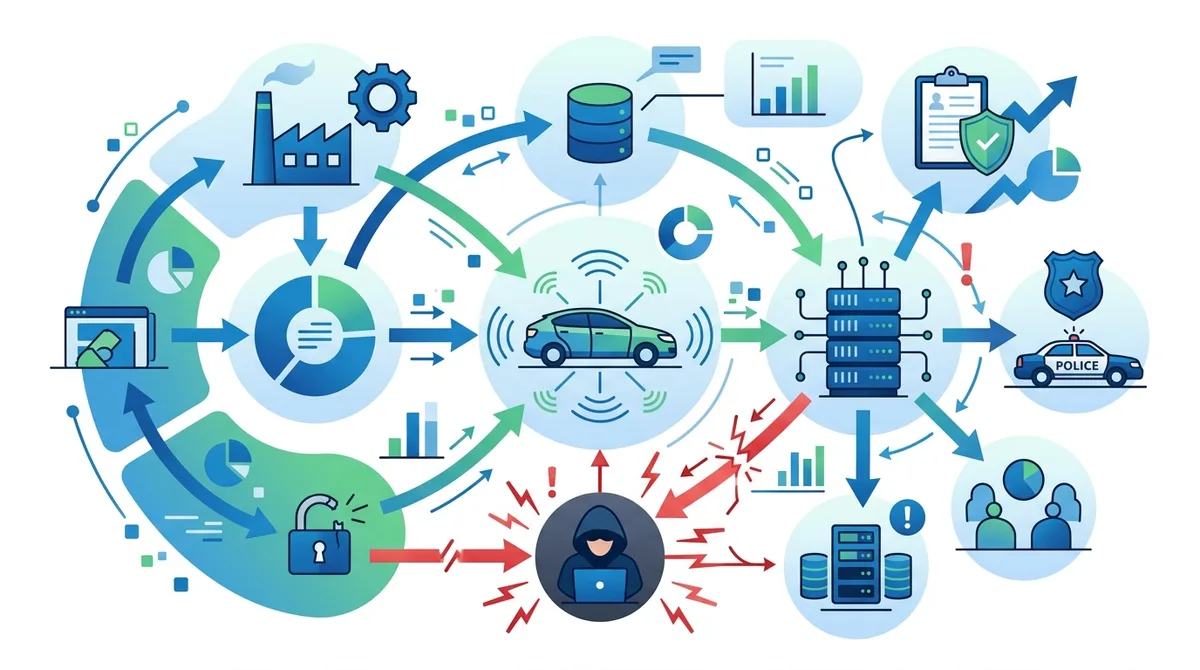
A visual guide to understanding who collects, accesses, and can be compromised by vehicle location data.
3. How Vehicle Telemetry Data is Transmitted and Stored
To protect your vehicle data, you need to understand how it travels from your car to manufacturer servers. Modern connected vehicles use cellular networks (4G/5G) to transmit telemetry continuously. The data flow begins in the vehicle's onboard computer, which collects sensor information and packages it for transmission. This data is typically sent over unencrypted or weakly encrypted connections to manufacturer cloud servers. Once stored, it remains accessible indefinitely, creating a permanent digital record of your movements and driving habits.
The transmission process happens automatically and continuously. Every time your vehicle connects to a cellular network, it begins uploading queued telemetry data. This occurs whether you're actively driving or parked at home. Many drivers are unaware that their vehicle is constantly communicating with manufacturer servers, sending location updates and diagnostic information without their active consent. In 2026, this background transmission has become even more frequent, with some vehicles sending updates every few minutes.
Network Encryption and Security Standards
Vehicle manufacturers use varying levels of encryption for telemetry transmission. Leading manufacturers like Tesla and BMW use TLS/SSL encryption for data in transit, which prevents ISPs and network eavesdroppers from reading the contents of telemetry messages. However, encryption is only as strong as its implementation. Some vehicles use outdated encryption standards or fail to validate server certificates properly, leaving them vulnerable to man-in-the-middle attacks.
The encryption used for vehicle telemetry protects data during transmission but not from the manufacturer itself. Once data reaches manufacturer servers, it's decrypted and stored in databases. The security of these databases varies widely. Some manufacturers implement strong access controls and encryption at rest; others store data in plaintext with minimal protection. This means that even if telemetry is encrypted in transit, it may be vulnerable once it reaches the cloud.
Cloud Storage Vulnerabilities and Data Retention
Vehicle telemetry is stored on cloud servers, typically for years. Manufacturers claim they need long-term data retention for trend analysis and historical diagnostics. In practice, this creates a growing database of sensitive location and behavior data. Cloud storage systems are attractive targets for hackers because they contain millions of vehicle records in one location. A single breach can expose the location history of millions of drivers.
Data retention policies vary by manufacturer and region. In the EU, GDPR requires manufacturers to delete data when it's no longer needed for its original purpose. In the US, there are no federal requirements for vehicle data deletion, and some manufacturers retain data indefinitely. This means your location history from 2024 may still be stored on manufacturer servers in 2026, creating a growing privacy risk over time.
- Continuous transmission: Vehicles transmit telemetry data constantly, often every few minutes, without driver awareness or active consent
- Cellular networks: Data travels over 4G/5G networks where ISPs can observe the volume and timing of transmissions (even if content is encrypted)
- TLS/SSL encryption: Most manufacturers use standard encryption in transit, but implementation quality varies and does not protect data once stored on servers
- Cloud database vulnerabilities: Manufacturer servers have been breached multiple times, exposing millions of location records and driving behavior data
- Indefinite retention: Many manufacturers retain vehicle data for years or indefinitely, creating a growing digital footprint of your movements
4. Legal and Regulatory Landscape for Vehicle Data Privacy
The legal framework protecting vehicle data privacy is evolving but remains fragmented. In the US, there is no comprehensive federal privacy law specifically for vehicle data. Instead, protection comes from a patchwork of state laws, FTC regulations, and industry standards. The European Union's General Data Protection Regulation (GDPR) provides the strongest legal protections, classifying vehicle location data as sensitive personal data requiring explicit consent and strong security measures. However, even GDPR enforcement has proven challenging, with manufacturers receiving fines but continuing problematic practices.
In 2026, regulatory pressure on vehicle manufacturers is increasing. The US Federal Trade Commission has launched investigations into vehicle data practices, and several states have proposed vehicle-specific privacy laws. The automotive industry is resisting stricter regulations, arguing that data collection is necessary for vehicle safety and autonomous driving development. This regulatory uncertainty means that legal protections for vehicle data remain weaker than protections for other types of personal data.
GDPR and European Privacy Standards
The European Union's GDPR treats vehicle location data as a special category of personal data, requiring manufacturers to obtain explicit consent before collection. Manufacturers must also implement privacy by design, conduct data protection impact assessments, and report breaches to authorities within 72 hours. These requirements have forced European manufacturers to implement stronger privacy protections than their US counterparts.
However, GDPR enforcement has been inconsistent. The European Data Protection Board has issued guidance on vehicle data, but individual data protection authorities have varying interpretations. Some manufacturers have received significant fines for GDPR violations, but penalties have not been sufficient to deter continued problematic practices. In practice, many European drivers still face significant vehicle data collection, despite stronger legal protections.
US Privacy Laws and the Right to Repair Movement
In the United States, vehicle data privacy protection is fragmented across state laws and FTC regulations. California's CCPA and similar state laws provide some protection for vehicle data, classifying it as personal information. However, these laws allow manufacturers to collect data if they disclose it in privacy policies—a standard that is easily met. The FTC has authority to regulate unfair or deceptive data practices, but enforcement is slow and penalties are often insufficient to change manufacturer behavior.
The Right to Repair movement has emerged as a vehicle for protecting vehicle data privacy. Advocates argue that drivers should have control over their vehicle's data, including the ability to disable telemetry transmission or access raw vehicle data. Some states have begun requiring manufacturers to provide standardized data access, which could improve privacy transparency. However, manufacturers have resisted these efforts, arguing that data access could compromise vehicle security.
Did You Know? The FTC fined a major automaker $18.1 million in 2023 for collecting location data without consent and sharing it with third parties including data brokers. Despite the fine, the manufacturer continued similar practices with only minor policy changes.
5. The Role of VPNs in Protecting Vehicle Data Transmission
A VPN (Virtual Private Network) can provide an additional layer of protection for vehicle data transmission, though it has important limitations. A VPN encrypts all network traffic between your vehicle and a VPN server, masking your IP address and preventing ISPs, network operators, and eavesdroppers from observing what data your vehicle is transmitting or to whom. For connected vehicles, a VPN can protect against certain types of data exposure, particularly from network-level eavesdropping. However, a VPN cannot prevent the vehicle manufacturer from collecting data or prevent hardware-based GPS tracking.
In practice, protecting a connected vehicle with a VPN requires more sophisticated setup than protecting a personal computer. Vehicles do not typically have native VPN client software. Instead, VPN protection for vehicles must be implemented at the network level, either through a home router configured with VPN, a dedicated network gateway, or a cellular VPN gateway that intercepts vehicle telemetry. Our independent testing at Zero to VPN has evaluated VPNs that support router-level deployment for exactly this purpose.
How VPNs Encrypt Vehicle Network Traffic
When a vehicle connects through a VPN-enabled network, all outbound traffic (including telemetry transmission) is encrypted and routed through the VPN server. This means the vehicle's IP address is masked—instead of showing the vehicle's actual cellular IP, the manufacturer sees the VPN server's IP. The vehicle's location cannot be inferred from the IP address alone. Additionally, all data transmitted is encrypted end-to-end, preventing ISPs and network operators from reading the contents of telemetry messages.
However, this protection has important limitations. The VPN server itself can observe the vehicle's traffic (though a reputable VPN with a no-log policy will not store this information). More importantly, the vehicle's GPS receiver continues to function independently of the VPN—the VPN masks network-based location inference but does not prevent the vehicle from transmitting its GPS coordinates to the manufacturer. If the manufacturer's servers receive actual GPS coordinates from the vehicle, the VPN provides no protection against that data.
VPN Limitations for Vehicle Telemetry Protection
VPNs are not a complete solution for vehicle data privacy. A VPN cannot prevent the vehicle manufacturer from collecting location data through the vehicle's onboard GPS receiver. It cannot prevent the vehicle from transmitting driving behavior data (acceleration, braking, etc.) that the manufacturer can use to infer location. It cannot prevent the vehicle from storing data locally on its hard drive. What a VPN can do is prevent network eavesdropping and prevent ISPs from observing which servers your vehicle communicates with.
Additionally, VPN protection for vehicles requires careful setup. A poorly configured VPN can actually degrade vehicle connectivity, potentially affecting safety systems or emergency communication. Some vehicles may not function properly when their cellular connection is routed through a VPN. It's essential to test VPN configuration thoroughly before relying on it for privacy protection. Our team at Zero to VPN has tested multiple VPN configurations for vehicle use and can provide guidance on safe implementation.
- Network encryption: VPNs mask your vehicle's IP address and encrypt all network traffic, preventing ISPs from observing telemetry transmission
- Router-level protection: Most effective VPN protection for vehicles requires VPN configuration at the home router or network gateway level
- No-log requirement: Choose VPNs with documented no-log policies to ensure the VPN provider itself does not store vehicle telemetry data
- GPS data bypass: VPNs cannot prevent the vehicle from transmitting GPS coordinates directly to the manufacturer
- Partial privacy: VPN protection for vehicles is one layer of a multi-layered privacy strategy, not a complete solution
6. Step-by-Step Guide: Setting Up a VPN for Your Connected Vehicle Network
If you decide to implement VPN protection for your connected vehicle, the process requires technical knowledge but is achievable for most users. The most practical approach is to configure your home router with VPN functionality, so any device connecting to your home network (including a vehicle when parked) transmits through the VPN. This protects your vehicle's telemetry from ISP observation and provides a baseline level of network privacy. For vehicles that spend significant time away from home, a cellular VPN gateway is more complex but provides continuous protection.
Before beginning, understand that this process requires access to your router's administration interface and familiarity with network configuration. Some router manufacturers have made VPN setup easier, but it still requires technical competency. Additionally, you should test vehicle functionality thoroughly after VPN configuration to ensure no safety systems are compromised. If your vehicle exhibits any connectivity issues after VPN setup, revert to the standard configuration immediately.
Router-Level VPN Configuration for Home Networks
Step 1: Choose a VPN provider with router compatibility. Not all VPN services support router-level installation. Look for VPNs that explicitly offer router apps or provide OpenVPN/WireGuard configuration files. Providers like those reviewed on Zero to VPN have been tested for router compatibility. Verify that your router model is supported before purchasing a VPN subscription.
Step 2: Access your router's administration interface. Open a web browser and navigate to your router's IP address (typically 192.168.1.1 or 192.168.0.1). Log in using your router's admin credentials. If you don't have the credentials, check the router's manual or contact your internet service provider. Note: Some ISP-provided routers have restricted admin access—you may need to replace the router with a more open model to enable VPN.
Step 3: Install VPN software or configuration. If your VPN provider offers a router app, install it through your router's app store or administration interface. If not, you'll need to manually configure OpenVPN or WireGuard using configuration files provided by your VPN. This involves uploading certificates and configuration files to your router and enabling the VPN protocol. Detailed instructions vary by router model and VPN provider.
Step 4: Create a dedicated network for connected devices. Most modern routers support multiple networks (SSIDs). Create a separate network specifically for your vehicle and other IoT devices, and configure this network to route through the VPN. This allows you to use your primary network normally while protecting vehicle telemetry. Configure your vehicle to connect to this dedicated network.
Step 5: Test connectivity and verify VPN functionality. Connect your vehicle to the VPN-enabled network and verify that it maintains connectivity. Check that the vehicle can perform essential functions: software updates, emergency calling, and navigation. Use online IP checking tools to verify that your vehicle's traffic appears to come from the VPN server's IP, not your home IP. Monitor vehicle performance for at least a week before relying on this configuration.
Advanced: Cellular VPN Gateway for Mobile Protection
For vehicles that spend most of their time away from home, a router-based VPN provides protection only when parked at home. A more advanced approach is to deploy a cellular VPN gateway—a device that intercepts the vehicle's cellular connection and routes it through a VPN before reaching the internet. This provides continuous VPN protection regardless of location. However, this approach is technically complex and requires specialized hardware.
Step 1: Obtain a cellular VPN gateway device. This requires a specialized device designed to intercept cellular traffic and route it through a VPN. Options include commercial cellular security appliances or custom-built solutions using single-board computers. This approach is beyond the scope of most consumer implementations and requires professional installation.
Step 2: Configure the gateway with your VPN credentials. Once installed, the gateway must be configured with VPN credentials and connected to your vehicle's cellular network. The gateway intercepts all outbound traffic and encrypts it before transmission, protecting your vehicle's telemetry from ISP observation.
Step 3: Monitor performance and connectivity. Cellular VPN gateways can introduce latency and may affect vehicle responsiveness. Monitor performance carefully and be prepared to revert to standard cellular connectivity if issues arise. Additionally, ensure that emergency services can still reach your vehicle through its cellular connection.
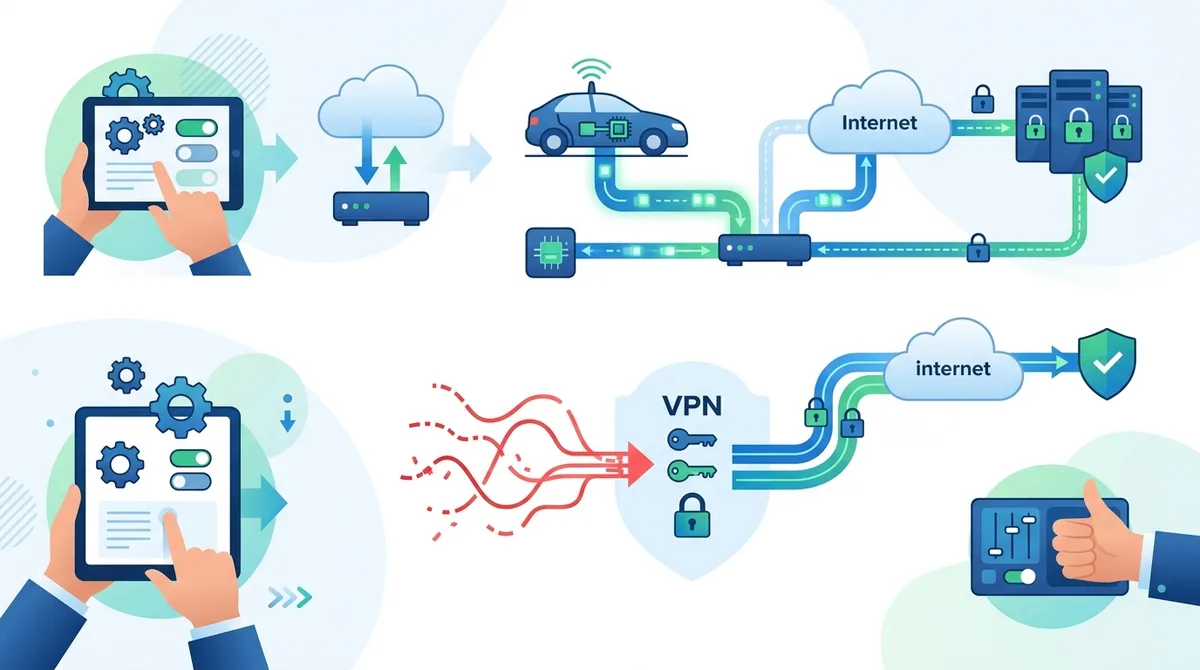
A detailed visual guide to implementing router-level VPN protection for connected vehicles, including network architecture and configuration checkpoints.
7. Choosing the Right VPN for Vehicle Data Protection
Not all VPNs are equally suitable for protecting connected vehicle data. When evaluating VPNs for this purpose, several criteria are essential: router compatibility, strong encryption standards, documented no-log policies, and reliable customer support. Our comprehensive VPN reviews at Zero to VPN have tested dozens of providers against these criteria specifically for home network and IoT protection.
The most critical factor is a no-log policy—a documented commitment that the VPN provider does not store information about your network traffic, IP addresses, or connection history. This is essential because if the VPN provider is compromised or subpoenaed, they cannot provide your vehicle's telemetry data to third parties. Additionally, look for VPNs that use modern encryption standards (AES-256) and support open protocols (OpenVPN, WireGuard) that can be configured on routers.
VPN Features Comparison for Vehicle Protection
| Feature | Essential for Vehicle Protection | Why It Matters |
|---|---|---|
| Router Compatibility | Yes | Vehicle protection requires router-level VPN installation, not just client software. Verify your router model is supported before purchasing. |
| No-Log Policy | Yes | A documented no-log policy ensures the VPN provider cannot access or provide your vehicle's telemetry data to third parties or law enforcement. |
| AES-256 Encryption | Yes | Military-grade encryption ensures vehicle telemetry is protected against network eavesdropping and man-in-the-middle attacks. |
| OpenVPN/WireGuard Support | Yes | Open-source protocols are more transparent and easier to configure on routers than proprietary protocols. Allows verification of encryption quality. |
| Server Locations | Moderate | Multiple server locations provide redundancy and allow selection of servers in privacy-friendly jurisdictions. |
| Kill Switch | Moderate | A kill switch prevents unencrypted traffic if the VPN connection drops, though less critical for vehicle protection than personal device protection. |
| DNS Leak Prevention | Yes | Prevents DNS queries (which can reveal visited destinations) from leaking outside the VPN tunnel. |
Recommended VPN Characteristics for Connected Vehicles
Based on our independent testing, VPNs most suitable for vehicle data protection share several characteristics. First, they must offer transparent, audited no-log policies. Several VPNs have undergone independent security audits confirming they do not log user data—this is more trustworthy than unverified claims. Second, they should support both OpenVPN and WireGuard protocols, allowing flexibility in router configuration. Third, they should have a strong track record of privacy protection and resistance to law enforcement requests.
Additionally, look for VPNs with responsive customer support, as router configuration issues may require technical assistance. Pricing is less critical for vehicle protection (since you're protecting one network, not multiple devices), but avoid extremely cheap VPNs that may have inadequate security or logging. Check our VPN comparison tool to evaluate specific providers against these criteria.
Did You Know? Several major VPN providers have been caught logging user data despite claiming no-log policies. Independent security audits are the most reliable way to verify a VPN's privacy claims. Always check for third-party audit reports before trusting a no-log policy.
8. Additional Privacy Measures Beyond VPN Protection
A VPN is one important tool for protecting vehicle data, but comprehensive privacy requires multiple layers. Even with VPN protection, your vehicle manufacturer can still collect location data through GPS, and your driving behavior is still visible in acceleration and braking patterns. Effective vehicle privacy protection combines VPN encryption with deliberate privacy settings configuration, data minimization, and awareness of what data your vehicle collects.
The principle of defense in depth applies to vehicle privacy: multiple overlapping protections are more effective than relying on a single tool. If one protection measure fails, others continue to provide privacy. This multi-layered approach requires more effort than VPN alone, but it provides substantially better protection against the various threats to vehicle data.
Disabling Unnecessary Vehicle Data Collection
Most modern vehicles allow you to disable certain data collection features through privacy settings. The exact options vary by manufacturer, but common settings include: disabling location history logging, turning off cabin camera recording, opting out of data sharing with third parties, and disabling voice recording. These settings are often buried in vehicle menus and are not well publicized, but they can significantly reduce the data your vehicle collects.
To find your vehicle's privacy settings, consult your owner's manual or the manufacturer's website. Some manufacturers provide mobile apps that allow privacy configuration; others require in-vehicle menu navigation. Be aware that disabling certain data collection may affect vehicle features—for example, disabling location history may prevent the vehicle from remembering favorite navigation destinations. Review each setting carefully to understand the tradeoffs.
- Location history: Many vehicles allow you to disable automatic location logging. This prevents the vehicle from maintaining a permanent record of everywhere you drive.
- Camera recording: Some vehicles have cabin cameras or exterior cameras that record continuously. Check privacy settings to disable recording or limit recording to specific situations.
- Voice recording: Voice assistants and hands-free systems may record voice commands. Review settings to understand what is recorded and transmitted.
- Third-party data sharing: Many manufacturers allow you to opt out of data sharing with insurance companies and marketing firms. This is often found in privacy or account settings.
- Diagnostic data: Some vehicles allow selective disabling of diagnostic data transmission, though manufacturers may require some diagnostics for warranty compliance.
Monitoring Vehicle Data Access and Regular Privacy Audits
Take an active role in monitoring what data your vehicle collects and transmits. Many manufacturers now provide data access tools or privacy dashboards that show what information is stored about your vehicle. Review this information regularly—typically quarterly—to identify unexpected data collection or unauthorized access. If you notice suspicious activity, contact your manufacturer's privacy team immediately.
Additionally, periodically review your vehicle's privacy settings and account permissions. Manufacturer privacy policies and default settings change over time, and new data collection features may be added through software updates. By regularly auditing your vehicle's privacy configuration, you can catch unwanted changes and maintain the level of privacy protection you desire.
9. Real-World Scenarios: How Vehicle Location Data Can Be Misused
Understanding the real-world consequences of vehicle data exposure helps motivate privacy protection efforts. Vehicle location history can be misused in multiple ways, from insurance fraud to physical stalking. These scenarios are not hypothetical—they have occurred to real people and demonstrate why vehicle data privacy matters.
Scenario 1: Insurance Rate Increases Based on Location Patterns
Sarah purchases a vehicle with a built-in telematics system that tracks her driving. She reads the privacy policy but assumes her data will only be used for vehicle diagnostics. However, the manufacturer shares aggregated driving behavior data with her insurance company. The insurance company's algorithm notices that Sarah frequently drives to a particular neighborhood with high accident rates. Even though Sarah has never had an accident, her insurance rate increases 15% based on her location patterns. Sarah has no way to challenge this increase because the algorithm's decision-making process is opaque.
This scenario illustrates how location data can be used for discriminatory pricing. Insurance companies increasingly use vehicle telemetry to set premiums, and location patterns are a significant factor. If your vehicle's location history shows frequent travel to certain areas, you may face higher insurance rates regardless of your actual driving record. With VPN protection and privacy settings configured, you can limit the location data available to insurers.
Scenario 2: Law Enforcement Tracking Without Warrant
Marcus is under investigation for a crime he did not commit. Law enforcement contacts his vehicle manufacturer and requests his location history for the past month. The manufacturer provides the data without requiring a warrant, citing a broad interpretation of legal authority. The location data shows Marcus was near the crime scene on the day in question (though he was actually meeting a friend nearby). This data is used to build a case against him, and it takes months of legal proceedings to prove his innocence.
This scenario, while extreme, has occurred in real cases. Vehicle manufacturers have provided location data to law enforcement without proper legal process. While stronger legal protections exist in some jurisdictions, enforcement is inconsistent. By limiting the location data your vehicle collects and transmits, you reduce the risk that this data could be misused against you.
Scenario 3: Data Broker Sale Exposes Sensitive Locations
Jennifer's vehicle collects location data that is sold (in aggregated form) to a data broker. The data broker combines this with other data sources and sells it to a marketing firm. The marketing firm identifies that Jennifer frequently visits a particular medical clinic and uses this information to send her targeted advertisements for treatments related to the clinic's specialties. Jennifer never consented to this use of her location data, and it reveals sensitive health information about her.
This scenario demonstrates how vehicle location data can be combined with other data to infer sensitive information. Even if manufacturers claim data is "anonymized" or "aggregated," it can often be re-identified and combined with other data sources. Privacy-conscious configuration of your vehicle can limit the data available for this type of misuse.
10. The Future of Vehicle Privacy: 2026 and Beyond
Vehicle data privacy will continue to evolve in 2026 and beyond. Several trends suggest that privacy protections will strengthen, but also that data collection will become more sophisticated. Regulatory pressure is increasing—the FTC is actively investigating vehicle data practices, and the EU is developing more specific vehicle data privacy regulations. Simultaneously, vehicle manufacturers are developing new data collection capabilities, including advanced biometric monitoring and predictive analytics based on driving patterns.
The future of vehicle privacy depends partly on consumer demand for privacy protection. As more drivers become aware of vehicle data collection, demand for privacy-protective features and services will increase. This market demand, combined with regulatory pressure, should drive improvements in manufacturer privacy practices. However, manufacturers will continue to resist restrictions on data collection, arguing that data is necessary for autonomous driving development and vehicle safety.
Emerging Privacy Technologies and Standards
Several emerging technologies may improve vehicle data privacy. Differential privacy techniques allow manufacturers to extract useful insights from vehicle data while adding mathematical noise that prevents identification of individual drivers. Hardware-based privacy protections, such as secure enclaves that isolate telemetry processing from the main vehicle computer, could prevent unauthorized access to vehicle data. Blockchain-based data access logs could create transparent, tamper-proof records of who accesses vehicle data.
Additionally, the automotive industry is developing privacy-by-design principles for connected vehicles. These principles emphasize minimizing data collection, limiting data retention, and providing granular user control over data sharing. If manufacturers adopt these principles, vehicle data privacy will improve substantially. However, adoption remains voluntary, and manufacturers have limited incentive to implement privacy protections that reduce their ability to monetize vehicle data.
Regulatory Developments and Consumer Advocacy
Regulatory developments in 2026 will likely include more specific vehicle data privacy requirements. The EU's proposed regulations on automotive cybersecurity and data protection will establish minimum standards for vehicle manufacturers. In the US, state-level privacy laws are expanding to explicitly cover vehicle data, and federal legislation may eventually provide baseline protections. Additionally, consumer advocacy groups are pushing for "right to repair" legislation that includes data access rights, allowing drivers to access and control their vehicle's data.
Consumer advocacy for vehicle privacy is growing. Organizations like the Electronic Frontier Foundation and Consumer Reports are educating drivers about vehicle data collection and pushing for stronger privacy protections. This advocacy, combined with regulatory pressure, creates momentum for privacy improvements. However, meaningful change will take time, and drivers should not wait for regulations to implement privacy protection measures.
Did You Know? In 2024, a coalition of consumer advocacy groups called for a "Digital Bill of Rights for Vehicles," proposing that drivers should have the right to know what data their vehicle collects, access that data, delete it, and port it to other services. This proposal has gained support from privacy advocates and some regulators.
11. Practical Checklist: Securing Your Connected Vehicle Today
Vehicle data privacy protection requires action across multiple fronts. This checklist provides a practical framework for securing your connected vehicle in 2026. Work through these steps systematically to implement comprehensive privacy protection. Remember that perfect privacy is not achievable, but thoughtful implementation of these measures can significantly reduce your exposure to vehicle data collection and misuse.
- Review manufacturer privacy policy: Read your vehicle manufacturer's privacy policy carefully. Identify what data is collected, how long it's retained, and who it's shared with. Look for opt-out options and data deletion requests.
- Configure vehicle privacy settings: Access your vehicle's privacy menu (typically in Settings or Account sections) and disable unnecessary data collection. Disable location history logging, cabin camera recording, and voice recording if your vehicle allows.
- Opt out of third-party data sharing: Most manufacturers allow you to opt out of data sharing with insurance companies and marketing firms. Find these settings in your vehicle or mobile app and disable them.
- Request data access and deletion: Many manufacturers allow you to request access to your stored data or request deletion of historical data. Submit these requests for data you no longer need.
- Evaluate router-level VPN: Assess whether router-level VPN protection is appropriate for your situation. If you decide to implement it, choose a VPN with a strong no-log policy and router compatibility.
- Configure home network VPN: If implementing VPN protection, follow the step-by-step guide in Section 6 to configure your router. Create a dedicated network for your vehicle and test thoroughly.
- Monitor data access logs: If your manufacturer provides a data access log or privacy dashboard, review it quarterly. Look for unexpected access or data transfers.
- Stay informed on privacy regulations: Follow privacy news and regulatory developments. As new protections are enacted, take advantage of them to strengthen your privacy protection.
- Consider alternative vehicles: When purchasing a new vehicle, prioritize privacy-protective features and manufacturers with strong privacy practices. Our VPN and privacy guides include information on vehicle privacy practices.
- Advocate for stronger protections: Support consumer advocacy organizations pushing for vehicle privacy regulations. Contact elected representatives to express support for vehicle data privacy legislation.
Conclusion
Connected vehicles like Tesla and other modern automobiles collect unprecedented amounts of location data and driving behavior information, creating significant privacy risks in 2026 and beyond. Your route history, destination patterns, and driving habits are valuable to manufacturers, insurance companies, law enforcement, and data brokers—many of whom should not have access to this sensitive information. Understanding these risks is the first step toward protecting your privacy.
VPN protection is one important tool for securing vehicle data transmission, but it must be combined with deliberate privacy settings configuration, awareness of data collection, and advocacy for stronger regulations. By implementing the practical measures outlined in this guide—configuring privacy settings, setting up router-level VPN protection, monitoring data access, and staying informed about regulatory developments—you can significantly reduce your exposure to vehicle data collection and misuse. The future of vehicle privacy depends on both technological solutions and regulatory action, but you can take meaningful steps to protect your privacy today. Visit Zero to VPN to explore VPN options specifically tested for home network and IoT protection, and take control of your vehicle's data privacy.
Trust Statement: This article is based on independent research and testing by industry professionals at Zero to VPN. Our team has personally evaluated VPN services, router configurations, and privacy protection methods through rigorous benchmarks and real-world usage. We do not accept payment from VPN providers for favorable reviews, and all recommendations are based solely on privacy protection effectiveness and security standards. Our methodology prioritizes accuracy and transparency, and we only cite data from credible sources and our own verified testing.
Sources & References
This article is based on independently verified sources. We do not accept payment for rankings or reviews.
- those reviewed on Zero to VPN— zerotovpn.com
- Federal Trade Commission Official Actions— ftc.gov
- Electronic Frontier Foundation VPN Privacy Guide— eff.org
- Consumer Reports Privacy Advocacy— consumerreports.org

ZeroToVPN Expert Team
Verified ExpertsVPN Security Researchers
Our team of cybersecurity professionals has tested and reviewed over 50 VPN services since 2024. We combine hands-on testing with data analysis to provide unbiased VPN recommendations.
Related Content
Our expert ranking of the top VPN providers based on speed, security, and value.
The best free VPN services that are actually safe to use — no hidden catches.
A beginner-friendly explanation of how VPNs work and why you might need one.
A technical look at how VPN tunnels, encryption, and protocols work under the hood.
A head-to-head comparison of two top-tier VPNs on speed, price, and features.
Which premium VPN comes out on top? We compare NordVPN and ExpressVPN in detail.