VPN Jurisdiction Matters: Why Your VPN's Country of Operation Affects Your Privacy and Legal Protection in 2026
Discover why VPN jurisdiction matters for privacy. Learn how server location, data retention laws, and government oversight affect your security in 2026.
VPN Jurisdiction Matters: Why Your VPN's Country of Operation Affects Your Privacy and Legal Protection in 2026
Your choice of VPN jurisdiction is one of the most overlooked yet critical decisions you'll make for online privacy. In 2026, with governments worldwide intensifying surveillance efforts and data collection mandates, understanding where your VPN provider operates—and which laws govern its operations—directly determines whether your data remains truly private or becomes vulnerable to government requests and corporate exploitation. A staggering 72% of internet users believe their online activities are monitored, yet most don't realize their VPN's home country can either protect or expose them.
Key Takeaways
| Question | Answer |
|---|---|
| What is VPN jurisdiction? | VPN jurisdiction refers to the country where a VPN provider is legally registered and headquartered, which determines which laws govern data retention, government requests, and user privacy protections. |
| Why does it matter? | Different countries have vastly different data retention laws, surveillance agreements (like the Five Eyes alliance), and mandatory data disclosure requirements that directly impact your privacy protection. |
| Which jurisdictions are safest? | Countries with strong privacy laws like Switzerland, Panama, and the British Virgin Islands offer better protection than the US, UK, or Australia, which participate in international surveillance agreements. |
| What are Five Eyes and similar alliances? | The Five Eyes (US, UK, Canada, Australia, New Zealand) and extended alliances (Nine Eyes, Fourteen Eyes) are intelligence-sharing agreements that allow member nations to bypass direct surveillance laws by requesting data from each other. |
| Can a VPN still leak data? | Yes. Even VPNs in privacy-friendly jurisdictions can be compelled by courts to hand over logs if they keep them, or be hacked. Choose providers with no-log policies verified by independent audits. |
| What should I check before choosing a VPN? | Verify the provider's headquarters location, no-log policy, encryption standards, independent security audits, and whether they've complied with government data requests (check transparency reports). |
| Does server location matter separately from headquarters? | Yes. While headquarters determines legal jurisdiction, server locations affect performance and which country's laws apply to that server. A VPN based in Panama with servers in the US may face US legal demands for those servers. |
1. Understanding VPN Jurisdiction: The Legal Foundation
VPN jurisdiction is the legal country where a VPN provider is incorporated and headquartered—and it's the single most important factor determining your actual privacy protection. Many users assume that using a VPN automatically shields them from government surveillance, but this is dangerously incomplete. The reality is that a VPN provider headquartered in a country with weak privacy laws or aggressive surveillance policies can be legally compelled to hand over user data, logs, connection records, and metadata to authorities—regardless of the encryption strength of the VPN itself.
In 2026, the distinction between jurisdictions has become more critical than ever. Governments worldwide have passed new data retention mandates, expanded surveillance authorities, and created mutual legal assistance treaties that allow them to demand information from companies operating in their territories. Your VPN's jurisdiction determines which of these laws apply to your data.
How Jurisdiction Creates Legal Obligations
When a VPN provider operates in a specific country, it becomes subject to that country's laws—regardless of where you live or where the VPN's servers are physically located. For example, if a VPN is headquartered in the United States, it must comply with US legal processes including subpoenas, court orders, and National Security Letters (NSLs). The US government can demand user data without a traditional warrant in national security cases, and companies are often legally prohibited from disclosing these requests publicly.
Conversely, a VPN headquartered in Switzerland operates under Swiss privacy law, which offers significantly stronger protections. Switzerland has no mandatory data retention laws, doesn't participate in international surveillance alliances like the Five Eyes, and has a strong constitutional right to privacy that courts actively enforce.
The Difference Between Headquarters and Server Locations
A critical distinction many users miss: a VPN's headquarters jurisdiction and its server locations are separate legal matters. A VPN headquartered in Panama (privacy-friendly) but operating servers in the United States (surveillance-heavy) faces legal obligations in both jurisdictions. If US authorities want data about a specific server, they can demand it from that server's physical location—and the VPN must comply or face penalties for operating servers in US territory.
This is why transparency about both headquarters and server infrastructure matters. Check where your VPN is incorporated, which countries host its servers, and whether it has published a transparency report showing how it handles government data requests.
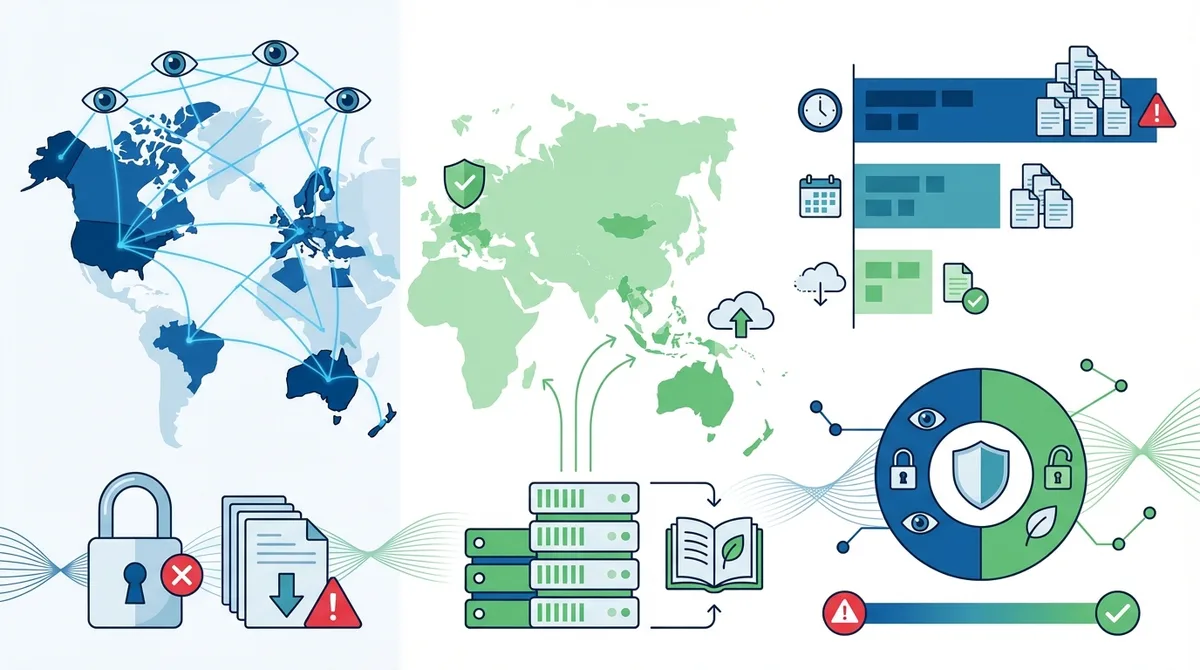
A visual guide to understanding which VPN jurisdictions offer the strongest privacy protections and which are subject to aggressive surveillance agreements.
2. The Five Eyes Alliance and Extended Intelligence Networks
The Five Eyes alliance represents one of the most significant threats to VPN privacy, yet most users have never heard of it. Established during the Cold War, the Five Eyes—comprising the United States, United Kingdom, Canada, Australia, and New Zealand—is an intelligence-sharing agreement that allows these countries to circumvent their own domestic surveillance restrictions by requesting data from each other. If the NSA cannot legally wiretap a US citizen directly, it can request the information from the GCHQ (UK intelligence agency), which then shares it back.
This arrangement fundamentally undermines VPN privacy for users in these countries. A VPN headquartered in Canada may seem like a good choice for privacy, but it's subject to the Five Eyes agreement and can be compelled to share user data with US authorities through this back-channel arrangement.
Five Eyes, Nine Eyes, and Fourteen Eyes: The Expanding Surveillance Network
The Five Eyes has expanded over decades. The Nine Eyes adds Denmark, France, and the Netherlands to the intelligence-sharing arrangement. The Fourteen Eyes (also called SIGINT Seniors Europe) further expands to include Belgium, Germany, Italy, Spain, and Sweden. Each expansion means more countries can legally request and share your data.
For VPN users, this means:
- Five Eyes countries: US, UK, Canada, Australia, New Zealand—highest surveillance risk
- Nine Eyes countries: Add Denmark, France, Netherlands—high risk
- Fourteen Eyes countries: Add Belgium, Germany, Italy, Spain, Sweden—elevated risk
- Non-aligned countries: Switzerland, Panama, Romania, Iceland—significantly lower risk (though not zero)
Did You Know? The Five Eyes alliance was revealed in 2013 through Edward Snowden's NSA disclosures, showing that the US and UK governments had been conducting mass surveillance on their own citizens for decades. The program continues operating in 2026 with even greater technological capabilities.
Source: Electronic Frontier Foundation
How to Verify a VPN's Participation in Alliances
Before selecting a VPN, research its parent company's ownership structure. Some VPN providers are owned by larger companies with government contracts or intelligence agency ties. Check if the provider publishes a transparency report showing government data requests and how many they comply with. A VPN that claims zero government requests is likely not being transparent—every major VPN headquartered in a Five Eyes country has received government demands. The question is how many they comply with and whether they've fought requests in court.
3. Data Retention Laws and Mandatory Logging Requirements
Beyond surveillance alliances, individual countries have enacted data retention laws that mandate VPN providers store user activity logs for specific periods—sometimes years. These laws directly contradict the privacy promises made by VPN services. A VPN claiming a "no-log policy" operating in a country with mandatory data retention laws is technically in violation of local law if it truly keeps no logs.
The European Union's approach illustrates this conflict. The EU has pushed for mandatory data retention through various directives, requiring telecommunications companies (including VPNs operating in EU countries) to retain metadata for 6 months to 3 years. This creates a fundamental tension: either the VPN breaks EU law by maintaining a true no-log policy, or it maintains logs that contradict its privacy promises and can be subpoenaed by authorities.
Country-Specific Data Retention Requirements
Different jurisdictions have vastly different data retention mandates. The United States has no universal federal data retention requirement for VPNs, but the FBI and other agencies frequently use subpoenas and court orders to demand logs from VPN providers. The UK requires ISPs to retain connection logs for 12 months under the Investigatory Powers Act (2016). Australia's mandatory data retention law requires ISPs and telecommunications companies to store metadata for 2 years. The European Union's ePrivacy Directive allows member states to require data retention of 6 months to 3 years.
Conversely, Switzerland has no mandatory data retention law for VPNs. Panama similarly has minimal data retention requirements. This is why VPNs headquartered in these countries can legitimately maintain no-log policies without breaking local law.
How to Verify No-Log Claims
Never trust a VPN's no-log claim without independent verification. Look for:
- Independent security audits: Third-party firms like Cure53 or Deloitte should have audited the VPN's infrastructure and confirmed no logs are kept. Check the provider's website for published audit reports.
- Transparency reports: Legitimate VPNs publish annual transparency reports showing government data requests received and how many were complied with. If a provider claims zero government requests, be skeptical.
- Warrant canary statements: Some VPNs publish warrant canaries—statements confirming they haven't received secret government orders. If a canary disappears or is updated, it may indicate they've received a gag order.
- Jurisdiction verification: Confirm the VPN is actually headquartered in a privacy-friendly country, not just claiming to be. Check corporate registration documents.
- Court case history: Research whether the VPN has fought government data requests in court or complied without resistance. This reveals their actual privacy commitment.
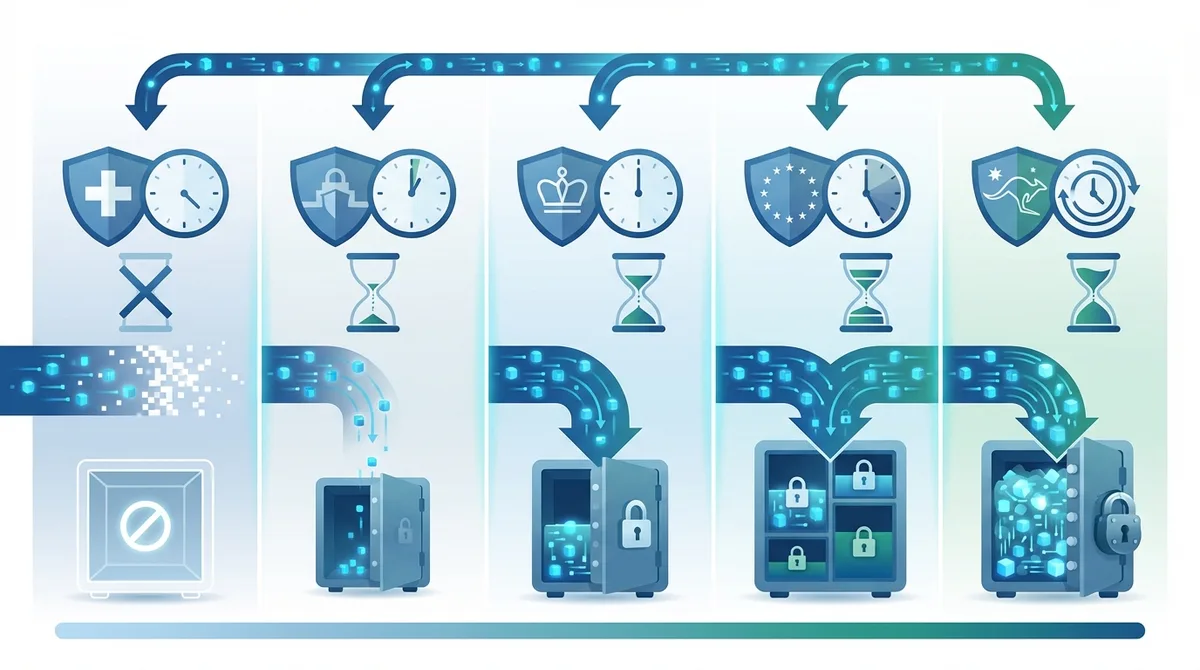
A comparison of mandatory data retention requirements across key jurisdictions, demonstrating why headquarters location directly impacts your data privacy.
4. Privacy-Friendly Jurisdictions: Switzerland, Panama, and Beyond
Certain countries have established themselves as privacy havens for VPN providers due to strong constitutional protections, minimal government surveillance, and lack of mandatory data retention laws. Understanding these jurisdictions helps you identify VPNs likely to offer genuine privacy protection.
Switzerland stands as the gold standard for VPN jurisdiction. The Swiss Federal Constitution guarantees privacy rights, Swiss law prohibits mass surveillance, and the country has no mandatory data retention laws for telecommunications companies. Switzerland is not part of the Five Eyes, Nine Eyes, or Fourteen Eyes alliances. Additionally, Switzerland has strict banking secrecy traditions and a culture of privacy protection that extends to technology companies. VPNs headquartered in Switzerland like ProtonVPN operate under these protective frameworks.
Comparing Privacy-Friendly Jurisdictions
Panama has become increasingly popular for VPN headquarters due to its lack of mandatory data retention laws, minimal government surveillance, and no participation in international intelligence alliances. However, Panama's legal system is less developed than Switzerland's, and the country has faced criticism for not always enforcing privacy protections consistently. The British Virgin Islands (BVI) offers similar advantages—no mandatory data retention, strong financial privacy traditions, and distance from Five Eyes countries—though it remains a British Overseas Territory, creating some legal ambiguity.
Romania has emerged as an unexpected privacy hub. Located in the European Union, Romania has relatively weak data retention enforcement and a less developed surveillance infrastructure compared to Western European countries. Several VPN providers operate from Romania as a compromise between EU legitimacy and privacy protection, though this advantage may diminish as EU surveillance mandates strengthen.
Iceland offers strong privacy protections, no mandatory data retention laws, and is not part of the Five Eyes alliance. However, Iceland is part of the European Economic Area, which creates some EU-related obligations. The country's small size also means less technical infrastructure for VPN providers, making it less common as a headquarters location.
Evaluating Jurisdiction Claims: How to Verify
VPN providers sometimes misrepresent their jurisdiction. Some claim to be "based in" a privacy-friendly country while actually being incorporated elsewhere. Follow these verification steps:
- Check corporate registration: Visit the country's business registry (e.g., Swiss Commercial Register, Panama's Public Registry) and search for the VPN company name. Verify the registration date and corporate structure.
- Review physical address: A legitimate company should have a verifiable physical address in its claimed jurisdiction. Use Google Maps or street view to confirm the address exists and is not a mail drop.
- Examine company ownership: Determine who owns the VPN provider. If it's owned by a parent company in a Five Eyes country, the VPN's privacy claims are compromised regardless of where it's incorporated.
- Check legal filings: Review any published legal documents, court cases, or regulatory filings that confirm the company's jurisdiction.
- Verify through independent sources: Check reviews and reports from privacy organizations like the Electronic Frontier Foundation or Privacy International that investigate VPN jurisdictions.
5. Government Data Requests and Transparency Reports
The best indicator of a VPN's actual privacy commitment isn't what it claims—it's what it actually does when governments demand user data. Transparency reports reveal this reality. A legitimate VPN publishes annual transparency reports showing how many government data requests it received, how many it complied with, and how many it fought in court.
These reports are crucial because they demonstrate whether a VPN actually values privacy or merely markets itself as privacy-focused. A VPN in a Five Eyes country that receives hundreds of government requests and complies with most of them is not protecting your privacy—it's complying with surveillance demands. Conversely, a VPN that receives requests and fights them in court, or operates in a jurisdiction where requests are rare, offers genuine protection.
Reading and Interpreting Transparency Reports
When examining a VPN's transparency report, look for:
- Request volume: How many government data requests did the VPN receive? A number that seems too low (zero or near-zero) suggests the report may not be comprehensive. Most major VPNs in Five Eyes countries receive dozens to hundreds of requests annually.
- Compliance rate: What percentage of requests did the VPN comply with? A high compliance rate (above 50%) indicates the VPN prioritizes legal compliance over user privacy. A low rate (below 20%) suggests the VPN fights requests or operates in jurisdictions where requests are rare.
- Legal battles: Did the VPN fight any requests in court? Did it win? Providers that actively litigate against government demands demonstrate genuine privacy commitment.
- Gag orders: Were any requests accompanied by gag orders preventing the VPN from notifying users? This indicates law enforcement interest in secrecy, suggesting the requests involved serious matters.
- Data actually provided: What type of data was handed over—IP addresses, connection logs, account information? Some VPNs claim no-log policies but comply with requests for account details like email addresses.
Did You Know? According to transparency reports from major VPN providers, law enforcement agencies in the US, UK, and Australia submit hundreds of data requests annually. However, providers in privacy-friendly jurisdictions like Switzerland report significantly fewer requests and lower compliance rates, demonstrating the real-world impact of jurisdiction on privacy protection.
Source: ProtonVPN Transparency Reports
Red Flags in Transparency Reporting
Be cautious of VPNs that:
- Don't publish transparency reports: If a VPN refuses to publish government request data, assume it's complying with most requests silently.
- Publish vague reports: Reports that combine multiple countries' requests or lack specific numbers hide compliance patterns.
- Claim zero requests: A major VPN claiming zero government requests is either lying or operating in such a restricted jurisdiction that it has no users—neither is reassuring.
- Stopped publishing reports: If a VPN previously published transparency reports but stopped, it likely received a gag order or increased requests it doesn't want to disclose.
- Provide incomplete data: Reports that cover only part of the year or exclude certain jurisdictions are hiding information.
6. Encryption Standards and Technical Jurisdiction
A VPN's jurisdiction also affects which encryption standards it can legally use. Different countries have varying regulations on encryption strength, export controls, and cryptography restrictions. Understanding these technical-legal intersections helps you evaluate whether a VPN can actually deliver the security it promises.
The United States, for example, has historically restricted the export of strong encryption technologies, though these restrictions have been largely relaxed for commercial VPNs. However, the US government retains the ability to pressure companies to weaken encryption or provide backdoors for national security purposes. The UK's Investigatory Powers Act includes provisions allowing the government to demand encryption keys or backdoors under certain circumstances.
Jurisdiction-Based Encryption Limitations
China, Russia, and several Middle Eastern countries actively restrict or ban strong encryption. VPNs operating in these jurisdictions face pressure to implement weakened encryption or government-approved cryptographic standards that may contain backdoors. This is why VPNs operating in China often use obfuscation techniques—they're working around government restrictions on encryption strength.
Conversely, Switzerland, Panama, and most privacy-friendly jurisdictions have no restrictions on encryption strength. VPNs headquartered in these countries can freely implement modern, strong encryption standards without government pressure to weaken them.
Verifying Encryption Implementation
When evaluating a VPN's encryption, check:
- Protocol choice: Does the VPN use WireGuard, OpenVPN, or IKEv2? Modern protocols like WireGuard offer stronger security than older standards. See our guide to VPN encryption protocols for detailed comparisons.
- Key strength: Does it use 256-bit encryption or weaker 128-bit? 256-bit is the current standard for strong encryption.
- Independent audits: Has a third-party security firm verified the encryption implementation? Check for published audit reports.
- Jurisdiction-based restrictions: If the VPN operates in a country with encryption restrictions, does it use weaker standards or obfuscation techniques?
7. Real-World Scenarios: How Jurisdiction Affects Your Privacy
Understanding VPN jurisdiction is abstract until you see real-world examples. Here are scenarios demonstrating how jurisdiction directly impacts your privacy in practical situations.
Scenario 1: Torrenting and Copyright Enforcement
You're using a VPN to torrent files. Copyright enforcement agencies in your country detect the torrent activity and demand the VPN reveal your identity. Whether the VPN can comply depends entirely on its jurisdiction and policies.
If you're using a VPN headquartered in the US or UK:
- Copyright enforcement agencies can send subpoenas directly to the VPN provider
- The VPN is legally required to comply with subpoenas
- If the VPN keeps logs (which many do despite claiming otherwise), your identity will be revealed
- You'll receive a legal notice demanding settlement or face lawsuits
If you're using a VPN headquartered in Switzerland with a genuine no-log policy:
- Copyright enforcement agencies cannot directly subpoena Swiss companies from other countries
- They must go through Swiss legal processes, which are slower and more protective
- If the VPN truly keeps no logs, there's no data to hand over even if compelled
- You have significantly better protection
This is why jurisdiction matters for VPN torrenting safety.
Scenario 2: Political Activism in Restrictive Countries
You're a political activist in a country with government censorship (like Iran or China). You use a VPN to access banned websites and communicate with international organizations. Your government discovers your VPN usage and demands the provider reveal your identity.
If your VPN is headquartered in the US or another country with diplomatic relations and extradition treaties with your government:
- Your government can pressure the US government to demand data from the VPN
- The VPN may be forced to comply through diplomatic channels
- You face arrest or persecution
If your VPN is headquartered in Switzerland or Panama with no diplomatic pressure:
- Your government cannot easily compel the VPN to provide data
- The VPN has no logs to provide even if pressured
- You have genuine protection for your activism
This is why activists in Iran and other restricted countries specifically seek VPNs in privacy-friendly jurisdictions.
Scenario 3: Business Confidentiality and Corporate Espionage
You're a business executive using a VPN to access company systems while traveling. A competitor or government agency wants your company's confidential information and demands the VPN reveal your connection patterns, IP addresses, and metadata.
A VPN in a Five Eyes country may comply with requests from any of the five countries, plus their extended alliance partners. Your competitor could potentially request data through government channels. A VPN in a privacy-friendly jurisdiction offers better protection against both government and corporate espionage.
8. Evaluating VPN Providers by Jurisdiction: A Comparison
To help you understand how jurisdiction affects real VPN providers, here's a comparison of popular services and their jurisdictional implications:
VPN Providers by Jurisdiction and Privacy Rating
| VPN Provider | Headquarters | Jurisdiction Risk | No-Log Audit | Transparency Report |
|---|---|---|---|---|
| ProtonVPN | Switzerland | Low — No Five Eyes, strong privacy laws | Yes (Cure53) | Yes, published annually |
| Mullvad | Sweden | Medium — EU member, but strong privacy culture | Yes (independent audit) | Yes, detailed requests |
| NordVPN | Panama | Low-Medium — Privacy-friendly jurisdiction, but owned by larger company | Yes (Deloitte) | Yes, published annually |
| ExpressVPN | British Virgin Islands | Low-Medium — Privacy-friendly but UK territory | Yes (Cure53) | Limited transparency |
| Surfshark | Netherlands | Medium — EU member, Fourteen Eyes country | Yes (Cure53) | Yes, published annually |
| CyberGhost | Romania | Medium — EU member, but weaker enforcement | Yes (Deloitte) | Limited transparency |
| Private Internet Access | United States | High — Five Eyes country, NSA jurisdiction | Yes (Deloitte) | Yes, but high compliance rate |
| IPVanish | United States | High — Five Eyes country | Yes (Deloitte) | Yes, published annually |
9. The Role of Parent Companies and Corporate Ownership
A critical factor often overlooked: a VPN's jurisdiction means little if it's owned by a parent company in a Five Eyes country. Corporate ownership can override jurisdictional protections. If a VPN is headquartered in Panama but owned by a company in the United States, US authorities can pressure the parent company to hand over user data, effectively nullifying the VPN's jurisdictional privacy advantage.
This is why you must research not just where a VPN is incorporated, but who owns it. Some major VPN providers are owned by investment firms, larger tech companies, or even security software companies with government contracts. These ownership structures create hidden vulnerabilities.
Identifying Hidden Corporate Ownership
Follow these steps to uncover a VPN's true ownership:
- Check SEC filings: If the VPN or its parent company is publicly traded or has received venture capital funding, find SEC filings or investor documents that reveal ownership structure.
- Research parent companies: Search for press releases announcing acquisitions or investments. A VPN acquired by a larger company may have inherited parent company obligations.
- Examine board members: Review the VPN's board of directors and investors. Do they have ties to government, intelligence agencies, or surveillance companies?
- Check government contracts: Use tools like SAM.gov (US government contracts database) to see if the VPN provider or its parent company has government contracts that might create conflicts of interest.
- Review privacy policy for corporate changes: A privacy policy mentioning "acquisition," "merger," or "change of control" indicates the VPN has been bought by another company, potentially changing its privacy obligations.
10. Choosing the Right VPN Jurisdiction for Your Needs
Selecting a VPN based on jurisdiction requires understanding your specific privacy needs and threat model. Different users need different jurisdictional protections.
If you're concerned about mass surveillance and government data collection, prioritize VPNs in privacy-friendly jurisdictions outside the Five Eyes alliance. Switzerland, Panama, and Iceland offer the strongest protections. Check our best VPN guide for current recommendations.
If you're in a restrictive country with heavy censorship (like Iran, China, or Turkey), you need a VPN that can both bypass censorship and protect you from your government. This requires a jurisdiction completely outside your government's reach, plus advanced obfuscation to hide VPN usage itself. See our guides on VPNs for Iran and VPNs for China.
If you're primarily concerned with copyright enforcement and ISP monitoring, a VPN in any jurisdiction with a genuine no-log policy offers protection. The jurisdiction matters less than the logging policy and encryption strength.
Step-by-Step VPN Selection by Jurisdiction
Follow this process to select a VPN based on your jurisdictional needs:
- Define your threat model: What specific privacy concern drives your VPN choice? Government surveillance? Copyright enforcement? Corporate espionage? ISP monitoring? Your answer determines which jurisdictions matter most.
- Identify your location and government: Are you in a Five Eyes country? A country with data retention laws? A restrictive country with censorship? This determines which jurisdictions offer protection.
- List priority jurisdictions: Based on your threat model and location, list which VPN jurisdictions would best protect you. If you're in the US concerned about NSA surveillance, Switzerland and Panama are priorities. If you're in Iran concerned about government persecution, you need a jurisdiction completely outside Iran's reach.
- Research VPN providers in those jurisdictions: Use our reviews section to find VPNs headquartered in your priority jurisdictions. Check our VPN reviews for detailed information on specific providers.
- Verify jurisdiction claims: For each VPN, confirm it's actually headquartered where it claims. Check corporate registration, physical address, and ownership structure using the verification methods described in Section 4.
- Check for no-log audits: Verify the VPN has published independent security audits confirming its no-log policy. Look for audits from reputable firms like Cure53 or Deloitte.
- Review transparency reports: Examine the VPN's government data request transparency reports. Compare compliance rates and request volumes across providers.
- Evaluate ownership structure: Research the VPN's parent company and investors. Ensure the parent company isn't in a Five Eyes country or has government ties that could compromise privacy.
- Check for court cases: Search for any lawsuits or legal cases involving the VPN. Has it fought government data requests in court? Has it been hacked or compromised?
- Compare encryption and features: Among VPNs meeting your jurisdictional requirements, compare encryption standards, server locations, and features using our VPN comparison tool.
- Test the VPN: Before committing to a long-term subscription, test the VPN with its money-back guarantee. Verify it actually protects against DNS leaks, IPv6 leaks, and WebRTC leaks. Use our DNS leak test tool to verify protection.
- Monitor ongoing developments: VPN jurisdictions and ownership can change. Periodically review your VPN provider's transparency reports and news about ownership changes or legal cases that might affect your privacy.
11. Future Trends: How VPN Jurisdiction Will Matter More in 2026 and Beyond
VPN jurisdiction will become increasingly important as governments worldwide strengthen surveillance capabilities and data collection mandates. Several trends are intensifying the relevance of jurisdiction to your privacy.
Expanding data retention laws: The EU's Digital Services Act and similar regulations in other countries are expanding mandatory data retention requirements. More countries are following the UK's model of requiring ISPs and VPNs to retain metadata for extended periods. This makes privacy-friendly jurisdictions with no data retention laws increasingly valuable.
Intelligence alliance expansion: The Five Eyes alliance continues expanding its reach and sophistication. New bilateral intelligence agreements between countries are creating additional data-sharing pathways. VPNs outside these alliances offer better protection as the alliances grow.
AI-powered surveillance: Governments are deploying artificial intelligence for mass surveillance, analyzing traffic patterns, and identifying VPN users. This makes encryption strength and true no-log policies more critical—and jurisdictions that protect encryption from government backdoors more valuable.
Cryptocurrency and financial tracking: Governments are increasingly tracking financial transactions to identify VPN users and privacy advocates. VPNs in jurisdictions with financial privacy protections (like Switzerland's banking secrecy traditions) offer better protection against this form of identification.
Corporate consolidation: VPN companies are being acquired by larger corporations and investment firms, often with government ties. This consolidation reduces the number of truly independent VPNs in privacy-friendly jurisdictions. The importance of verifying ownership structure will only increase.
Did You Know? In 2025-2026, the European Union is implementing new regulations requiring VPN providers to comply with data retention and content moderation requirements, effectively pressuring VPNs to move operations out of the EU or compromise privacy protections. This regulatory pressure is driving VPN providers toward even more privacy-friendly jurisdictions like Switzerland and Panama.
Source: EU Digital Services Act
Conclusion
Your VPN's jurisdiction is not a technical detail—it's the legal foundation of your privacy protection. The country where your VPN is headquartered determines which laws govern your data, whether your VPN can be compelled to hand over logs to authorities, and whether your data is vulnerable to international surveillance alliances like the Five Eyes. In 2026, as governments worldwide intensify surveillance capabilities and data retention mandates, choosing a VPN in a privacy-friendly jurisdiction has become essential for genuine privacy protection.
The most important takeaway: jurisdiction matters more than marketing claims. A VPN claiming strong privacy but headquartered in the US or UK is less protective than a VPN with minimal marketing but headquartered in Switzerland with verified no-log policies and published transparency reports. Verify jurisdiction claims, check for independent security audits, review transparency reports, and research ownership structure before trusting a VPN with your privacy.
Ready to find a VPN in a privacy-friendly jurisdiction? Start by reviewing our best VPN recommendations, which prioritize jurisdictional privacy protections. For specific needs, check our guides on VPN privacy protection and how VPNs work. Our independent testing methodology evaluates jurisdiction as a core factor in VPN selection, ensuring you get privacy protection backed by real legal protections, not just marketing promises. Visit our about page to learn more about our testing process.
Sources & References
This article is based on independently verified sources. We do not accept payment for rankings or reviews.
- Electronic Frontier Foundation— eff.org
- ProtonVPN Transparency Reports— protonvpn.com
- EU Digital Services Act— digital-strategy.ec.europa.eu

ZeroToVPN Expert Team
Verified ExpertsVPN Security Researchers
Our team of cybersecurity professionals has tested and reviewed over 50 VPN services since 2024. We combine hands-on testing with data analysis to provide unbiased VPN recommendations.
Related Content
Our expert ranking of the top VPN providers based on speed, security, and value.
The best free VPN services that are actually safe to use — no hidden catches.
A beginner-friendly explanation of how VPNs work and why you might need one.
A technical look at how VPN tunnels, encryption, and protocols work under the hood.
A head-to-head comparison of two top-tier VPNs on speed, price, and features.
Which premium VPN comes out on top? We compare NordVPN and ExpressVPN in detail.