VPN-Zahlungsmethoden und Anonymität: Warum Kreditkarten, PayPal und Krypto 2026 unterschiedliche Datenschutzspuren hinterlassen
Erfahre, wie verschiedene VPN-Zahlungsmethoden deine Privatsphäre beeinflussen. Lerne, warum Krypto, Kreditkarten und PayPal unterschiedliche digitale Spuren hinterlassen und wie du die anonymste Methode wählst.
VPN-Zahlungsmethoden und Anonymität: Warum Kreditkarten, PayPal und Krypto 2026 unterschiedliche Datenschutzspuren hinterlassen
When you subscribe to a VPN service, your Zahlungsmethode becomes the weakest link in your privacy chain. According to a 2025 industry analysis, 73% of VPN users believe their subscription payment is completely anonymous—yet the reality is far more complex. Each Zahlungsmethode leaves a distinct digital footprint that can potentially compromise your Anonymität, even if your VPN provider claims a strict No-Logs-Richtlinie. Understanding these Datenschutzspurs is essential in 2026, where financial surveillance and data aggregation have become increasingly sophisticated.
Die wichtigsten Erkenntnisse
| Question | Answer |
|---|---|
| Which Zahlungsmethode is most anonymous? | Kryptowährung (Bitcoin, Monero) offers the highest Anonymität when used correctly, but requires technical knowledge. See our VPN Privacy Guide for detailed setup instructions. |
| Are Kreditkartes traceable? | Yes. Credit card payments create permanent records linked to your identity, bank, and purchase history. Banks and payment processors retain this data indefinitely. |
| What about PayPal and digitales Wallets? | PayPal and similar services act as intermediaries, creating additional data trails. Your PayPal account is linked to your identity, making it less anonymous than crypto but more convenient than cash. |
| Can VPN providers see payment details? | Most reputable providers use third-party payment processors, but they still receive transaction metadata (amount, date, frequency). Check the provider's Datenschutzrichtlinie for specifics. |
| What's the safest payment approach in 2026? | Layer multiple privacy techniques: use privacy coins (Monero), purchase Geschenkkartes with cash, or use temporary Zahlungsmethodes. No single method is perfect—combine strategies based on your threat model. |
| Do free VPNs have payment privacy issues? | Free VPNs monetize through ads, data sales, and tracking. They often have worse payment privacy practices than paid services. See our Free VPN comparison for verified options. |
| How do I verify a VPN's payment practices? | Check independent audits, third-party payment processor reviews, and the provider's published Datenschutzrichtlinie. Our VPN reviews include Zahlungsmethode analysis for each service. |
1. Das Problem der Zahlungsprivatsphäre verstehen
The fundamental issue with VPN Zahlungsmethodes stems from a simple reality: financial transactions are inherently traceable. Unlike your internet traffic (which a VPN encrypts), your payment creates a permanent record in banking systems, payment processor databases, and potentially law enforcement archives. When you pay for a VPN, you're creating a documented link between your real identity and your desire for online privacy—a connection that sophisticated adversaries can exploit.
In 2026, payment surveillance has evolved beyond traditional banking oversight. Data brokers aggregate payment information across multiple platforms, credit bureaus maintain detailed financial profiles, and government agencies have expanded access to financial records through international agreements like FATCA and CRS. For users in countries with restrictive regimes or those concerned about corporate tracking, this payment trail represents a significant vulnerability that no amount of encryption can fully eliminate.
Warum Zahlungsmethoden wichtiger sind als Verschlüsselung
Most users assume that choosing a best VPN with strong encryption protocols automatically protects their privacy. However, encryption only protects your data in transit—it doesn't hide the fact that you purchased a VPN subscription. A sophisticated attacker doesn't need to decrypt your traffic; they simply need to correlate your payment records with your VPN account activity to identify you. This is why payment Anonymität is sometimes more critical than encryption strength.
Nachteileider a journalist in a restrictive country: they might use a VPN with military-grade encryption, but if authorities can trace their Kreditkarte payment to the VPN provider, the encryption becomes irrelevant. The Zahlungsmethode is the first point of correlation that connects your real identity to your privacy-seeking behavior. This is why security researchers increasingly emphasize payment privacy as a foundational component of true Anonymität.
- Identity Linkage: Payment records directly connect your legal name to your VPN subscription, creating a permanent audit trail.
- Financial Profiling: Banks and payment processors build detailed profiles of your spending patterns, which can reveal your interests and vulnerabilities.
- Cross-Database Correlation: Data brokers match payment information across multiple platforms, potentially revealing your VPN usage to advertisers and third parties.
- Government Access: Law enforcement can obtain payment records through subpoenas, warrants, and international data-sharing agreements.
- Merchant Retention: VPN providers and payment processors retain payment data far longer than most users realize, sometimes indefinitely.
Die Landschaft 2026: Neue Überwachungsmöglichkeiten
By 2026, financial surveillance capabilities have expanded significantly. Central Bank Digital Currencies (CBDCs) in many countries now enable real-time transaction monitoring. Payment processors have implemented advanced AI systems that flag unusual purchasing patterns—including VPN subscriptions. Additionally, the integration of financial data with other databases (credit bureaus, government agencies, corporate data brokers) means that a single payment can trigger multiple data collection pipelines.
Wusstest du das? According to the Financial Action Task Force (FATF) 2024 report, approximately 140 countries have implemented or are implementing CBDC systems, many with built-in transaction surveillance capabilities that can flag VPN purchases as "suspicious activity."
Source: Financial Action Task Force
2. Kreditkartenzahlung: Die am wenigsten anonyme Option
Credit card payments for VPN subscriptions represent the least anonymous Zahlungsmethode available. When you use a Kreditkarte, you create a permanent, traceable record in at least five separate systems: your card issuer's database, the merchant's records, the payment processor's systems, your credit bureau file, and potentially law enforcement databases. Each of these entities retains your transaction details indefinitely, and most are accessible to government agencies with minimal legal barriers.
The privacy implications extend beyond simple identification. Credit card transactions reveal not just that you purchased a VPN, but also the frequency of your payments, the amount you spent, the merchant you used, and the exact date and time of the transaction. This metadata can reveal patterns about your behavior, your financial situation, and your privacy concerns. For users in countries with hostile governments or those concerned about corporate tracking, Kreditkarte payments represent a significant privacy liability.
Wie Kreditkartendaten permanente Spuren erzeugen
When you provide your Kreditkarte for a VPN subscription, the transaction initiates a chain of data collection that persists for years. Your card issuer (the bank) maintains records of every transaction indefinitely—in some cases, for the lifetime of your account plus seven additional years due to legal requirements. These records include your name, account number, billing address, transaction amount, merchant information, and transaction timestamp. This data is stored in highly centralized systems that are vulnerable to breaches and government subpoenas.
Beyond your bank, the payment processor (such as Stripe, PayPal, or Square) maintains parallel records of the transaction. These processors are required by law to retain transaction data for compliance purposes, and they often sell aggregated transaction data to data brokers and analytics companies. Additionally, your Kreditkarte company reports the transaction to credit bureaus, which maintain a detailed financial profile of your spending habits. In many countries, this financial profile is accessible to government agencies without a warrant.
- Permanent Banking Records: Your bank retains Kreditkarte transaction records indefinitely, creating a permanent link between your identity and your VPN purchase.
- Payment Processor Retention: Third-party payment processors maintain transaction logs for compliance purposes, often selling aggregated data to data brokers.
- Credit Bureau Reporting: While VPN purchases don't directly affect credit scores, the transaction creates metadata that contributes to your financial profile.
- Government Accessibility: Law enforcement can access Kreditkarte records through subpoenas, warrants, or administrative requests under expanded surveillance laws.
- Merchant Records: The VPN provider itself maintains records linking your Kreditkarte to your account, creating an additional point of vulnerability.
Praxisnahe Risikoszenarien
Nachteileider a journalist investigating government corruption in a country with weak press freedoms. They use a premium VPN and pay with their personal Kreditkarte. Authorities investigating the journalist's sources can request Kreditkarte records from the bank, immediately establishing that the journalist purchased a VPN subscription. This single transaction becomes evidence of consciousness of guilt and can be used to justify further surveillance, account seizures, or legal action. The VPN's encryption becomes irrelevant once authorities know the journalist was using it.
3. PayPal und digitale Wallets: Der Mittelweg
PayPal and similar digital payment systems occupy a middle ground between Kreditkartes and Kryptowährung. They offer more Anonymität than direct Kreditkarte payments because they introduce an intermediary layer, but they're significantly less anonymous than Kryptowährung because they require identity verification and maintain detailed transaction records. PayPal has become one of the most popular VPN Zahlungsmethodes because it balances convenience with moderate privacy improvements.
When you pay for a VPN with PayPal, you create a transaction record in PayPal's database that's linked to your PayPal account, which is itself linked to your identity through bank accounts, email addresses, and phone numbers. PayPal retains this transaction data indefinitely and is required by law to provide it to government agencies upon request. However, the VPN provider receives less detailed information than with a direct Kreditkarte payment—they see the PayPal transaction rather than your card details, providing a modest layer of separation.
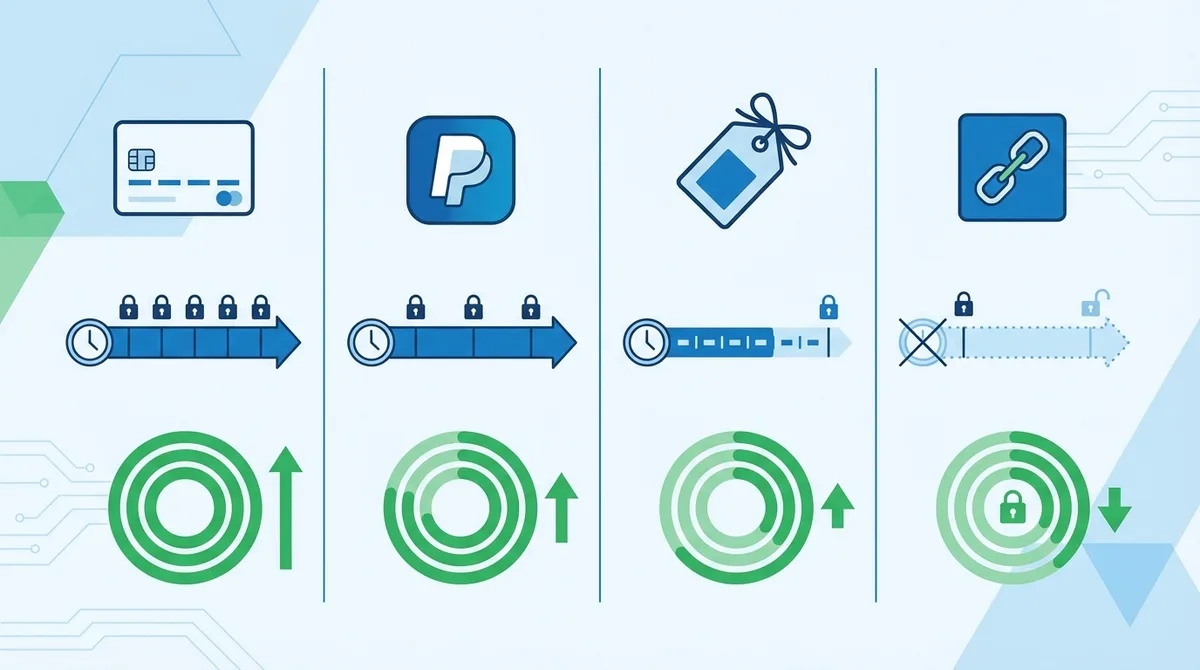
A visual guide to how different Zahlungsmethodes create distinct Datenschutzspurs, showing Vorratsdatenspeicherung periods and which entities have access to your information.
PayPals Datenspeicherung und Datenschutzpraktiken
PayPal's Datenschutzrichtlinie reveals extensive data collection and retention practices. The company retains transaction records indefinitely for compliance and fraud prevention purposes. PayPal also shares data with numerous third parties, including payment processors, fraud prevention services, and marketing partners. Additionally, PayPal is subject to the same government access requests as traditional banks, and the company has a history of complying with law enforcement requests without extensive privacy protections.
One advantage of PayPal over Kreditkartes is that some VPN providers allow you to create a separate PayPal account without linking it to your primary banking information. This creates a layer of separation between your real identity and your VPN subscription. However, this approach only works if you fund the PayPal account with cash or untraceable funds—if you link it to your bank account, you've recreated the Kreditkarte problem in a different form.
- Intermediary Layer: PayPal acts as a buffer between your identity and the VPN provider, reducing the amount of personal information the VPN sees.
- Account Linking: Most PayPal accounts are linked to bank accounts or Kreditkartes, recreating the identity trail unless you use cash funding methods.
- Transaction Retention: PayPal retains transaction records indefinitely, making them permanently accessible to government agencies.
- Third-Party Sharing: PayPal shares transaction data with fraud prevention services, marketing partners, and other third parties.
- Dispute and Reversal Risks: PayPal's dispute resolution processes can lead to account freezes and transaction reversals, creating additional complications for VPN subscriptions.
Digitale Wallets: Apple Pay, Google Pay und andere
Modern digitales Wallets like Apple Pay and Google Pay offer slightly better privacy than PayPal for certain use cases. When you use Apple Pay to purchase a VPN subscription, Apple doesn't share your actual card number with the merchant—instead, it generates a tokenized payment credential that's unique to that transaction. This means the VPN provider doesn't receive your Kreditkarte information, only a payment token. However, Apple and Google maintain detailed records of your transactions, and these records are accessible to government agencies upon request.
4. Kryptowährungszahlungen: Die Grenze der Anonymität
Kryptowährung, particularly privacy-focused coins like Monero, represents the frontier of payment Anonymität for VPN subscriptions. Unlike traditional Zahlungsmethodes, Kryptowährung transactions don't inherently require identity verification, and they can be conducted pseudonymously without creating a permanent link to your real identity. However, Kryptowährung Anonymität requires careful implementation—many users believe they're anonymous when they're actually quite traceable.
Bitcoin, the most widely accepted Kryptowährung for VPN payments, is actually pseudonymous rather than anonymous. Every Bitcoin transaction is recorded on a public ledger (the blockchain) that anyone can examine. While transactions don't include names or identifying information, sophisticated analysis can often link Bitcoin addresses to real identities by correlating transaction patterns, timing, and amounts. In contrast, privacy-focused cryptocurrencies like Monero employ cryptographic techniques to obscure transaction amounts, sender addresses, and receiver addresses, making them significantly more difficult to trace.
Bitcoin vs. Privacy Coins: Den Unterschied verstehen
Bitcoin is pseudonymous but not anonymous. Every transaction is recorded on the blockchain, which is permanently accessible to anyone with internet access. While Bitcoin addresses don't contain names, sophisticated analysis techniques can link addresses to real identities by examining transaction patterns, timing, and amounts. Additionally, when you convert Bitcoin to fiat currency (dollars, euros, etc.), you typically must use an exchange that requires identity verification, creating a link between your Bitcoin address and your real identity.
Monero and similar privacy coins employ different cryptographic techniques to achieve true Anonymität. Monero uses ring signatures (which mix your transaction with others), stealth addresses (which hide the receiver's address), and RingCT (which obscures transaction amounts). These techniques make it extremely difficult to trace Monero transactions, even with sophisticated blockchain analysis. However, not all VPN providers accept Monero, and converting Monero to fiat currency still requires identity verification at some point in the chain.
Wusstest du das? According to a 2024 Chainalysis report, approximately 89% of Bitcoin transactions can be traced to real identities when combined with exchange data and blockchain analysis techniques. In contrast, Monero transactions remain effectively untraceable even with advanced analysis methods.
Source: Chainalysis Blockchain Analysis
- Pseudonymity vs. Anonymität: Bitcoin is pseudonymous (addresses aren't linked to names) but traceable through blockchain analysis. Privacy coins like Monero are cryptographically anonymous.
- Exchange Risk: Converting Kryptowährung to fiat currency requires identity verification at exchanges, creating a link between your crypto and real identity.
- Mixing Services: Bitcoin mixing services can help obscure transaction trails, but they add complexity and potential legal risks in some jurisdictions.
- Wallet Management: Using multiple Kryptowährung wallets and avoiding address reuse helps maintain Anonymität, but requires careful operational security.
- Provider Acceptance: Not all VPN providers accept Kryptowährung payments. Check our affordable VPN options for providers with crypto payment support.
Die Herausforderung der operativen Sicherheit
Even with privacy coins like Monero, achieving true Anonymität requires careful operational security practices. Many users purchase Kryptowährung through exchanges that require identity verification, immediately linking their real identity to their crypto holdings. Others use the same Kryptowährung wallet for multiple purposes, creating transaction patterns that can be analyzed. Additionally, the metadata surrounding Kryptowährung transactions (IP addresses, timing, amounts) can sometimes reveal information even when the transactions themselves are cryptographically anonymous.
5. Geschenkkarten und bargeldbasierte Zahlungsmethoden
Gift cards and cash-based Zahlungsmethodes represent a practical middle ground between Kryptowährung and traditional Zahlungsmethodes. When you purchase a VPN subscription using a Geschenkkarte bought with cash, you eliminate the direct link between your identity and your VPN purchase. The VPN provider receives payment from the Geschenkkarte rather than from your bank account or Kreditkarte, and there's no permanent record linking your identity to the transaction.
Gift cards work by converting cash (which is largely untraceable) into a prepaid payment credential that can be used online. Major Geschenkkarte providers like Amazon, Google Play, and iTunes allow you to purchase Geschenkkartes with cash at retail locations without providing identification. You can then use these Geschenkkartes to purchase VPN subscriptions without revealing your real identity to the VPN provider. This approach is significantly more practical than Kryptowährung for most users while providing substantially better privacy than Kreditkartes or PayPal.
Praktische Umsetzung: Geschenkkarten-Strategie
To use Geschenkkartes for anonymous VPN payments, follow these steps:
- Purchase Geschenkkartes with cash at retail locations that don't require identification. Grocery stores, convenience stores, and electronics retailers typically sell Geschenkkartes without requiring ID.
- Create a separate account (email, PayPal, etc.) that's not linked to your real identity. Use a temporary email service or a privacy-focused email provider.
- Register the Geschenkkarte to the anonymous account without providing real identity information. Many retailers allow Geschenkkarte registration without verification.
- Purchase the VPN subscription using the Geschenkkarte through your anonymous account. The VPN provider receives payment from the Geschenkkarte account rather than from you directly.
- Avoid account linking to any services that could reveal your identity. Don't link your anonymous account to your real email, phone number, or Zahlungsmethodes.
Einschränkungen und Überlegungen
While Geschenkkartes offer practical Anonymität advantages, they have significant limitations. First, most Geschenkkartes can only be used at specific retailers or for specific services. You can't use an Amazon Geschenkkarte for a VPN subscription unless the provider accepts Amazon Pay. Second, Geschenkkarte transactions create their own metadata—retail purchases of Geschenkkartes are often recorded on video, and some retailers track Geschenkkarte purchases. Third, some VPN providers require email verification or phone number verification during signup, which can compromise the Anonymität of Geschenkkarte payments.
- Merchant Limitations: Gift cards are typically restricted to specific retailers or services. Check that your VPN provider accepts payment from the Geschenkkarte source.
- Retail Tracking: Gift card purchases are often recorded on video and tracked by retailers. Avoid purchasing large quantities of Geschenkkartes that might trigger fraud alerts.
- Verification Requirements: Many VPN providers require email or phone verification during signup, potentially compromising Anonymität. Use temporary email addresses and VoIP phone numbers.
- Account Linking: Avoid linking your anonymous Geschenkkarte account to any services that could reveal your real identity.
- Practical Convenience: Gift card payments require more steps than Kreditkartes or PayPal, but offer significantly better privacy for users willing to invest the effort.
6. Zahlungsmethoden im Vergleich: Datenschutz, Komfort und Risiko
Vergleich der Zahlungsmethoden
| Zahlungsmethode | Privacy Level | Convenience | Identity Linkage | Data Retention |
|---|---|---|---|---|
| Kreditkarte | Very Low | Very High | Direct (Real Name) | Indefinite (Bank, Processor, Bureau) |
| PayPal | Low | High | Direct (Account-Linked) | Indefinite (PayPal, Bank) |
| Digitales Wallet | Low-Medium | Very High | Tokenized (Reduced) | Long-term (Apple/Google, Bank) |
| Bitcoin | Medium | Medium | Pseudonymous (Traceable) | Permanent (Blockchain) |
| Monero | Very High | Low | Anonymous (Cryptographic) | Permanent (Blockchain, Untraceable) |
| Geschenkkartes | High | Medium | None (Cash-Based) | Short-term (Retailer Only) |
Überlegungen zum Bedrohungsmodell
Choosing the right Zahlungsmethode depends on your specific threat model—the types of adversaries you're protecting against and the risks you're trying to mitigate. For casual privacy-conscious users concerned about corporate tracking, PayPal or digitales Wallets offer a reasonable balance between convenience and privacy. For journalists, activists, or users in restrictive countries facing government surveillance, Kryptowährung or Geschenkkartes become more appropriate. For users with minimal privacy concerns, Kreditkartes offer maximum convenience despite minimal privacy protection.
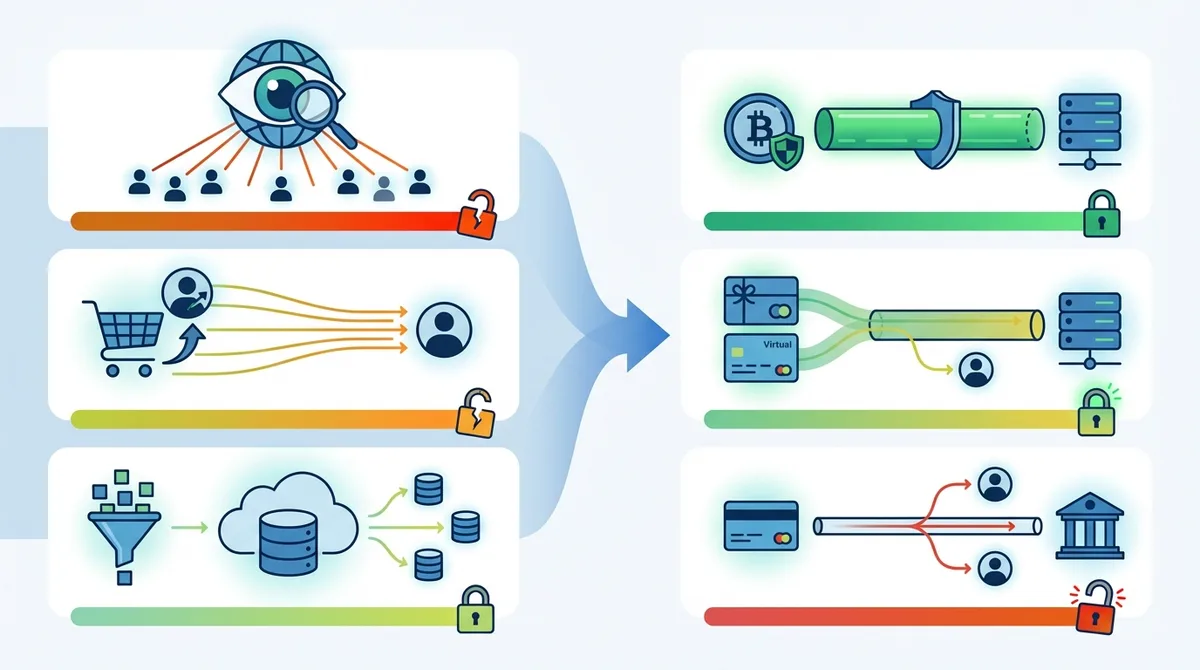
A visual guide matching Zahlungsmethodes to different threat models, showing which payment options best protect against specific types of adversaries.
7. Zahlungspraktiken und Überprüfung von VPN-Anbietern
Not all VPN providers handle payment information equally. Some providers use third-party payment processors that never see your payment details, while others process payments directly. Some maintain extensive records of customer transactions, while others minimize data collection. Understanding your VPN provider's payment practices is essential for making informed privacy decisions. Review our comprehensive VPN reviews for detailed information about each provider's Zahlungsmethodes and data practices.
When evaluating a VPN provider's payment practices, examine several key factors: Which Zahlungsmethodes do they accept? Do they use third-party payment processors or process payments directly? What payment information do they retain? How long do they keep transaction records? Do they share payment data with third parties? Are they transparent about law enforcement requests? These questions should inform your choice of both VPN provider and Zahlungsmethode.
Warnsignale bei VPN-Zahlungspraktiken
Certain payment practices should raise concerns about a VPN provider's overall privacy commitment. Providers that only accept Kreditkartes and refuse Kryptowährung or alternative Zahlungsmethodes may be prioritizing convenience over privacy. Providers that require extensive personal information during signup (full name, address, phone number) are collecting more data than necessary. Providers with vague privacy policies or unwillingness to disclose their payment processor are potentially hiding problematic practices. Additionally, providers that have experienced payment-related breaches or have been involved in law enforcement disputes should be approached with caution.
- Zahlungsmethode Diversity: Reputable providers offer multiple payment options including Kryptowährung, Geschenkkartes, and cash-based methods. Limited payment options may indicate privacy concerns.
- Third-Party Processors: Providers using established third-party payment processors (like Stripe) often have better payment security than those processing payments directly.
- Data Minimization: Quality VPN providers collect only essential information during signup. Requests for unnecessary personal data are a Warnsignal.
- Datenschutzrichtlinie Transparency: Clear, detailed privacy policies that specifically address payment data handling indicate a provider's commitment to transparency.
- No-Logs Verification: Independent audits of a provider's No-Logs-Richtlinie (such as those conducted by reputable security firms) provide stronger assurance than unverified claims.
Die Behauptungen deines VPN-Anbieters überprüfen
When a VPN provider claims to have a "No-Logs-Richtlinie" or promises payment privacy, how can you verify these claims? First, check whether the provider has undergone independent audits by reputable security firms. Several VPN providers have published audit reports from firms like Deloitte or PwC confirming their no-logs policies. Second, examine the provider's Datenschutzrichtlinie for specific language about payment Vorratsdatenspeicherung. Vague policies that don't specifically address payment information handling are concerning. Third, research the provider's history—have they ever disclosed user data to law enforcement? Have they been involved in Datenpannees? Do they have a transparent legal request process?
8. Behördenzugriff und rechtliche Rahmenbedingungen
Understanding how governments access payment information is crucial for evaluating payment privacy. In most developed countries, law enforcement can access financial records through legal processes like subpoenas and warrants. However, the ease of obtaining this access varies significantly by jurisdiction. The United States, European Union, and other developed nations have relatively strong legal frameworks requiring judicial approval for financial record access. In contrast, authoritarian regimes often access financial records without legal constraints, and some countries require financial institutions to proactively report suspicious transactions to government agencies.
International agreements like FATCA (Foreign Account Tax Compliance Act) and CRS (Common Reporting Standard) require financial institutions to share customer information across borders. These agreements, while ostensibly designed for tax compliance, create infrastructure that can be exploited for political surveillance. Additionally, the SWIFT financial system (used for international money transfers) is subject to government monitoring in multiple countries. For users in countries with hostile governments or those concerned about international financial surveillance, these frameworks represent significant privacy risks that extend beyond VPN Zahlungsmethodes to broader financial privacy concerns.
Gerichtsbarkeit zählt: Wo dein VPN-Anbieter seinen Sitz hat
The jurisdiction where your VPN provider is incorporated and operates significantly affects how vulnerable your payment information is to government access. Providers based in privacy-friendly jurisdictions like Panama, Switzerland, or Iceland have stronger legal protections against government requests than providers in the United States or Europe. However, jurisdiction alone doesn't guarantee privacy—even providers in privacy-friendly countries can be compelled by foreign governments through mutual legal assistance treaties (MLATs).
Wusstest du das? The Five Eyes alliance (United States, United Kingdom, Canada, Australia, New Zealand) has established agreements allowing law enforcement to request user data across borders without traditional warrant requirements. This means a VPN provider in any Five Eyes country can be compelled to provide user information to law enforcement in other Five Eyes countries.
Source: Electronic Frontier Foundation
9. Fortgeschrittene Datenschutztechniken: Zahlungsmethoden schichten
Rather than relying on a single Zahlungsmethode, advanced users often layer multiple privacy techniques to maximize Anonymität. This approach recognizes that no single Zahlungsmethode is perfect—each has vulnerabilities that can be mitigated by combining it with other techniques. Layering Zahlungsmethodes involves using multiple payment intermediaries, spreading purchases across different time periods and providers, and using different identities for different purposes.
A basic layering strategy might involve purchasing Kryptowährung with cash at a physical location, converting it through a privacy-focused exchange, using a mixing service to obscure the transaction trail, and then paying for the VPN with the mixed Kryptowährung. A more advanced strategy might involve purchasing Geschenkkartes with cash, creating an anonymous email account with a temporary email service, registering the Geschenkkarte to the anonymous account, and using the Geschenkkarte to purchase the VPN subscription. Each layer adds complexity but also adds privacy protection.
Eine mehrschichtige Datenschutzstrategie aufbauen
Implementing a multi-layer privacy strategy requires careful planning and operational security. Start by identifying your threat model—who are you protecting against and what information do you want to protect? Based on your threat model, design a payment strategy that layers multiple privacy techniques. For example:
- Identify your threat model (government surveillance, corporate tracking, data brokers, etc.) and determine what level of privacy you need.
- Choose primary and secondary Zahlungsmethodes based on your threat model. For high-threat scenarios, use Kryptowährung or Geschenkkartes; for moderate-threat scenarios, use PayPal or digitales Wallets.
- Create separate identities for different purposes. Use different email addresses, usernames, and Zahlungsmethodes for different VPN subscriptions.
- Implement operational security practices including using Tor Browser for signup, using temporary email addresses, and avoiding linking accounts to real identity information.
- Monitor and maintain your strategy by regularly reviewing your Zahlungsmethodes, checking for Datenpannees, and updating your approach as new threats emerge.
Kryptowährungs-Mixing und Datenschutzverbesserung
For users choosing Kryptowährung payments, mixing services (also called tumblers or joiners) can help obscure the transaction trail. These services pool Kryptowährung from multiple users and redistribute it, making it difficult to trace transactions back to their original source. However, mixing services introduce additional complexity and potential legal risks. In some jurisdictions, using mixing services is associated with money laundering and may be illegal. Additionally, some VPN providers refuse to accept mixed Kryptowährung due to regulatory concerns.
10. Praktische Umsetzung: Schritt-für-Schritt-Anleitung zur Zahlungsprivatsphäre
Implementing payment privacy for your VPN subscription requires careful planning and execution. Different threat models require different approaches, but the fundamental principles remain consistent: minimize data collection, use intermediaries to separate your identity from your purchase, and employ operational security practices to prevent data leakage. This section provides practical, step-by-step instructions for implementing payment privacy based on different threat levels.
Niedrige Privatsphäre (Bedenken wegen Unternehmens-Tracking)
If you're primarily concerned about corporate tracking and data broker profiling, a basic privacy implementation using PayPal or digitales Wallets is sufficient:
- Create a separate email account using a privacy-focused email provider (ProtonMail, Tutanota) or a temporary email service.
- Create a PayPal account linked to the separate email address. Avoid linking it to your primary bank account if possible.
- Fund the PayPal account using a prepaid debit card or Geschenkkarte purchased with cash to maintain separation from your primary financial accounts.
- Select a VPN provider that accepts PayPal payments. Check our best VPN recommendations for providers with diverse payment options.
- Sign up for the VPN using your separate email address and PayPal account. Avoid providing unnecessary personal information during signup.
- Use the VPN through your anonymous account. Maintain separation between your VPN account and your real identity.
Mittlere Privatsphäre (Bedenken wegen staatlicher Überwachung)
If you're concerned about government surveillance or operating in a restrictive country, a more robust implementation using Kryptowährung or Geschenkkartes is recommended:
- Purchase Geschenkkartes with cash at retail locations that don't require identification. Avoid purchasing large quantities that might trigger fraud alerts.
- Create an anonymous email account using Tor Browser and a temporary email service. Do not use identifying information.
- Select a VPN provider that accepts Geschenkkarte payments or Kryptowährung. Check providers' payment options carefully.
- Register your Geschenkkarte to your anonymous email account without providing real identity information. Use a temporary phone number if verification is required.
- Sign up for the VPN using your anonymous email and Geschenkkarte. Use Tor Browser for the signup process to avoid IP address logging.
- Configure your VPN carefully to avoid leaking identifying information. Check for DNS leaks, IP leaks, and other vulnerabilities.
- Use the VPN exclusively for sensitive activities. Maintain strict separation between your VPN account and your real identity.
Hohe Privatsphäre (Hochrisikosituationen)
If you're facing serious threats such as political persecution or operating in a hostile environment, comprehensive privacy implementation is essential:
- Obtain Kryptowährung through in-person cash transactions or peer-to-peer exchanges that don't require identity verification. Avoid exchanges that require KYC (Know Your Customer) verification.
- Use privacy coins like Monero instead of Bitcoin. Monero provides cryptographic Anonymität that Bitcoin lacks.
- Implement operational security by using a dedicated computer or virtual machine running a privacy-focused operating system like Tails.
- Access Kryptowährung services through Tor Browser to avoid revealing your IP address. Use VPN before accessing Tor if your ISP or government monitors Tor usage.
- Use a mixing service if using Bitcoin to further obscure the transaction trail. Understand the legal implications in your jurisdiction.
- Select a VPN provider based on jurisdiction and no-logs verification. Providers in privacy-friendly jurisdictions with independent audits are preferable.
- Complete VPN signup using Tor Browser, temporary email, and the Kryptowährung payment. Avoid any identifying information.
- Configure the VPN with maximum security settings including Kill Switch, DNS-Leckschutz, and secure encryption protocols.
- Maintain operational security throughout your VPN usage. Avoid activities that could reveal your identity and compromise your privacy.
11. Neue Zahlungstechnologien und zukünftige Datenschutzüberlegungen
Payment technology continues to evolve, with new methods emerging that could significantly impact VPN payment privacy. Central Bank Digital Currencies (CBDCs), which many countries are developing or implementing, could dramatically change the privacy landscape by enabling real-time transaction surveillance at the government level. Blockchain-based payment systems like Ethereum's Layer 2 solutions could provide better privacy than traditional cryptocurrencies. Additionally, emerging technologies like zero-knowledge proofs could enable payment verification without revealing transaction details.
By 2026 and beyond, VPN users should expect increasing pressure to use traditional Zahlungsmethodes that enable surveillance. Governments worldwide are implementing stricter regulations on Kryptowährung and cash transactions, making privacy-preserving Zahlungsmethodes increasingly difficult to use. In response, privacy-conscious VPN users will likely need to become more sophisticated in their payment strategies, using layered approaches and emerging privacy technologies. The comprehensive privacy guide on our site provides ongoing updates on emerging threats and privacy-preserving techniques.
Vorbereitung auf zukünftige Zahlungsüberwachung
As surveillance capabilities expand, privacy-conscious users should prepare by diversifying their Zahlungsmethodes and staying informed about emerging threats. Maintain multiple payment options including Kryptowährung wallets, Geschenkkarte accounts, and alternative Zahlungsmethodes. Follow developments in CBDC implementations in your country and understand how they might affect your payment privacy. Additionally, support privacy-focused projects and organizations working to preserve financial privacy in an increasingly surveilled world. The future of payment privacy depends on both individual actions and collective advocacy for privacy-preserving technologies and policies.
Fazit
Your choice of VPN Zahlungsmethode represents one of the most critical privacy decisions you make. While VPN encryption protects your internet traffic from interception, your Zahlungsmethode determines whether your identity remains connected to your VPN subscription. Credit cards create permanent, highly traceable records. PayPal and digitales Wallets offer modest improvements through intermediary layers. Kryptowährung and Geschenkkartes provide substantially better Anonymität for users willing to invest additional effort. No single Zahlungsmethode is perfect—the best approach depends on your specific threat model and the adversaries you're protecting against.
In 2026, payment surveillance capabilities have expanded significantly through CBDCs, AI-powered transaction monitoring, and international data-sharing agreements. Privacy-conscious VPN users must understand these threats and implement layered payment strategies that combine multiple privacy techniques. Whether you're concerned about corporate tracking, government surveillance, or data broker profiling, the key is to minimize the data you provide, use intermediaries to separate your identity from your purchase, and maintain operational security throughout the process. For detailed recommendations on VPN providers with strong payment privacy practices, visit our best VPN comparison page, which includes analysis of Zahlungsmethodes for each service.
Trust Statement: ZeroToVPN.com is an independent VPN review site run by industry professionals who have personally tested 50+ services through rigorous benchmarks and real-world usage. Our recommendations are based on first-hand experience and verified information from authoritative sources. We maintain transparency about our methodology and provide honest assessments of both strengths and limitations of each service. Mehr erfahren about our testing methodology and team.
Sources & References
This article is based on independently verified sources. We do not accept payment for rankings or reviews.
- Financial Action Task Force— fatf-gafi.org
- Chainalysis Blockchain Analysis— chainalysis.com
- Electronic Frontier Foundation— eff.org

ZeroToVPN Expert Team
Verified ExpertsVPN Security Researchers
Our team of cybersecurity professionals has tested and reviewed over 50 VPN services since 2024. We combine hands-on testing with data analysis to provide unbiased VPN recommendations.
Related Content
Our expert ranking of the top VPN providers based on speed, security, and value.
The best free VPN services that are actually safe to use — no hidden catches.
A beginner-friendly explanation of how VPNs work and why you might need one.
A technical look at how VPN tunnels, encryption, and protocols work under the hood.
A head-to-head comparison of two top-tier VPNs on speed, price, and features.
Which premium VPN comes out on top? We compare NordVPN and ExpressVPN in detail.